

Toronto, July 29: Support within Premier Doug Ford’s government for the federal Alto high-speed rail project appears to be weakening as members of the Progressive Conservative caucus from eastern Ontario publicly raised concerns about its impact on local communities, while senior provincial sources say the premier is reconsidering his backing for the project.
The growing uncertainty follows the federal government’s recent decision to reject Ontario’s proposal to expand Billy Bishop Toronto City Airport, a move that has strained relations between Queen’s Park and Ottawa.
Eastern Ontario MPPs Call for Greater Consultation
Eleven Progressive Conservative Members of Provincial Parliament representing eastern Ontario issued a joint statement urging the federal government to ensure that local communities have a meaningful role in planning the proposed high-speed passenger rail service between Quebec City and Toronto.
The statement said farmers, landowners and municipalities directly affected by the project deserve to see their concerns reflected in decisions regarding the rail line’s route, planning and construction.
“If Alto is to proceed, local voices impacted by this project deserve to see their feedback reflected in the project’s planning, route selection and delivery,” the caucus members said.

They also urged Ottawa to minimize impacts on farmland and ensure any future rail project has the support of affected communities.
The statement was signed by Colleges and Universities Minister Nolan Quinn, Labour Minister David Piccini, Government House Leader Steve Clark, and MPPs John Jordan, Tyler Allsopp, George Darouze, Billy Denault, Laurie Scott, Stéphane Sarrazin, Ric Bresee and Dave Smith.
Rural Opposition Growing
Opposition to the Alto project has intensified across parts of eastern Ontario, where construction of the high-speed rail corridor could require the acquisition or expropriation of significant amounts of privately owned land.
Farmers, municipalities and property owners have voiced concerns about losing agricultural land and disrupting rural communities, with several groups taking their protests to Parliament Hill in recent weeks.
Airport Decision Adds Political Tension
The public criticism comes only days after federal Transport Minister Steven MacKinnon rejected Ontario’s proposal to modernize and expand Billy Bishop Toronto City Airport.
The decision followed a public consultation in which 87 per cent of approximately 87,000 respondents opposed expanding the airport to accommodate larger jet aircraft.
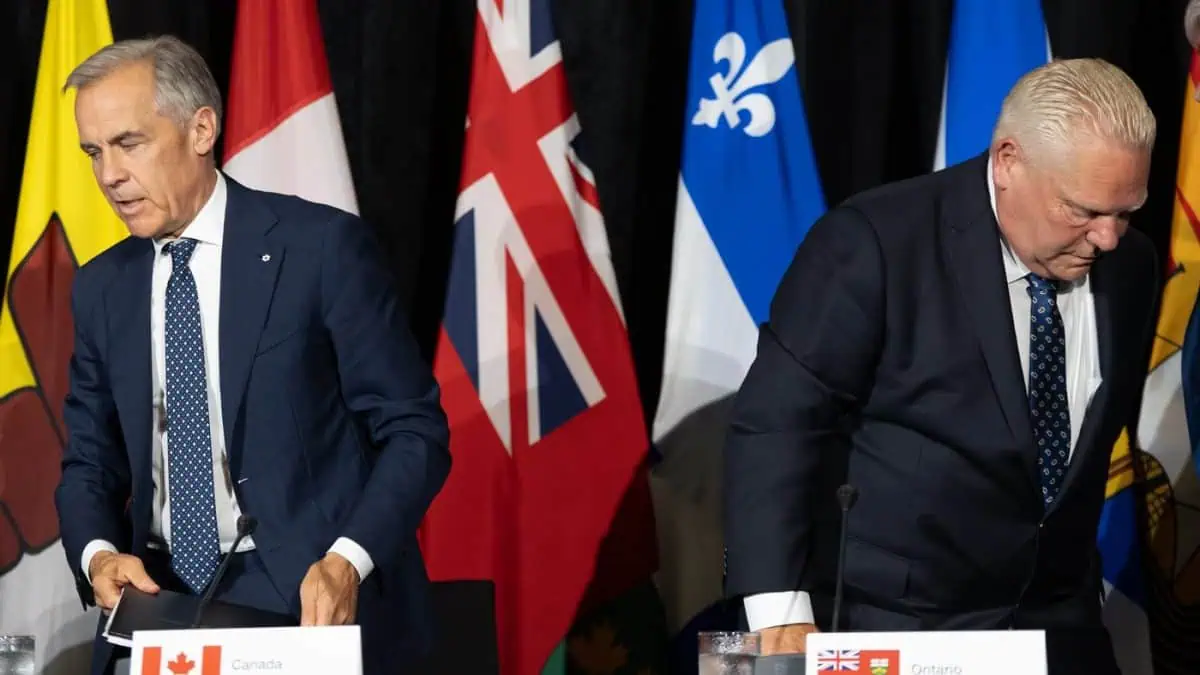
According to senior provincial government sources cited by The Canadian Press, Premier Ford was disappointed by Ottawa’s decision and raised the matter directly with Prime Minister Mark Carney over the weekend.
The sources, who spoke on condition of anonymity because they were not authorized to discuss internal government deliberations, alleged there had been an informal understanding under which Ontario would support the Alto project while the federal government would back Billy Bishop airport expansion.
Neither government has publicly confirmed the existence of such an agreement.
Province Continues Airport Push
Despite the federal rejection, Ontario Transportation Minister Prabmeet Sarkaria said the province remains committed to pursuing modernization of Billy Bishop Airport.
He said the Toronto Port Authority is expected to release a comprehensive modernization proposal in the near future.
Sarkaria also rejected Toronto Mayor Olivia Chow’s request that the province return lands around the Toronto Islands that were recently expropriated under provincial legislation.
Earlier this year, Ontario passed legislation giving itself authority to assume control of lands on the Toronto Islands and replaced the City of Toronto in the long-standing tripartite agreement governing Billy Bishop Airport, joining the federal government and the Toronto Port Authority.
Federal Government Remains Committed
Despite Ontario’s apparent hesitation, Transport Minister Steven MacKinnon reaffirmed Ottawa’s commitment to the Alto project.
He expressed confidence that the federal government would continue working with both Ontario and Quebec, emphasizing the strong relationship between the two levels of government on several major economic initiatives.
Future of Alto Faces New Political Questions
The emerging disagreement highlights the political and logistical challenges facing one of Canada’s largest proposed transportation infrastructure projects.
While the federal government continues to champion high-speed rail as a transformative investment in intercity transportation, growing concerns from rural communities, questions over land acquisition and increasing tensions between Ottawa and Queen’s Park may complicate efforts to move the project forward.
As consultations continue, both governments are expected to face mounting pressure to balance national infrastructure priorities with the interests of affected landowners, municipalities and local communities.