

Hundreds of international graduates across Canada are facing an uncertain future after the federal government began refusing Post-Graduation Work Permit (PGWP) applications on the grounds that their diploma programs are classified as “non-credit.” The unexpected refusals have left many graduates shocked, unemployed and facing expensive legal battles, despite having enrolled in their programs under rules they believed made them fully eligible to work in Canada after graduation.
Among those affected is Sukhmani Kaur, an international student from India, who completed a two-year Business Management diploma at the Canadian Institute of Osteopathic Therapy (CIOT) in Calgary through an academic partnership with Alberta’s public Portage College. After successfully graduating, she applied for a Post-Graduation Work Permit expecting to begin her professional career in Canada. Instead, her application was refused because immigration officials determined that her diploma was part of a “non-credit” program, making her ineligible for the work permit.
Kaur said the decision came as a complete surprise because when she enrolled in 2023, there was no public indication that graduates of non-credit diploma programs would be excluded from the PGWP program. She had already confirmed that her studies were not affected by Ottawa’s 2024 restrictions on private-public college partnerships, which had introduced new limitations for international students. The refusal, therefore, was based on an entirely different interpretation that had never been clearly communicated.
On June 24, Immigration, Refugees and Citizenship Canada (IRCC) quietly updated its website, stating that the change was intended only to “clarify” existing eligibility requirements relating to non-credit programs rather than introduce a new policy. However, immigration lawyers and consultants argue that the interpretation is effectively a new criterion because neither Canada’s immigration legislation, regulations, official policies nor previous public guidance had explicitly identified completion of a non-credit diploma program as an independent reason for refusing a Post-Graduation Work Permit.
Since the website update, several hundred graduates from three diploma programs delivered jointly by CIOT and Portage College have reportedly had their work permit applications rejected. Immigration professionals fear that the policy could soon affect graduates from similar private-public college partnerships across Canada, potentially impacting thousands of international students.

Toronto immigration lawyer Amir Zarei, who is representing several affected graduates, believes the issue extends far beyond one institution. According to him, similar non-credit programs exist at colleges in several provinces, and the government’s new interpretation could expose many more graduates to unexpected refusals. He argues that students enrolled in these programs relied on the published government guidelines available at the time of admission and therefore had a legitimate expectation that they would qualify for work permits after graduation.
The controversy comes amid sweeping reforms introduced by the federal government in 2024 to reduce the number of temporary residents in Canada. As part of those reforms, Ottawa tightened eligibility for Post-Graduation Work Permits, requiring graduates of many public college diploma programs to complete studies in fields linked to Canada’s labour shortages while also meeting higher language proficiency standards.
Recent data obtained by Vancouver immigration lawyer Steven Meurrens indicates that approval rates for Post-Graduation Work Permits have already declined significantly, falling from 87 per cent in 2023 to approximately 79 per cent by late 2025. Immigration experts say the emerging interpretation regarding non-credit programs may further reduce approval rates and create additional uncertainty for international graduates.
IRCC maintains that no new policy has been introduced. Department officials state that eligibility for the PGWP program has always required students to complete a degree, diploma or certificate from a designated learning institution and that this long-standing requirement excludes general interest courses, English or French language training and other non-credit programs. However, the department acknowledged that it does not collect specific data on refusals based on non-credit programs and therefore cannot estimate how many students have been affected.
Portage College confirmed that it entered into a curriculum licensing partnership with the Canadian Institute of Osteopathic Therapy in 2023 and stopped accepting new students after May 2024. While expressing sympathy for graduates experiencing uncertainty, the college emphasized that immigration decisions are made exclusively by the federal government and that the institution has no role in assessing individual work permit applications. The college has advised affected graduates to seek guidance from licensed immigration lawyers or regulated consultants.
Calgary immigration consultant Mandeep Lidher, who represents several refused applicants, believes the government’s position represents a significant departure from previous policy. He noted that the affected students had enrolled in teacher’s assistant, business management and administrative professional diploma programs years before the website clarification appeared and had every reason to believe they would qualify for work permits upon graduation.
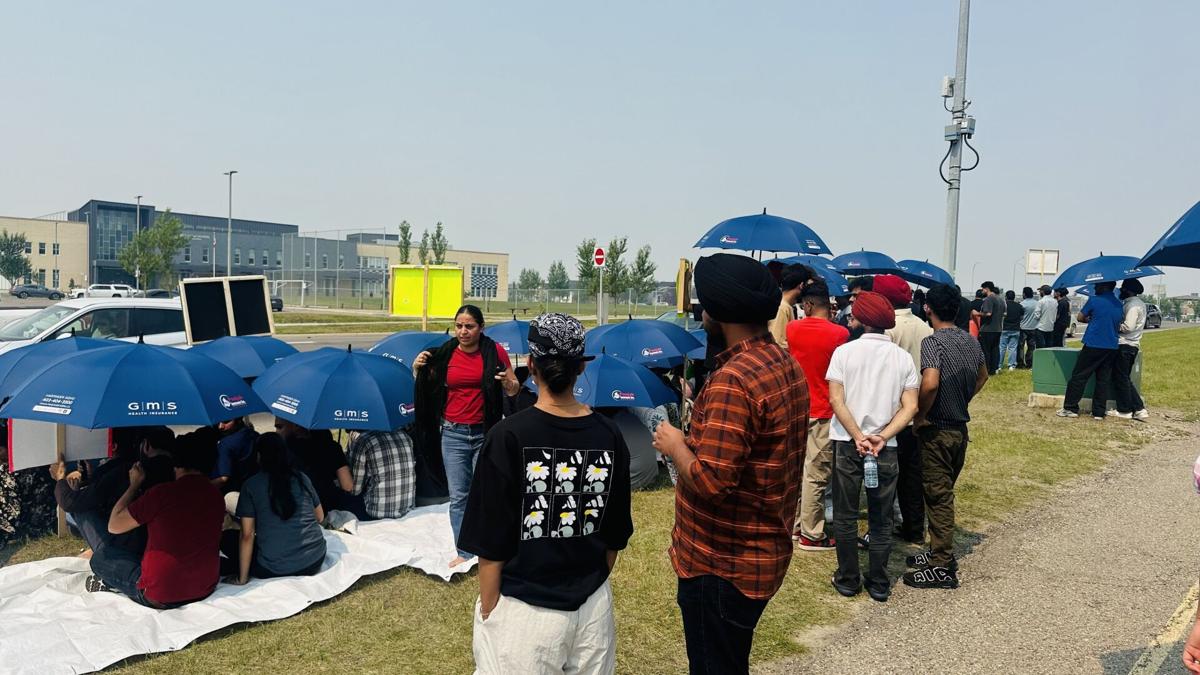
Meanwhile, frustration among students continues to grow. Approximately 500 graduates associated with Portage College are believed to have already received refusals, while many additional applications remain under review. Protest demonstrations have been taking place near the college’s downtown Calgary campus, with graduates demanding fairness and transparency from the federal government.
Student organizer Sikander Singh said many international students invested their families’ life savings to pursue Canadian education. He explained that numerous parents mortgaged their homes in India to finance tuition and living expenses, believing that Canada offered a clear pathway from education to skilled employment. Students maintain that they complied with every published requirement, enrolled before the government’s May 2024 policy changes and therefore should be protected under the existing grandfathering provisions.
Lawyers representing the graduates are encouraging refused applicants to immediately request reconsideration from Immigration, Refugees and Citizenship Canada while also preparing for possible judicial review before the Federal Court. Under Canadian law, applicants generally have only 15 days from receiving a refusal decision to file an application for judicial review, making timely legal action essential.
For many graduates, the consequences have been immediate and severe. Sukhmani Kaur was forced to leave her warehouse job as soon as her work permit application was refused and now faces thousands of dollars in legal expenses while fighting to remain in Canada.
“We have done nothing wrong,” Kaur said, echoing the concerns of hundreds of other international graduates who believe they followed every rule in good faith and are now paying the price for a policy interpretation they never anticipated.
Courtesy: The Toronto Star