

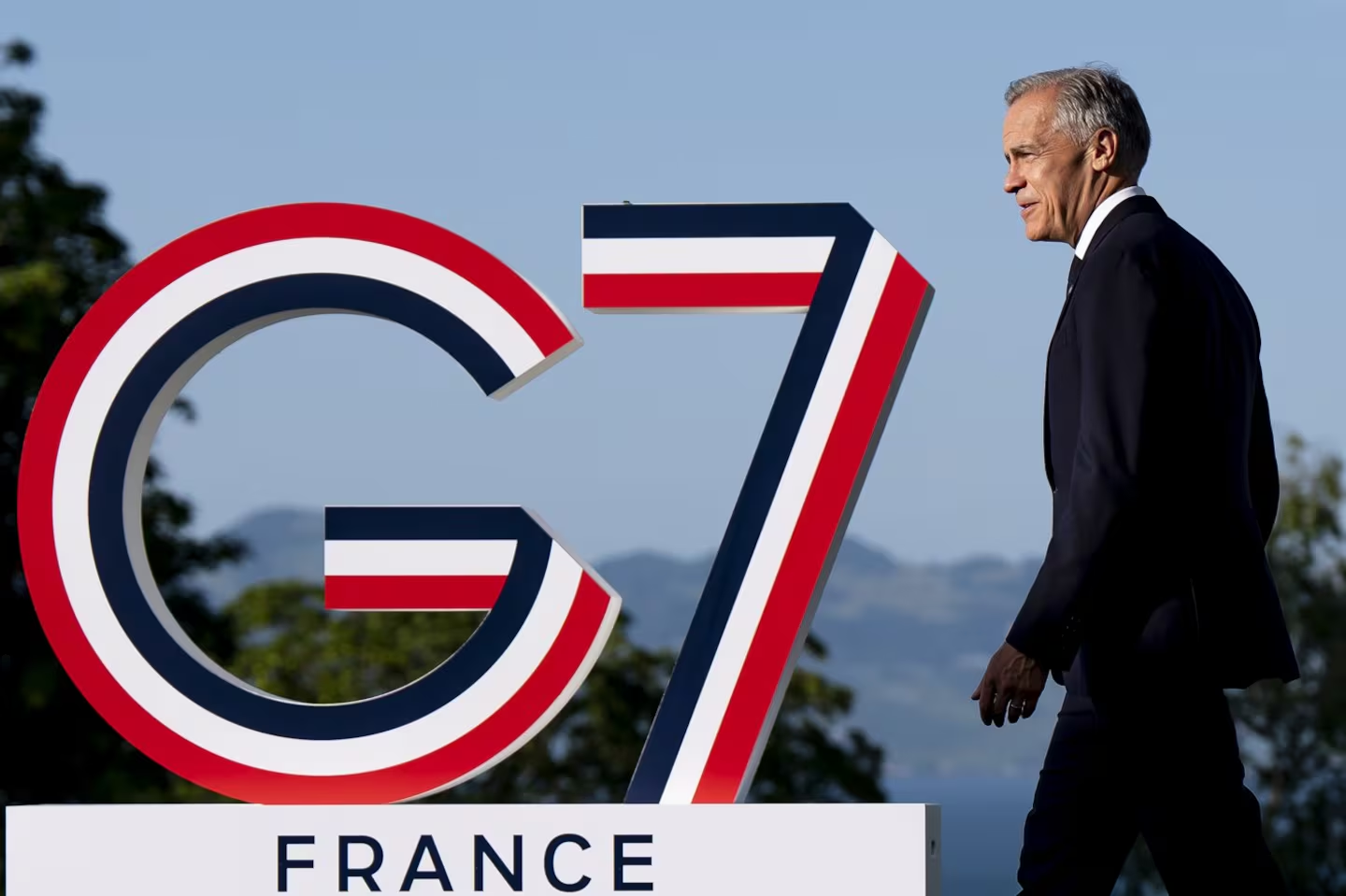
A brief but revealing exchange between Prime Minister Mark Carney and U.S. President Donald Trump at the G7 summit has drawn attention to Canada’s evolving trade relationship with China and the delicate balancing act Ottawa faces between its two largest economic partners.
The conversation, captured by microphones before a working lunch at the G7 gathering in France, appeared to focus on Canada’s agreement allowing a limited number of Chinese-made electric vehicles into the Canadian market.
As leaders assembled around the table, Carney was overheard explaining Canada’s restrictions on Chinese EV imports, telling Trump that the arrangement allows a maximum of 49,000 vehicles annually, representing less than three per cent of Canada’s overall vehicle market.
Carney described the arrangement as a cap on imports and suggested that the measure was designed in a way that would be acceptable to Washington. Trump appeared receptive, responding that he liked the approach.
The exchange sheds light on one of the most closely watched elements of Carney’s economic strategy since taking office. Earlier this year, Canada reached an agreement with China that significantly reduced tariffs on Chinese electric vehicles while establishing import limits. In return, China agreed to reduce tariffs on several Canadian exports, including canola and seafood products.

The agreement marked a notable shift in Canadian policy. Under former prime minister Justin Trudeau, Canada had aligned closely with the United States by imposing a 100 per cent tariff on Chinese electric vehicles. Carney’s government has instead sought to cautiously reopen economic engagement with China while attempting to maintain strong ties with Washington.
The move has generated debate among politicians, business leaders, and foreign policy experts. Supporters argue that expanding access to Chinese markets benefits Canadian exporters and diversifies trade opportunities. Critics warn that deeper economic engagement with China could complicate Canada’s relationship with the United States, its largest trading partner.
The concerns have been echoed by senior American officials. Earlier this year, U.S. Commerce Secretary Howard Lutnick questioned Canada’s strategy and suggested that increased economic cooperation with China could influence future discussions surrounding the Canada-United States-Mexico Agreement (CUSMA).
The discussion between Carney and Trump was not originally expected to focus on trade issues. Prior to the summit, Carney had indicated that detailed trade negotiations would primarily be handled by Canada’s chief negotiators, including Dominic LeBlanc and senior officials working directly with their American counterparts.
Following meetings at the summit, LeBlanc downplayed the significance of the hot mic moment, describing the EV discussion as a reiteration of policies already publicly known. He emphasized that Carney was simply reminding Trump about the details of an agreement that has been in place for several months.
LeBlanc also noted that the discussion on Chinese EVs was only one of several topics raised between the two leaders during their conversations at the summit.
The episode highlights the increasingly complex trade environment facing Canada. As Ottawa seeks new export opportunities and stronger access to global markets, it must simultaneously navigate strategic competition between the United States and China while protecting Canadian economic interests.
With trade negotiations continuing and CUSMA discussions approaching, the brief exchange offered a rare glimpse into the behind-the-scenes conversations shaping Canada’s economic and diplomatic priorities on the world stage. The fact that Trump responded positively to Canada’s import cap may provide some reassurance to Ottawa as it attempts to maintain productive relationships with both global powers while pursuing its own trade objectives.