

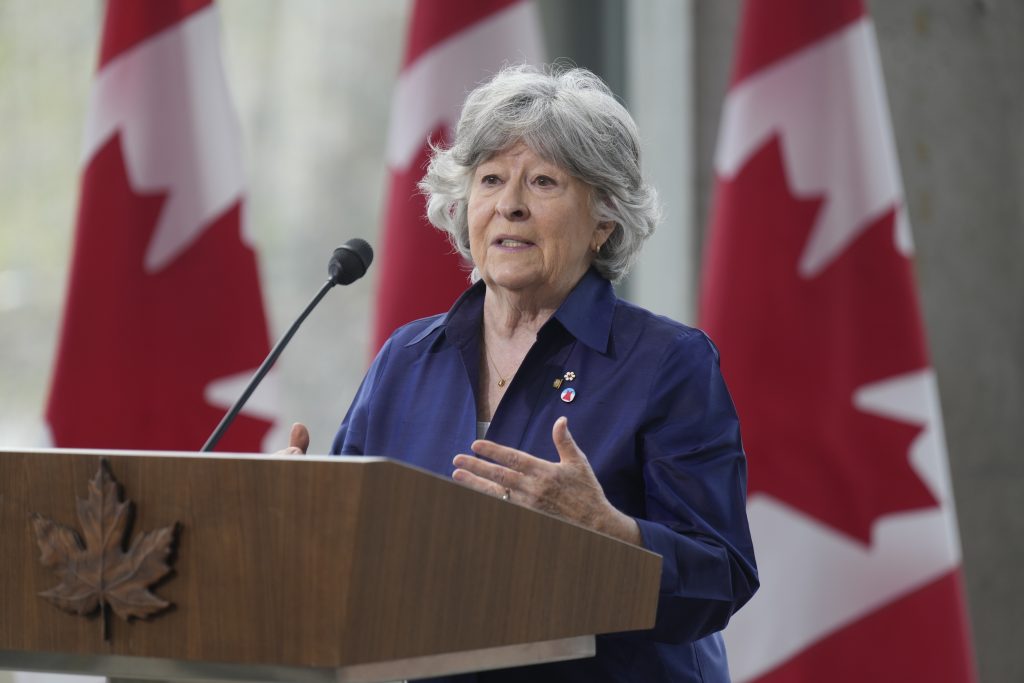
Louise Arbour, the former Supreme Court justice and internationally respected human rights advocate, is preparing to become Canada’s next governor general after being appointed by Prime Minister Mark Carney.
Arbour, 79, will succeed Mary Simon when her term officially ends later this year, bringing to the role decades of experience in law, international justice and public service.
Widely recognized for her legal expertise and commitment to human rights, Arbour has held some of the most influential judicial and diplomatic positions in Canada and internationally.
Born in Montreal, Arbour began her legal career after being called to the Quebec Bar in 1971 and later to the Ontario Bar in 1977. She served as a law clerk at the Supreme Court of Canada before teaching at Osgoode Hall Law School in Toronto.
In 1987, she was appointed to Ontario’s Supreme Court before moving to the Court of Appeal for Ontario in 1990.
Arbour rose to international prominence in the 1990s after being appointed chief prosecutor for the United Nations international criminal tribunals for Rwanda and the former Yugoslavia by then-UN secretary-general Boutros Boutros-Ghali.
During her tenure, she led major war crimes and genocide prosecutions, including the indictment of former Serbian president Slobodan Milošević.
In 1999, Arbour was appointed to the Supreme Court of Canada, becoming only the third woman to serve on the country’s highest court.
Five years later, she resigned from the Supreme Court after being named the United Nations High Commissioner for Human Rights, where she became a leading international voice on human rights issues in conflict zones including Sudan, Gaza, Afghanistan, Iraq and Chechnya.
Colleagues who worked alongside Arbour describe her as exceptionally intelligent, principled and deeply compassionate, while also highlighting her humility and sharp sense of humour.
Daniel Jutras, rector of Université de Montréal and a former colleague at the Supreme Court, said Arbour’s judicial background makes her especially well suited for the governor general role.
“She will understand that this is a delicate role,” Jutras said, noting her strong understanding of constitutional limits and democratic institutions.
Even after retiring from international public service, Arbour remained active in Canadian public life. In 2021, she led an independent review into sexual misconduct and harassment within the Canadian Armed Forces, issuing dozens of recommendations aimed at reforming military accountability systems.
When sworn in as governor general in June, Arbour will also assume the role of commander-in-chief of the Canadian Armed Forces.
Observers say her appointment signals a continuation of Canada’s emphasis on human rights, constitutional integrity and international diplomacy at a time of growing political and global uncertainty.