

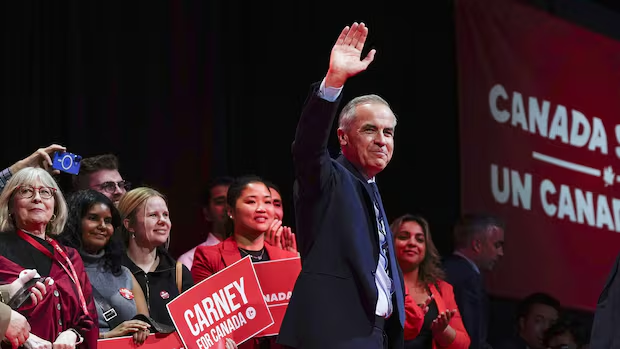
In one of the most surprising political reversals in recent Canadian history, Mark Carney’s Liberals have emerged victorious in the 2025 federal election, riding a wave of anti-Trump sentiment and voter anxiety to secure a minority mandate. While the Conservative Party made substantial gains in both seats and popular vote share, they fell short of overtaking the Liberals—raising major questions about the direction of Canada’s political future.
Here are five key takeaways that help explain why the Liberals won—and why the Conservatives lost:
1. Trump Became the Ballot Box Issue
The defining theme of the election wasn’t domestic policy—but foreign threats. U.S. President Donald Trump’s aggressive rhetoric, including economic threats and talk of annexation, put Canadian sovereignty at the center of the campaign. Carney framed the election as a national crisis, casting himself as the leader who could defend Canada on the global stage.
His statement, “Trump wants to break us so America can own us,” became a rallying cry that resonated deeply, especially with older voters and centrist Liberals. While Conservative leader Pierre Poilievre focused on traditional domestic issues like housing and affordability, his failure to address Trump’s threats head-on may have cost him politically.
Businessman and former Conservative leadership hopeful Kevin O’Leary even admitted the strategy worked: “Carney distracted Canadians from his own mistakes and said, ‘Stop looking at that. Look south of the border and I can save you.’”
2. A Remarkable Debut for a First-Time Politician
Mark Carney’s political story reads like a script—former central banker turned political saviour. With no prior experience in elected office, Carney rose to the leadership of the Liberal Party in March after Justin Trudeau’s resignation, and just weeks later, delivered a campaign win many thought impossible.
His calm, credentials-driven approach appealed to Canadians wary of economic uncertainty, especially after Trump’s late-March announcement of global tariffs. Carney seized the moment, taking on the role of crisis negotiator during the campaign, even fielding calls with the White House. The strategy worked.
3. Conservatives Win the Vote, But Not the Seats
By the numbers, this was a strong performance for the Conservatives—41.4% of the popular vote, higher than Stephen Harper’s 2011 majority-winning 39.6%. Yet the seat count didn’t match the momentum. The Tories are projected to win 144 seats, up from 120—but still short of the Liberals’ lead.
Adding to the blow was Poilievre’s personal loss in his own riding of Carleton. Just months ago, a Conservative win seemed inevitable. Now, the party must reckon with the possibility of replacing yet another leader after three consecutive election defeats.
4. A Divided Canada and a Fractured Electorate
The vote map revealed a stark regional divide. The Liberals were nearly shut out in Alberta and Saskatchewan, deepening longstanding resentment toward Ottawa. Meanwhile, the Conservatives dominated in rural Canada and among younger voters, particularly young men.
Polling revealed a generational split: 44% of voters aged 18–34 supported the Conservatives, while older voters leaned heavily Liberal—driven, in part, by concerns about Trump. In contrast, only 18% of voters under 30 cited Trump as a major issue, compared to 45% of those over 60.
Carney acknowledged the divide in his victory speech: “I intend to govern for all Canadians.”
5. Collapse of the NDP and Smaller Parties
The 2025 election marked a major collapse for the New Democratic Party, which secured just 6% of the vote compared to 18% in 2021. NDP leader Jagmeet Singh lost his seat and promptly announced his resignation, ending an eight-year leadership tenure.
The Green Party also saw its vote share halved, while the Bloc Québécois held steady with 23 projected seats. The overall trend showed a consolidation of votes around the two main parties—particularly as left-leaning Canadians rallied around the Liberals to block Conservative gains.
Shachi Kurl of the Angus Reid Institute explained it simply: “The threats, the annexation talk, all of that has been a huge motivator for left-of-centre voters.”