

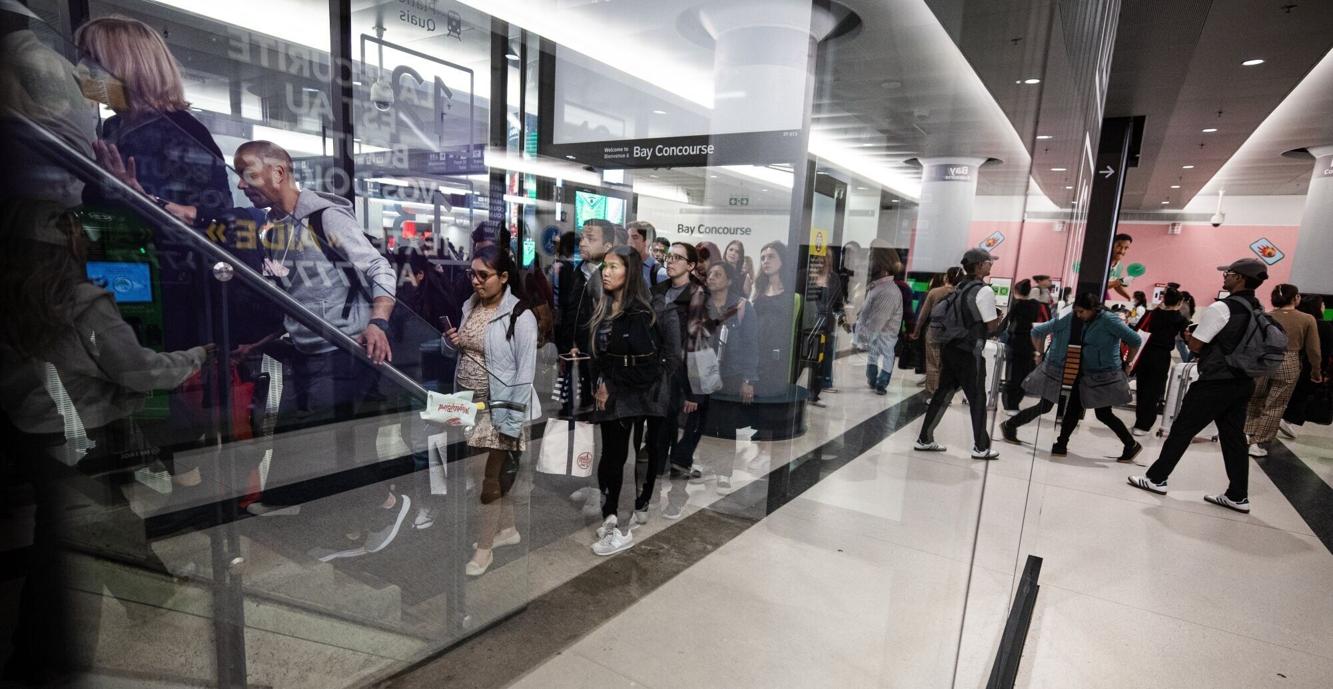
TORONTO — A national privacy controversy has erupted after revelations that digital billboards inside Toronto’s Union Station and other locations are equipped with cameras capable of detecting faces, prompting Canada’s privacy commissioner to launch a formal investigation into whether the technology violates federal privacy laws.
The Office of the Privacy Commissioner, led by Philippe Dufresne, confirmed it has opened a probe into the use of facial-detection technology on digital signs, examining whether companies are complying with the Personal Information Protection and Electronic Documents Act (PIPEDA). The office declined further comment due to the active investigation.
Public concern exploded after a Reddit post earlier this month claimed that billboards near the Union Station Bus Terminal were scanning passersby. The software company behind the displays told the Toronto Star that the cameras perform only “facial detection” — estimating demographics, not identifying individuals — and insisted no biometric data is collected or stored. The company also said it consulted the federal privacy commissioner before deployment.
But cybersecurity and privacy experts say those assurances fall far short of addressing the real risks.
Charles Finlay, founding executive director of the Rogers Cybersecure Catalyst at Toronto Metropolitan University, said even momentary capture of facial data invites potential misuse. “We are placing a lot of trust in their word. That is where the risk begins,” he said, noting the ambiguity around how images are collected, stored, accessed, and ultimately secured.
Other experts warn that even systems intended only for demographic analysis could be repurposed for mass video surveillance. Diogo Barradas, associate director at the University of Waterloo’s Cybersecurity and Privacy Institute, said that images collected for a split second could later be upgraded with technology capable of identifying individuals outright. Worse, the devices themselves could be hijacked by cybercriminals. Poorly secured kiosks and camera systems have historically been compromised and indexed on Shodan, a search engine that exposes insecure internet-connected devices.
In the hands of hackers, even short video clips could be extracted and manipulated — including to create “digital doppelgangers,” an emerging AI-generated threat that experts say is becoming increasingly dangerous.
A digital doppelganger is an artificially created version of a person that mimics their speech, facial movements, behaviour and appearance. Barradas warned that footage of a bystander walking past a billboard could be transformed into deepfake imagery showing them in fabricated scenarios, including committing crimes. “The face of some bystander in front of the kiosk could later be used to produce deepfake imagery,” he said.
Experts worry that such systems create an ecosystem of metadata — time stamps, partial images, demographic details — that allows companies or criminals to track individuals across multiple locations. Tomas Stamulis, chief security officer at Surfshark, said even so-called “anonymous” data can be re-identified when paired with payment histories, loyalty programs or other datasets. “That correlation can quickly turn ‘anonymous’ into re-identifiable,” he said.
The risk extends beyond data collection. Without clear rules on how recordings are handled, transferred, or deleted, a valuable pool of biometric information may be exposed to insiders, third-party vendors or attackers. Stamulis warns that “policies or system configurations can change, and breaches or insider misuse can occur without anyone noticing.”
New research from Surfshark underscores how vulnerable Canadians already are. Canada ranks sixth in the world for leaked biometric data — including eye colour, height, weight and even shoe size. Combined with stolen login credentials, these biological identifiers create a “disturbingly complete picture” of a person. “We have entered an era where your digital self can be weaponized against you in frighteningly realistic ways,” said Sarunas Sereika, a senior product manager at Surfshark.
For privacy advocates, the emergence of digital doppelgangers — and the possibility that everyday billboard cameras could help generate them — highlights an urgent need for transparency, regulation and public consent.
As the federal investigation unfolds, Canadians are left questioning how often they are being scanned in public — and whether their future digital twin is already being created without their knowledge.