

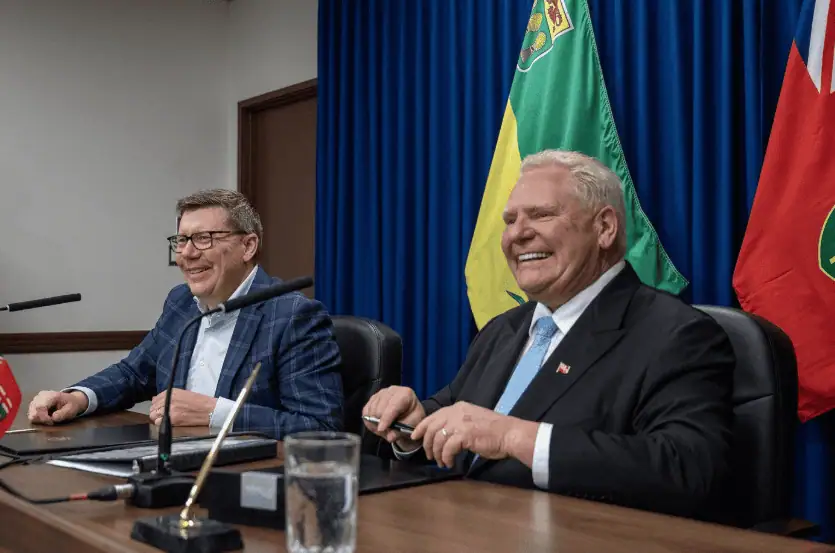
SASKATOON — Ontario Premier Doug Ford signed separate trade agreements with Alberta and Saskatchewan over the weekend, marking a show of provincial unity just ahead of a high-level meeting with Prime Minister Mark Carney focused on revving up Canada’s economy.
The agreements, signed Sunday in Saskatoon, are aimed at eliminating trade barriers and simplifying the movement of goods, workers, and investment between the provinces. Ontario and Saskatchewan signed a memorandum of understanding that establishes mutual recognition of each other’s goods and services, while Alberta’s MOU emphasizes the free flow of goods and services and streamlining of regulations—especially in skilled trades.
Both deals also endorse expanding direct-to-consumer alcohol sales and pledge to remove outdated rules hindering economic growth. Alberta’s statement further suggests Ontario could soon join the New West Partnership Trade Agreement, a pact that already includes British Columbia, Alberta, Saskatchewan, and Manitoba.
Ford positioned the agreements as a united front against mounting trade tensions with the United States, taking direct aim at U.S. President Donald Trump’s latest tariff threats on Canadian steel. “We’re going to band together,” Ford declared. “We’ve never been attacked by any leader in the world like we have by President Trump… but he’s going to have a rude awakening. We’re going to fight like we’ve never fought before.”
Ford estimates that removing interprovincial trade barriers could unlock $200 billion in economic potential. Alberta Premier Danielle Smith echoed the urgency, calling on Canadians to embrace “real economic leadership” and end regulatory stagnation.
The premiers gathered in Saskatoon for Monday’s First Ministers’ Meeting with Carney to discuss major nation-building initiatives. While no single project was confirmed, leaders pushed for streamlined regulatory approval processes. Ford called for repealing the federal Impact Assessment Act, warning that project delays are stalling progress.
Saskatchewan Premier Scott Moe pushed for a massive port-to-port corridor across Western Canada to facilitate exports through northern British Columbia and Manitoba. Calling it the “largest single opportunity” of his lifetime, Moe urged provinces to unite and defend Canada’s trade and energy ambitions. He insisted that expanding oil and gas pipelines must remain central to Canada’s economic future if it hopes to become the G7’s top economy and a true global energy power.
Moe and Smith both criticized former Prime Minister Justin Trudeau’s policies, which they say hindered energy development and alienated the West. Smith reiterated her calls for Carney to dismantle the federal oil and gas emissions cap, abandon clean electricity regulations, repeal carbon pricing on industry, and overhaul Ottawa’s regulatory framework.
Despite Quebec’s historical resistance to oil pipelines—highlighted by the rejection of the Energy East project and the GNL Quebec proposal—Premier François Legault recently signaled openness to some energy initiatives. Ford expressed cautious optimism, saying, “I hope Legault is going to bring a pipeline through. Last time I checked, Quebecers drive cars, they need gas.”
The provincial momentum heading into the meeting reflected a coordinated push for economic sovereignty, regulatory reform, and energy expansion—issues likely to define Canada’s political and economic direction in the coming years.