

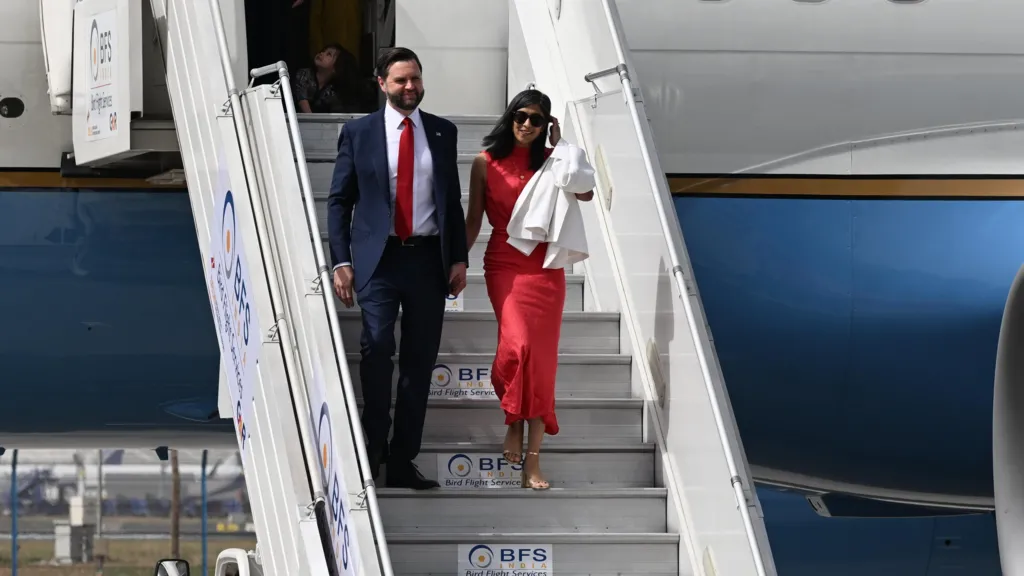
United States Vice-President JD Vance arrived in New Delhi today for a four-day official visit aimed at strengthening bilateral trade and diplomatic ties between the U.S. and India. Accompanied by his wife, Usha Vance, and their children, Vice-President Vance’s trip comes at a crucial juncture, as both countries face mounting pressure to finalize a long-pending trade agreement before U.S. President Donald Trump’s 90-day pause on new reciprocal tariffs ends on July 9.
Upon arrival in Delhi on Monday morning, Vance visited the Akshardham temple with his family, marking the start of his cultural and diplomatic engagements. Later today, he is scheduled to meet with Indian Prime Minister Narendra Modi for high-level discussions, with Modi also expected to host Vance and his family for a private dinner this evening.
According to India’s Ministry of External Affairs, the talks will focus on finalizing a bilateral trade deal, reviewing tariff issues, and exchanging perspectives on pressing regional and global matters. The Indian government has expressed optimism that the visit will add momentum to bilateral efforts toward balancing trade, reducing friction, and expanding strategic cooperation.
The visit is taking place against the backdrop of tense trade relations, as President Trump has accused India of being a “tariff abuser” and announced steep 27% reciprocal tariffs on Indian imports—currently paused until July. Despite recent tariff reductions by India on select U.S. goods, the balance remains tilted with India maintaining a $45 billion trade surplus. India’s average tariffs hover around 12%, compared to just 2% in the U.S.
Vice-President Vance’s trip follows a string of recent U.S. diplomatic engagements in India, including a visit by Director of National Intelligence Tulsi Gabbard and a trade delegation led by Brendan Lynch, Assistant U.S. Trade Representative for South and Central Asia.
Notably, Vance’s wife, Usha Vance, has ancestral roots in India—her family hails from Andhra Pradesh—adding a personal dimension to this high-stakes diplomatic engagement.
The timing of this visit is particularly significant as President Trump is expected to visit India later this year for the Quad summit, where he will join leaders of India, Australia, and Japan to discuss Indo-Pacific cooperation and security.
India’s foreign ministry spokesperson Randhir Jaiswal reaffirmed Delhi’s enthusiasm, stating that “the visit will give a further boost to our bilateral ties.”