

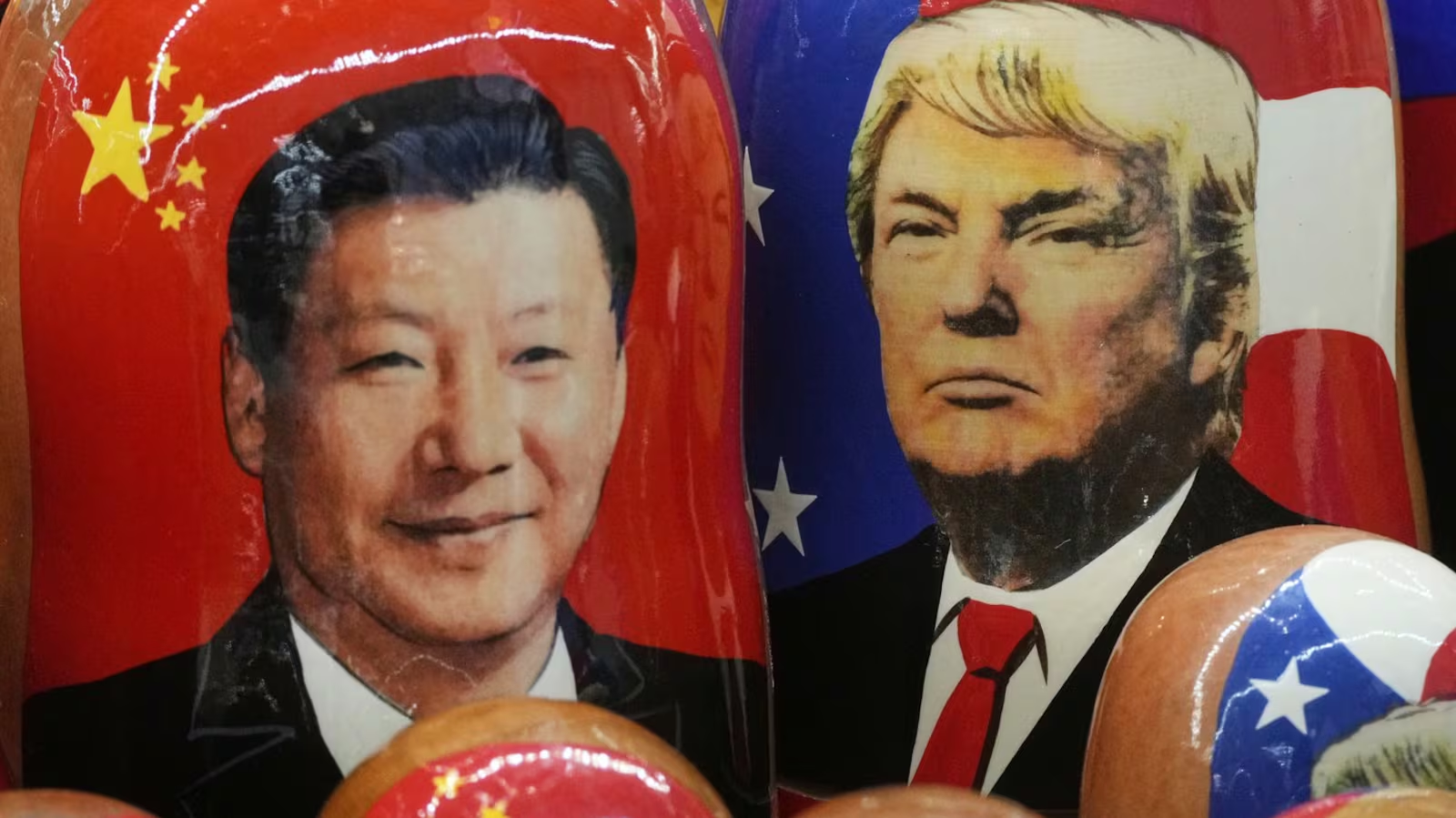
President Donald Trump and Chinese President Xi Jinping have agreed to extend the fragile U.S.-China trade truce for another 90 days, easing tensions that threatened to reignite a costly economic showdown between the world’s two largest economies.
Trump announced the move on Truth Social Monday, confirming he had signed an executive order to keep the existing deal intact. Beijing’s Ministry of Commerce issued its own statement, confirming a matching extension of its tariff pause. The previous deadline was set to expire at 12:01 a.m. Tuesday, potentially triggering a surge in U.S. tariffs on Chinese goods beyond the current 30%, and prompting retaliatory levies from Beijing.
The extension buys negotiators more time to resolve key disputes and could pave the way for a Trump–Xi summit later this year. U.S. companies welcomed the pause, with Sean Stein of the U.S.-China Business Council calling it “critical” for securing a longer-term agreement that improves market access and restores stability for business planning.
China also offered partial relief to some American companies targeted by its export control and “unreliable entities” lists, temporarily lifting restrictions on certain goods and investment.
The truce follows years of bruising trade skirmishes in which Trump’s sweeping tariff strategy transformed the U.S. from one of the world’s most open markets to a heavily protectionist one, with average tariffs climbing from 2.5% to 18.6% — the highest since 1933. China countered with its own economic weapons, threatening to curtail exports of rare earths vital to industries from electric vehicles to aerospace.
A breakthrough came in June, when the U.S. eased restrictions on semiconductor technology and ethane exports, and China agreed to loosen rare earth access. That deal built on a May agreement that rolled back triple-digit tariffs to more manageable — but still high — levels of 30% for U.S. duties on Chinese imports and 10% for China’s tariffs on U.S. goods.
Analysts caution that while the extension lowers the immediate temperature, the toughest disputes remain unresolved, from Chinese industrial subsidies to intellectual property protections. Experts like Jeff Moon predict the trade conflict will continue “grinding ahead for years,” even if smaller deals — such as commitments to buy more U.S. soybeans or stem the flow of fentanyl-related chemicals — can be struck.
For now, the pause has averted another escalation, but the world’s biggest trade relationship remains on a knife’s edge.