

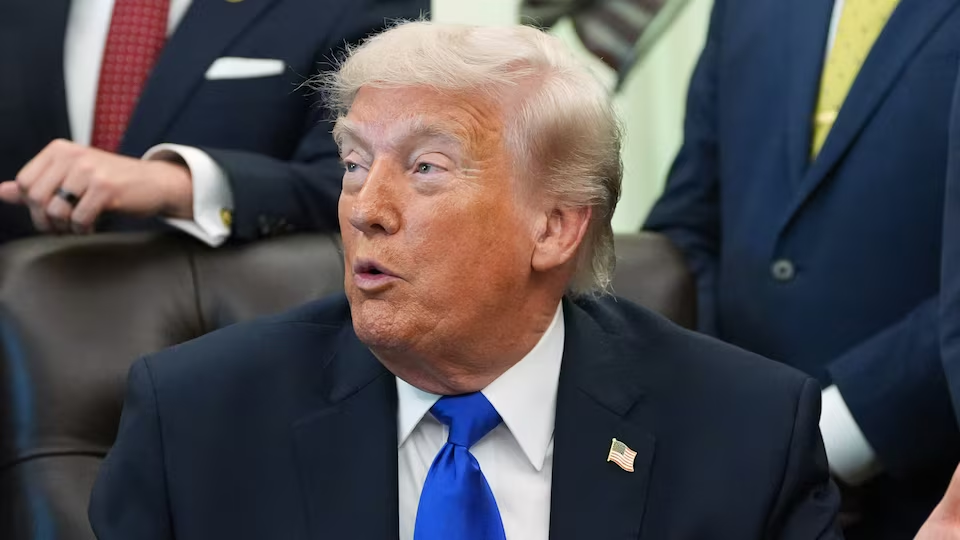
A sharp escalation in tensions between Washington and its European allies is unfolding after Donald Trump threatened to withdraw American troops from key NATO countries, including Germany, Italy, and Spain, amid growing disagreements over the ongoing Iran conflict.
In a series of blunt remarks, Trump signalled that the United States is actively reviewing its military presence in Europe, with Germany—home to the largest contingent of U.S. troops on the continent—at the center of the dispute. Expanding his criticism, he also took aim at Italy and Spain, questioning their level of support and suggesting troop reductions could follow.
The warning comes at a sensitive moment, as divisions widen over the U.S.-led military campaign involving Iran. European governments have largely resisted direct involvement in the conflict, instead calling for diplomatic solutions and expressing concerns over the absence of a clear long-term strategy.
German Chancellor Friedrich Merz has emerged as a key voice in that criticism, recently questioning Washington’s approach and warning that the United States risks being strategically weakened. His comments appear to have struck a nerve with Trump, who responded with pointed attacks, accusing Germany of economic and political weakness while dismissing Merz’s stance on Iran.
Despite the rhetoric, Germany has provided limited support to the U.S., including access to critical military infrastructure such as air bases. Berlin has also signalled willingness to contribute to post-conflict stabilization efforts, including potential naval deployments aimed at securing vital shipping routes like the Strait of Hormuz.
Italy, too, has expressed confusion over Trump’s remarks. Defence Minister Guido Crosetto emphasized that Rome has offered assistance in safeguarding maritime routes, a contribution he said had been positively received by U.S. military officials.
At the heart of the dispute is a broader question about the future of the transatlantic alliance. Trump has once again raised doubts about NATO’s role, reviving earlier criticisms and hinting that America’s long-standing security commitments in Europe could be reconsidered.
The numbers underscore what’s at stake: more than 36,000 U.S. troops are currently stationed in Germany, with thousands more in Italy and Spain. Any significant reduction would mark a major shift in global military posture and could have far-reaching implications for NATO’s strategic balance.
For now, European leaders are attempting to steady the relationship. Merz has sought to tone down the confrontation, reaffirming the importance of ties with Washington while acknowledging the economic and security challenges posed by the Iran conflict.
Still, the episode highlights a growing fracture in one of the world’s most important alliances. As the Iran crisis continues to unfold, the question is no longer just about military strategy—but about whether the unity that has defined the Western alliance for decades can withstand mounting political pressure from within.