

Modi’s Absence Raises Questions About India’s Global Role
India on the Sidelines: Modi’s Absence Noted as Trump Brokers Gaza Peace in Egypt
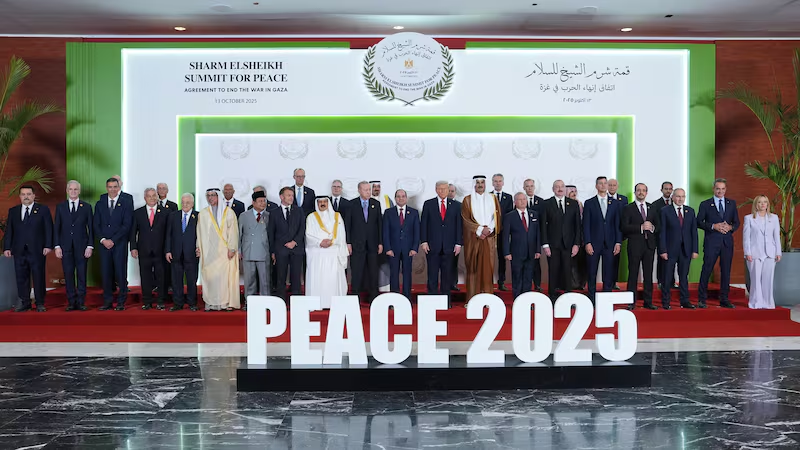
Sharm El Sheikh, Egypt –U.S. President Donald Trump on Monday declared the Gaza war officially over, leading a landmark signing ceremony in Sharm El Sheikh, Egypt, where Middle Eastern and world leaders endorsed a Gaza ceasefire agreement hailed as a “historic moment for the Middle East.”
“With the historic agreement we’ve just signed, those prayers of millions have finally been answered. At long last, we have peace in the Middle East,” Trump said, holding up a page of the accord pledging “tolerance and dignity” for the region.
Hosted by Egyptian President Abdel Fattah El Sisi, the summit brought together a powerful coalition of regional and global leaders including Qatar’s Emir Sheikh Tamim, Turkey’s President Recep Tayyip Erdogan, and European heads of state, who joined Trump in signing the deal. The accord is expected to set the stage for reconstruction in Gaza and a new governance framework following two years of war that claimed more than 67,000 Palestinian lives.
Trump arrived in Egypt after delivering a historic speech to the Knesset in Jerusalem — the first by a U.S. president since 2008 — declaring the end of the conflict and the “dawn of a new Middle East.” His speech was briefly interrupted by two left-wing MPs protesting Israel’s military actions, underscoring the polarizing nature of the conflict.
At the summit, Trump praised El Sisi’s role in brokering the truce and announced the formation of a “board of peace”, potentially involving Arab states and international figures such as former UK Prime Minister Tony Blair, to oversee the reconstruction of Gaza and political transition. El Sisi lauded Trump as “the only one who can achieve peace,” crediting his leadership for turning “a long and painful chapter” into a diplomatic breakthrough.
The ceasefire agreement has already led to major prisoner exchanges: Hamas released the last 20 surviving Israeli hostages, while Israel freed hundreds of Palestinian detainees, many returning to Gaza and the West Bank amid emotional family reunions. The remains of 28 deceased hostages are also expected to be handed over.
Phase two of the plan will focus on Hamas disarmament and a complete Israeli withdrawal from Gaza. Israeli forces have so far pulled back to agreed positions but retain control of roughly half the territory. Reconstruction, backed by Arab and international funds, is expected to follow.
The summit drew several European leaders, including UK Prime Minister Keir Starmer, who pledged $27 million to rebuild Gaza’s water and sanitation systems, French President Emmanuel Macron, and German Chancellor Friedrich Merz, signalling a broad international coalition for the peace effort.
Modi’s Absence Raises Eyebrows — and Strategic Questions
One notable absentee from this historic gathering was Indian Prime Minister Narendra Modi, whose decision not to attend the Sharm El Sheikh peace summit has drawn significant diplomatic attention. While Indian officials cited domestic commitments and a longstanding policy of non-involvement in third-party mediation as reasons for his absence, international observers view it as a missed opportunity for India to project itself as a major global diplomatic player.
India has maintained balanced relations with both Israel and Palestine and has often supported a two-state solution in principle. However, by sitting out of a globally significant peace process—one that brought together the U.S., key Arab powers, Turkey, and major European nations—New Delhi has inadvertently signalled a step back from the global stage at a time when other middle powers are asserting themselves.
Diplomatic analysts suggest Modi’s absence could have two key implications:
- Impact on Modi’s Personal Global Reputation
Over the past decade, Modi has cultivated an image as a statesman on the world stage, frequently appearing at G20, BRICS, and UN summits, and positioning India as a rising global power. His absence from the Gaza summit, where Trump and other leaders framed the event as “the dawn of a new Middle East,” risks casting him as disengaged from pivotal global peace efforts. This could diminish his personal stature among world leaders, especially at a moment when India has been trying to project leadership beyond Asia. - Perception of India’s Global Role
For India, the absence risks undermining its narrative as a responsible, proactive global power. With countries like Turkey, Qatar, Egypt, and several European states taking visible roles in the process, India’s lack of presence may be interpreted as hesitation or diplomatic caution, particularly in Washington, Brussels, and Middle Eastern capitals. It could also limit India’s influence in post-war reconstruction discussions, where contracts, technology, and strategic partnerships will play a major role.
Some analysts argue that India’s strategic focus has shifted heavily toward the Indo-Pacific and economic diplomacy, but others warn that remaining absent from high-stakes geopolitical negotiations weakens India’s ability to shape outcomes in regions where it has significant diaspora, energy, and trade interests.
A Defining Moment
As Trump and other leaders declared a “new era” in the Middle East, Modi’s absence stood in contrast to his otherwise assertive diplomatic profile. Whether this decision reflects strategic calculation or missed opportunity, its long-term impact on India’s global influence and Modi’s image as a world statesman will depend on how New Delhi positions itself in the subsequent phases of the Gaza peace process—particularly in reconstruction and governance discussions.