

One day into a trade war shaking North America, U.S. President Donald Trump stood firm, insisting that his tariff strategy would strengthen the American economy. Meanwhile, a top aide suggested a potential deal could emerge as early as Wednesday.
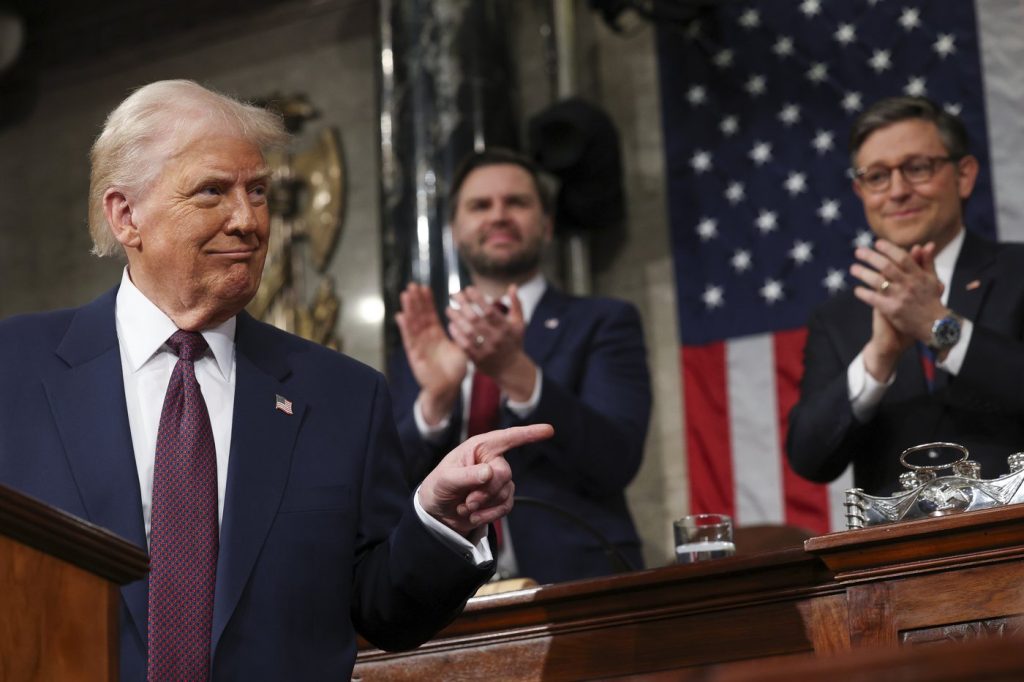
In his first address to a joint session of Congress since taking office in January, Trump championed his sweeping tariff plan on Tuesday night. “For decades, almost every nation has taken advantage of us, but that ends now,” he declared to lawmakers in Washington.
The president’s executive order, which slapped 25 per cent tariffs on all Canadian and Mexican imports—plus a 10 per cent levy on Canadian energy—kicked in on Tuesday.
Canadian Prime Minister Justin Trudeau slammed the move as “dumb,” arguing it forced Canada into a corner. He accused Trump of aiming to “cripple Canada’s economy entirely, just to make annexation easier.” Ottawa fired back with immediate 25 per cent counter-tariffs on $30 billion in U.S. goods, with plans to extend them to an additional $125 billion within three weeks.
Mexican President Claudia Sheinbaum promised retaliatory duties on specific U.S. products, to be detailed Sunday. “There’s no logic or basis for this decision—it hurts our people and our countries,” she said.
The tariffs unleashed instant market chaos, with stocks plunging for a second day and business leaders decrying the punishing levies on America’s nearest allies. U.S. news outlets looped footage of Ontario Premier Doug Ford threatening to cut power to American grids, while Canadian stores yanked U.S. liquor from shelves—vivid warnings of escalating fallout if Trump presses forward.
Yet, as markets reeled, U.S. Commerce Secretary Howard Lutnick offered a glimmer of hope. Speaking to Fox Business after Tuesday’s close, he hinted at a compromise. “We’re aiming to work something out—expect news Wednesday,” Lutnick said. “No pauses, though. We’ll likely land somewhere in between.”
Canada’s Finance Minister Dominic LeBlanc confirmed a Tuesday call with Lutnick, but Foreign Affairs Minister Mélanie Joly told CBC News she’d heard nothing of a “middle-ground” deal. Joly was set to speak with U.S. Secretary of State Marco Rubio on Wednesday. What Trump might accept as a concession remains murky.
Lutnick linked the potential agreement to the Canada-U.S.-Mexico trade pact, forged during Trump’s first term to replace NAFTA. Trump has long tied tariffs to grievances ranging from NATO spending to trade imbalances, even musing about turning Canada into a U.S. state.
Lutnick’s remarks bolster Ottawa’s view that the tariffs—legally justified as a fentanyl crackdown—aren’t truly about drugs. U.S. Customs data shows negligible narcotic flows from Canada compared to Mexico. “It’s a flimsy excuse,” Joly said.
Tuesday marked the first real test of Trump’s bold trade vision, offering a preview of how he might reshape global commerce. Beyond Canada and Mexico, Trump has ordered 25 per cent tariffs on all steel and aluminum imports starting March 12—stacking onto existing duties—and signed an April 2 executive order for “reciprocal tariffs” targeting cars, copper, lumber, and farm goods.