

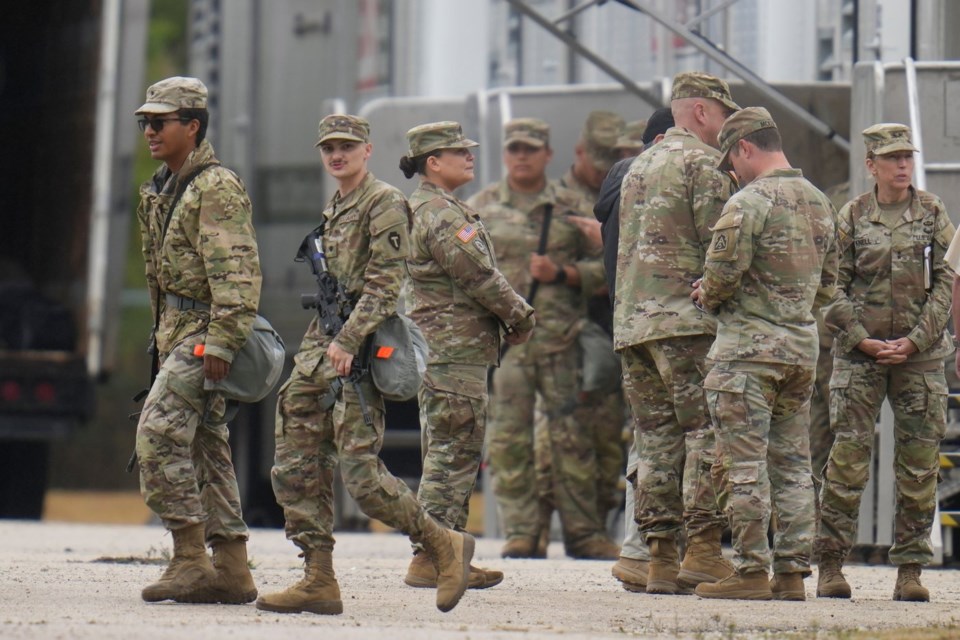
ELWOOD, Ill. — National Guard members from Texas were stationed Tuesday at an Army Reserve center in suburban Chicago, marking the most visible step yet in President Donald Trump’s plan to deploy troops to the region — a move that has triggered fierce political and legal battles with Democratic leaders.
Military personnel wearing Texas National Guard patches were seen by the Associated Press at the U.S. Army Reserve Center in Elwood, about 55 miles southwest of Chicago. Trucks marked “Emergency Disaster Services” delivered portable toilets and supplies, while rows of trailers were set up on site. The precise mission of the troops remains unclear, though the Trump administration has launched aggressive immigration enforcement operations in the Chicago area in recent weeks.
Illinois Governor JB Pritzker, who has accused Trump of using troops as “political props” and “pawns,” did not immediately comment on Tuesday’s developments. He and Chicago Mayor Brandon Johnson are challenging the deployment in court, calling it unconstitutional and illegal. A federal judge will hear their lawsuit on Thursday.
The deployment pits the White House against blue state governors who have accused Trump of overstepping his authority. Oregon has already blocked a similar Guard deployment through a court ruling, and Illinois is hoping for the same outcome. The nearly 150-year-old Posse Comitatus Act restricts the use of the military for domestic law enforcement, though Trump has suggested he may invoke the Insurrection Act, which would allow him to send active-duty troops if a state is deemed to be defying federal law.
Pritzker said Monday that Illinois National Guard troops would be activated alongside 400 soldiers from Texas. Texas Governor Greg Abbott posted a photo of troops boarding a plane, declaring them “ever ready.”
Chicago Mayor Brandon Johnson signed an executive order this week banning federal immigration agents from using city-owned property — including parking lots and vacant lots — as staging grounds for enforcement. “The president’s strategy is unconstitutional, it’s illegal and it’s dangerous,” Johnson said.
The arrival of troops follows months of escalating tension over immigration enforcement in Chicago, where armed Border Patrol agents have made arrests near major landmarks and in heavily Latino neighborhoods. Residents have expressed growing unease as federal operations intensify.
Similar deployments are being planned elsewhere. In Memphis, Tennessee, police chief Cerelyn Davis said Guard troops could arrive by Friday to support local law enforcement, though their role has not been clearly defined. Republican Governor Bill Lee supports the effort and said troops will be deputized by the U.S. Marshals Service.
Since beginning his second term, Trump has either sent or proposed sending troops to at least 10 cities, including Baltimore, Washington D.C., New Orleans, Oakland, San Francisco, Los Angeles, and Portland. The strategy comes despite nationwide declines in violent crime. In Chicago, homicides dropped 31% through August, while Portland recorded a 51% decline in killings in the first half of the year compared to 2024.
In Portland, a federal appeals court is set to hear arguments Thursday as the administration seeks to overturn a lower court ruling blocking the Guard’s deployment. Oregon Governor Tina Kotek met with Homeland Security Secretary Kristi Noem this week and firmly rejected the administration’s justification. “There’s no insurrection in our state,” she said. “Oregon is united against military policing in our communities.”
A federal judge previously ruled that the administration “willfully” broke federal law by placing Guard troops in Los Angeles over objections to immigration raids.
As troops settle into Illinois, the legal and political clash over Trump’s domestic military strategy is intensifying — raising profound questions about executive power, states’ rights, and the role of the military on U.S. soil.