

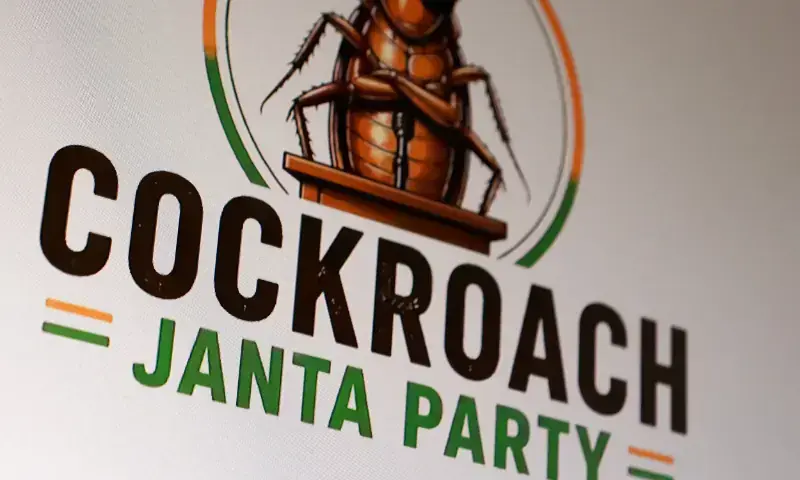
The founder of India’s rapidly growing satirical political movement known as the “Cockroach People’s Party” has returned to New Delhi, seeking to transform an online protest phenomenon into a real-world demonstration that is drawing national attention.
Abhijeet Dipke, a 30-year-old political communications strategist and Boston University graduate, announced that he was travelling from the United States to India to organize a peaceful protest and seek official permission from authorities for a public demonstration in the capital.
The online movement, formally known as the Cockroach Janta Party (CJP), emerged in May and quickly became one of the country’s most talked-about social media campaigns. The satirical group was created following controversy surrounding remarks attributed to India’s Chief Justice during a court hearing, comments that critics interpreted as referring to some young government critics as “cockroaches” and “parasites.” The Chief Justice later clarified that his remarks had been taken out of context.
Dipke responded by launching the fictional political party as a form of political satire and youth activism. The movement adopted the slogan “a political front for the youth, by the youth, for the youth,” and rapidly attracted millions of supporters online.
The party’s name deliberately mirrors that of India’s ruling Bharatiya Janata Party (BJP), using humour, memes, and satire to highlight issues that many young Indians say are affecting their future, including employment opportunities, education, examination controversies, and government accountability.
One of the movement’s primary demands has been the resignation of Education Minister Dharmendra Pradhan, who has faced criticism and public scrutiny regarding alleged irregularities in several major educational examinations and recruitment processes.
The campaign’s popularity has expanded far beyond what many observers initially expected. Its social media presence has attracted an enormous following, particularly among younger Indians who have embraced its unconventional style of political commentary. The movement’s rapid growth has transformed it from a niche online joke into a broader platform for political expression and youth engagement.
Prominent social activist Sonam Wangchuk has also indicated support for the planned demonstration, adding further visibility to the movement. Wangchuk has been an outspoken advocate on issues relating to governance, environmental protection, and regional autonomy.
Despite its popularity, some of the group’s social media accounts have reportedly faced restrictions, reflecting the broader challenges faced by political and activist movements operating in India’s highly regulated digital environment.
As enthusiasm grew among supporters, Dipke urged followers not to gather at the airport upon his arrival, emphasizing the importance of maintaining public order and respecting security arrangements. Instead, he encouraged supporters to await official approval for a peaceful protest and to conduct themselves responsibly.
The movement’s evolution from an online satirical campaign into a real-world political demonstration highlights the growing role social media plays in shaping political discourse among younger generations. What began as a humorous response to a controversial remark has evolved into a broader conversation about youth participation, freedom of expression, education policy, and political accountability.
Whether the Cockroach Janta Party remains a symbolic protest movement or develops into a more sustained form of civic activism remains to be seen. However, its remarkable rise has already demonstrated the power of satire, social media, and youth engagement in influencing public debate in one of the world’s largest democracies.