

TORONTO — Ontario prosecutors have disclosed nearly 30 instances over the past ten years where police officers were found to have been “deliberately untruthful” on the witness stand, according to newly obtained documents. The revelation comes amid ongoing scrutiny of police testimony in high-profile cases, including the prosecution of Umar Zameer, who was acquitted in 2024 of first-degree murder in the death of Const. Jeffrey Northrup at Toronto City Hall parkade.
Of the 28 documented cases, eight involve the Toronto Police Service, with others spread across Ontario Provincial Police (four), Ottawa, York Region, Cornwall (two each), and Durham, Hamilton, London, Niagara, Peel, Waterloo, and Windsor (one each). The records, obtained through a Freedom of Information request, reflect a policy implemented in 2012 requiring Crown attorneys to flag cases where judges determine an officer was untruthful under oath.
Former Toronto mayor John Sewell, now with the Toronto Police Accountability Coalition, called the findings serious, saying they underscore the importance of tracking and responding to dishonest testimony. “I like the idea that they have a policy … that it goes to someone who deals with that,” Sewell said.
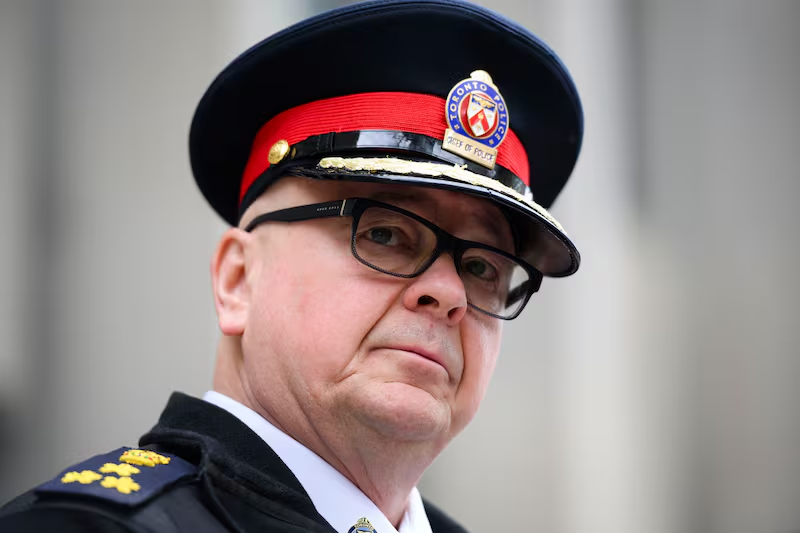
The case of Umar Zameer is among those flagged under this policy. Justice Anne Molloy, in directing the jury before acquitting Zameer, noted that three testifying officers appeared to share the same incorrect memory, raising concerns of possible collusion. The acquittal spurred Toronto Police Chief Myron Demkiw to request an Ontario Provincial Police review of the officers’ testimony, conduct, and training, along with a broader evaluation of plainclothes policing practices.
“It has been 17 months since the acquittal, and these reviews are still ongoing,” Toronto Police confirmed. Chief Demkiw defended his officers at a community event, emphasizing their commitment to service but reiterated that allegations of misconduct are taken seriously and fully investigated.
Toronto Police Association President Clayton Campbell expressed support for the officers, stating, “While a jury has found no criminal intent—a decision that we respect—that is what happened and cannot be forgotten. The TPA will continue to stand by these officers and we are all eager for the OPP to complete its investigation.”
The Crown’s reporting procedure was first triggered in 2013 when Justice Harriet Sachs acquitted a Toronto drug squad officer but cited concerns about the officers’ “lack of truthfulness” during testimony.
This latest disclosure renews calls from legal experts and community advocates for faster completion of reviews, stronger oversight mechanisms, and measures to restore public trust in policing and the justice system.