

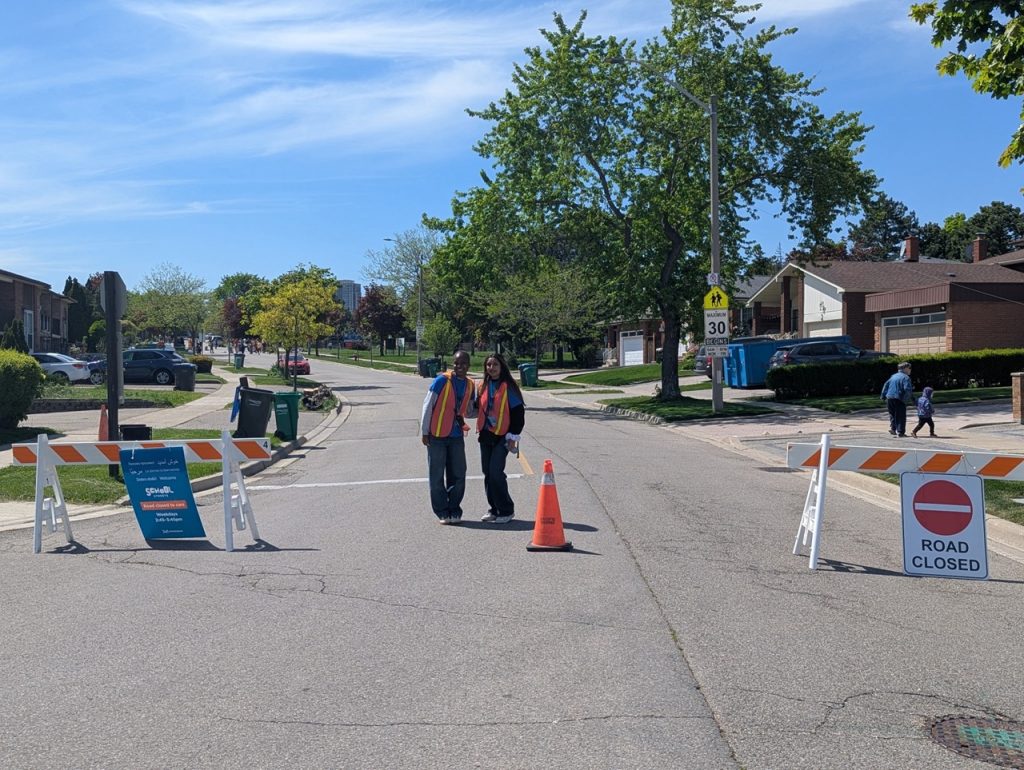
More Mississauga schools are taking bold steps to protect students and reduce dangerous traffic congestion by temporarily banning vehicles around school zones as part of a growing Canada-wide road safety initiative.
Sts. Peter and Paul Catholic Elementary School has become the latest school in Mississauga to participate in the national School Streets pilot program, a project aimed at creating safer, healthier, and more community-friendly environments for children travelling to and from school.
Since May 4, vehicle access in front of the school near Rathburn Road East and Central Parkway East has been restricted during peak drop-off and pickup times. The nearly month-long pilot concludes Friday and is designed to reduce traffic-related risks for students while encouraging families to walk, bike, or roll to school instead of relying on cars.
The initiative is part of the broader School Streets Canada program, which has been expanding across the country as municipalities search for new ways to improve child safety, lower emissions, and reduce traffic congestion around schools.
City officials say the objective is straightforward — make school zones safer for children and more welcoming for families.
Using barricades and temporary road closure signage, the program creates a car-free space directly outside participating schools during the busiest parts of the day. Supporters say the approach not only improves safety but also encourages healthier lifestyles and greater independence among students.
Sts. Peter and Paul is now the second school in Mississauga participating in the initiative following the earlier involvement of Corliss Public School in Malton, where similar vehicle restrictions have been in place since last September.
At Corliss Public School, cars have been kept away from student pickup and drop-off areas during specific periods each school day as part of the extended pilot project, which runs through the end of the current school year.
John Kovac, Deputy Mayor and Ward 4 Councillor, praised the initiative and said programs like School Streets help create safer neighbourhoods while promoting active transportation among families.
He noted that reducing traffic around schools not only protects students but also encourages walking and cycling while improving environmental conditions in school communities.
Meanwhile, Sam Rogers said the program delivers benefits that extend far beyond traffic safety.
Rogers emphasized that School Streets can improve both physical and mental health outcomes, reduce greenhouse gas emissions in school zones, and strengthen neighbourhood connectivity by creating safer and more welcoming public spaces.
The City of Mississauga says it plans to continue expanding the initiative and will begin recruiting more schools to participate when the next phase launches in September.
Mississauga is currently one of 25 Canadian communities participating in the national School Streets pilot project in partnership with Green Communities Canada and funded through support from the Public Health Agency of Canada.
City officials say many school zones across Mississauga continue facing temporary but severe congestion during morning drop-offs and afternoon pickups, creating traffic dangers, air pollution, and lost opportunities for children to engage in physical activity.
Officials believe the School Streets approach represents an innovative long-term solution that could permanently reshape how school communities manage traffic and prioritize student safety.
Mississauga first tested the initiative in 2022 through a pilot involving three elementary schools over several weeks in May and June. According to city officials, the program’s early success encouraged the municipality to continue expanding participation.
As urban centres across Canada search for safer and more sustainable transportation solutions, Mississauga’s growing involvement in School Streets reflects a broader shift toward designing communities that place student wellbeing, environmental responsibility, and active living ahead of vehicle convenience.