

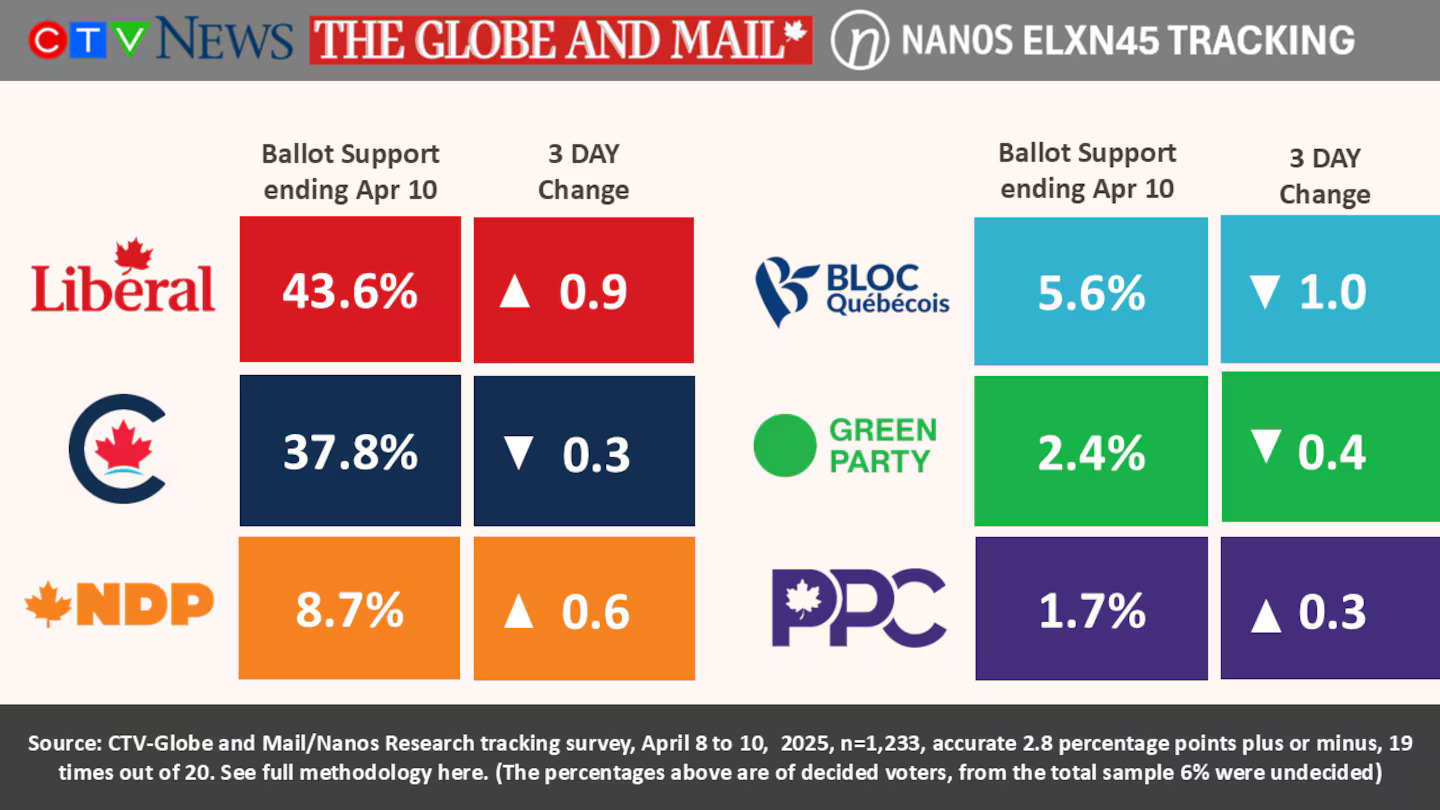
The latest Nanos Research tracking data shows the Liberal Party regaining momentum, widening its lead over the Conservatives to six points nationally as the 2025 federal election campaign enters its final stretch.
As of April 10, the three-day rolling sample places the Liberals at 44%, up slightly, while the Conservatives remain at 38%. The NDP continues to struggle, polling at just 9%, while the Bloc Québécois holds 6%, the Green Party sits at 3%, and the People’s Party of Canada trails with 2%.
Pollster Nik Nanos describes the current landscape as a clear “East versus West showdown”, with the Liberals dominating in Eastern Canada and the Conservatives maintaining strongholds in the Prairies. British Columbia, he notes, remains a statistical toss-up.
In Ontario, a critical battleground, the Liberals have rebounded strongly. After the Conservatives surged to 41% earlier this week, they’ve now slipped to 37%, while the Liberals have risen to 51%, reclaiming their dominant position in the province.
The Liberals are also holding steady in Quebec, leading with 43% support. The Bloc has dipped slightly to 25%, while the Conservatives remain in third at 24%. In Atlantic Canada, the Liberals continue to lead comfortably with 51%, compared to 43% for the Conservatives and just 6% for the NDP.
In contrast, the Prairies remain Conservative territory, where the party commands 53% support, well ahead of the Liberals at 39%. The parties are effectively tied in British Columbia, with the Conservatives holding a slim lead of less than a point—a region that could prove decisive on election night.
“The East-West division speaks to the political tensions within the federation,” Nanos explained. “Voters in the Prairies may struggle to understand the Liberal appeal, while those in the East likely underestimate the depth of Conservative support in the West.”
Leadership Preference and Gender Gap
On the question of preferred prime minister, Mark Carney continues to lead with 47%, ahead of Pierre Poilievre, who has narrowed the gap slightly to 34%. Just a week ago, Carney’s advantage exceeded 20 points, but recent numbers show a gradual tightening.
A breakdown by gender highlights one of the key dynamics of the campaign. Among women, 51% say they would vote Liberal, compared to 29% for the Conservatives and 11% for the NDP. Among men, the picture is reversed: 47% favour the Conservatives, while only 36% would vote Liberal. The NDP draws support from just 6% of men.
The data underscores growing polarization in the electorate—geographically and demographically—with the Liberals performing strongest in urban and eastern regions and among women, while Conservatives hold the advantage in western provinces and among men.
Nanos Research will continue releasing daily tracking results through to election day on April 28, with CTV News and the Globe and Mail providing exclusive coverage.