

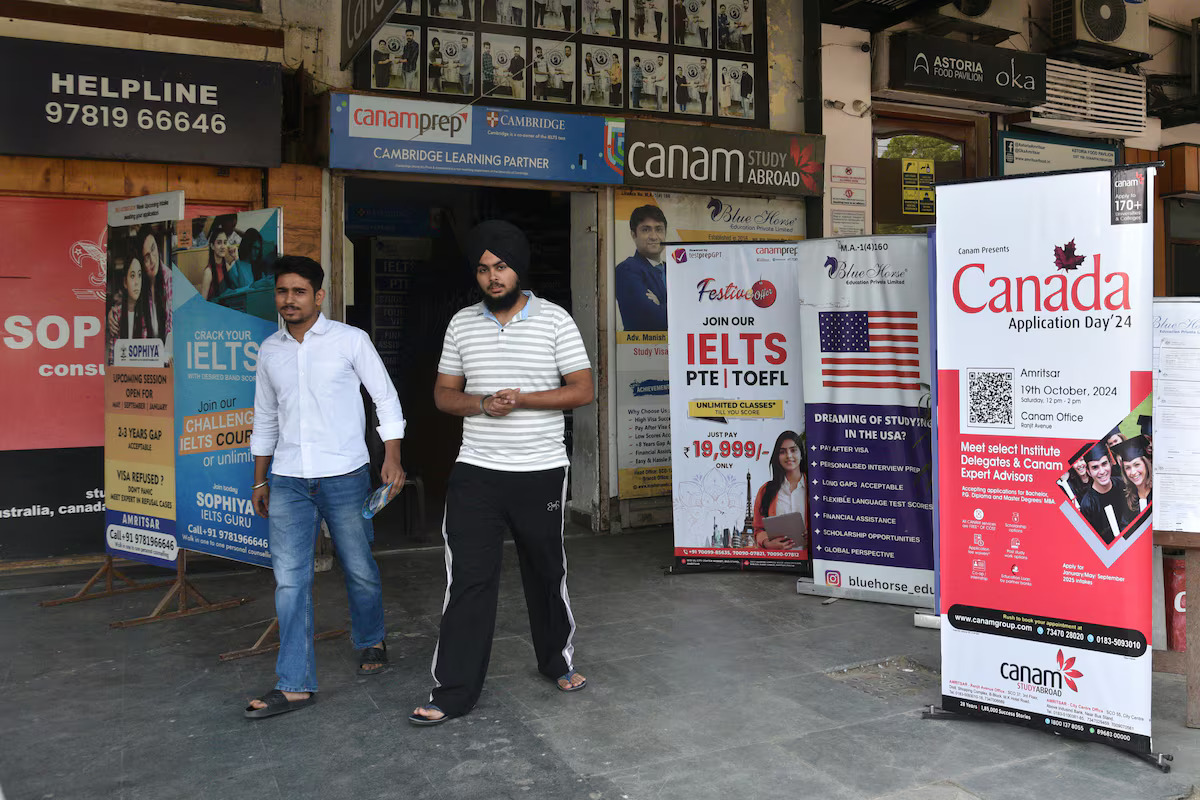
Majority of non-compliant students hail from India, sparking investigations and calls for stricter
Nearly 50,000 international students who received study permits to come to Canada were reported as “no-shows” at the colleges and universities where they were supposed to be enrolled, according to data released by Immigration, Refugees and Citizenship Canada (IRCC) for March and April 2024.
These non-compliant students accounted for 6.9% of the total international student population during that period. The findings raise concerns about abuse of Canada’s student visa system and its broader implications on immigration and border security.
Of the 49,676 non-compliant students, nearly 20,000 were from India, representing 5.4% of the total Indian students tracked by IRCC. Indian law enforcement officials are investigating potential connections between Canadian colleges and entities in India allegedly involved in illegal migration to the United States.
The Royal Canadian Mounted Police (RCMP) confirmed they are working with Indian authorities on the matter.
However, Henry Lotin, a former federal economist and immigration expert, suggested that most of these Indian students likely remain in Canada.
“While a very small subset might have crossed into the U.S., the majority are likely working in Canada and hoping to settle here,” Lotin said. “The record increase in asylum claims by international students last year underscores this trend.”
Non-compliance among international students is not limited to India. Data for March and April 2024 showed no-show rates varied by country, with Rwanda at 48.1% (802 students), Iran at 11.6% (1,848 students), and China at 6.4% (4,279 students).
Since the introduction of the International Student Compliance Regime in 2014, Canadian colleges and universities are required to report twice a year on international student enrollment. However, a further 23,514 students—3.3% of the total—were unaccounted for due to incomplete reporting by schools.
Immigration Minister Marc Miller recently announced tougher rules, including suspending colleges and universities that fail to submit compliance reports from accepting international students for up to a year.
“Canada is seeing increased exploitation of its temporary resident visa programs, including study permits,” said Renée LeBlanc Proctor, spokesperson for Minister Miller. “This system is now assessed as higher-risk due to increased abuse and organized smuggling networks.”
Suggestions for reform include requiring international students to pay tuition fees upfront and restricting the use of foreign agents or consultants in the application process.
David Matas, a Winnipeg-based immigration lawyer, advocated for tighter regulations on immigration consultants.
“Allowing only Canadian-regulated lawyers and consultants to assist applicants could reduce fraud and exploitation in the system,” he said.
The issue is further complicated by discrepancies in how international students are tracked. Statistics Canada estimates there were over one million valid student visa holders in April 2024, a significantly higher number than IRCC’s enrollment data suggests.
“This gap indicates that an even larger number of students are unaccounted for,” said Lotin. “There is an urgent need for better and more transparent data to address these concerns.”
Tom Kmiec, Conservative immigration critic, blamed the government for poor management of the immigration system.
“The lack of oversight is eroding trust in Canada’s immigration policies,” he said.
As Canada grapples with these issues, international students and institutions alike face increasing scrutiny, underscoring the need for robust measures to safeguard the integrity of the system.