

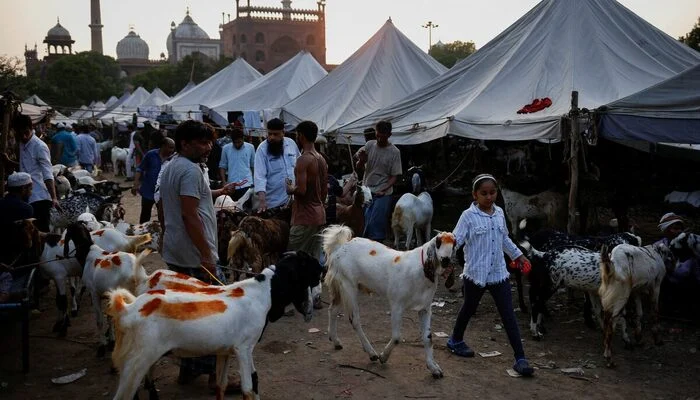
Authorities in several parts of India have announced strict regulations ahead of Eid al-Adha celebrations, including bans on the sacrifice of cows, calves and camels, along with restrictions on public prayers and animal slaughter practices.
The new measures, introduced days before Muslims across India and around the world prepare to celebrate Eid-ul-Adha on Wednesday, have intensified ongoing debates surrounding religious freedoms, public order and communal sensitivities in the country.
In Uttar Pradesh, Chief Minister Yogi Adityanath directed district officials to strictly enforce regulations governing Eid celebrations during a high-level law and order meeting held via video conference.
According to Indian media reports, Adityanath instructed authorities to ensure that animal sacrifices are carried out only at officially designated locations and prohibited any sacrifices in public places.
He also ordered that Eid prayers be conducted strictly at traditional prayer grounds and mosques, stating that no permission would be granted for namaz prayers on public roads under any circumstances.
Officials in Uttar Pradesh have additionally been directed to monitor slaughter activities closely, crack down on illegal slaughterhouses and enforce restrictions on open meat sales during the festival period.
Police and administrative authorities have reportedly been instructed to conduct flag marches, intensify patrols and strengthen security around religiously sensitive areas to maintain public order during the celebrations.
Meanwhile, in Delhi, minister Kapil Mishra warned of strict action against unauthorized animal transportation, illegal slaughter and violations related to what officials described as animal cruelty regulations.
Delhi authorities also emphasized that sacrifices will only be permitted at approved and designated sites in accordance with hygiene and legal requirements.
The restrictions are especially significant because cow slaughter remains a deeply sensitive political and religious issue in India.
Several Indian states already prohibit or heavily regulate cow slaughter due to the sacred status of cows within Hindu religious traditions.
Eid-ul-Adha, also known as the “Festival of Sacrifice,” is one of the most important celebrations in Islam and commemorates the willingness of Prophet Ibrahim (AS) to sacrifice his son in obedience to Allah before the sacrifice was divinely replaced with a ram.
The occasion is traditionally observed through prayers, family gatherings, charitable giving and the ritual sacrifice of animals such as goats, sheep, cows or camels, with meat distributed among family members, friends and people in need.
India’s Muslim population — one of the largest in the world — celebrates Eid-ul-Adha widely across the country each year.
However, religious observances have increasingly become politically sensitive in some regions amid rising tensions over religious identity, public space usage and communal relations.
Supporters of the restrictions argue the measures are intended to maintain law and order, regulate hygiene standards and prevent communal conflict during large-scale religious gatherings.
Critics, however, argue that repeated restrictions on Muslim religious practices risk deepening concerns about religious freedoms and equal treatment under the law.
The issue of public prayers on roads has also become increasingly controversial in India in recent years, with several state governments introducing stricter controls over religious gatherings in public spaces.
Security agencies across several Indian states are expected to remain on high alert throughout the Eid celebrations as authorities attempt to prevent communal tensions and ensure peaceful observances during one of the most significant religious festivals in the Islamic calendar.