

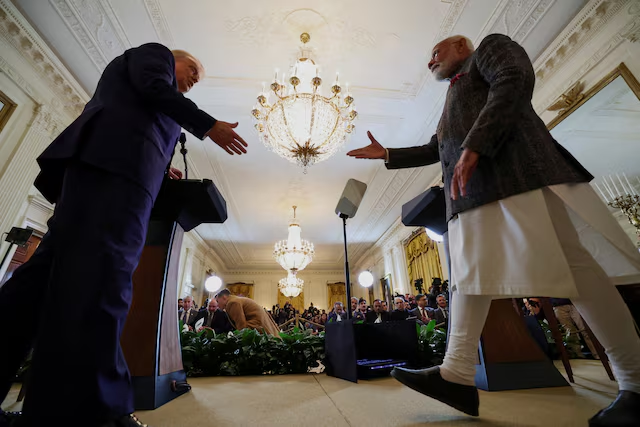
In a display of strategic maneuvering on Capitol Hill and beyond, both India and Pakistan are investing heavily in Washington lobbying to secure political access and influence U.S. policy decisions — with India’s efforts reportedly paving the way for a high-profile meeting between Prime Minister Narendra Modi and former U.S. President Donald Trump.
According to filings under the U.S. Foreign Agents Registration Act (FARA), India has contracted Jason Miller, a veteran Trump adviser and head of SHW Partners, for an estimated US$1.8 million annually. Miller’s role includes strategic counsel, tactical political outreach, and facilitation of high-level engagements with U.S. lawmakers and decision-makers. His deep connections to the Trump circle have reportedly played a pivotal role in coordinating a possible Modi–Trump meeting in New York this September, coinciding with the UN General Assembly session.
Pakistan, in contrast, has taken a leaner but sharply focused route. Islamabad is paying US$50,000 per month to Keith Schiller, Donald Trump’s former bodyguard and trusted confidant, through Javelin Advisors — an approach worth approximately US$600,000 annually. Schiller’s personal access to Trump has coincided with positive diplomatic optics for Pakistan, including a rare White House luncheon invitation for Pakistan’s army chief.
Further strengthening its Washington footprint, Pakistan’s Islamabad Policy Research Institute (IPRI) has retained Team Eagle Consulting, led by lobbyist Stephen Payne, under a contract worth US$1.5 million per year. This institutional engagement aims to bolster Pakistan’s policy positioning and outreach with U.S. think tanks and political influencers.
While India’s spend dwarfs Pakistan’s, both strategies underscore the increasing importance of lobbying in shaping foreign policy narratives, especially amid trade tensions, shifting alliances, and volatile tariff regimes. For India, this investment comes at a time when U.S. tariffs on Indian goods have spiked as high as 50%, adding urgency to its diplomatic messaging. Pakistan, meanwhile, enjoys a comparatively lower average tariff rate of 19%, but still seeks to secure and expand its strategic leverage in Washington.
Diplomatic analysts say these lobbying efforts highlight two contrasting approaches: India’s high-powered institutional strategy built on policy channels and formal engagements, versus Pakistan’s targeted relationship-driven model leveraging personal rapport for quick access.
As the potential Modi–Trump meeting draws closer, the spotlight will remain on how these lobbying investments shape not just bilateral relations, but also broader South Asian dynamics in Washington’s corridors of power.