

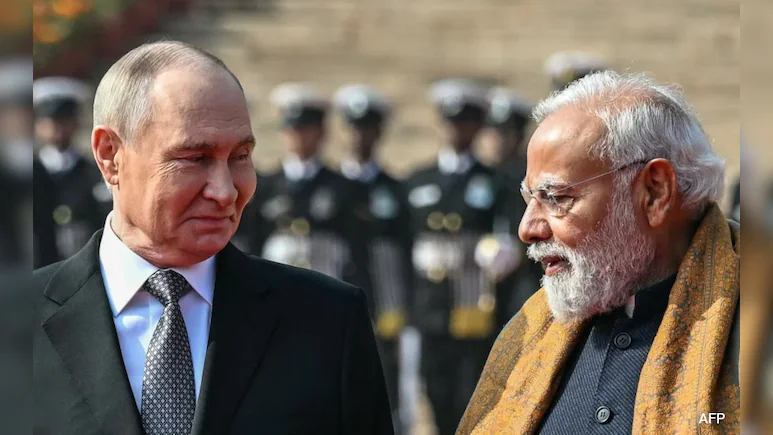
ST. PETERSBURG, RUSSIA — Russian President Vladimir Putin has strongly defended India’s strategic independence, declaring that any attempt to pressure New Delhi through sanctions would ultimately backfire under the leadership of Prime Minister Narendra Modi.
Speaking at the St. Petersburg International Economic Forum, Putin praised India’s long-standing tradition of pursuing an independent foreign policy guided by its national interests rather than external pressure. His remarks came amid continuing international scrutiny of India’s economic and defence relations with Russia.
Putin emphasized that India remains a sovereign nation fully capable of making its own decisions regarding defence acquisitions, trade partnerships, and international cooperation. He stated that India has consistently acted according to its national priorities and would continue to do so regardless of any outside attempts to influence its choices.
According to the Russian leader, sanctions threats directed at India would prove ineffective because New Delhi has demonstrated a strong commitment to strategic autonomy. He specifically credited Prime Minister Narendra Modi’s leadership for maintaining India’s independent approach to global affairs.
The Russian president’s comments are significant at a time when geopolitical tensions continue to shape international trade and defence relationships. India has maintained strong ties with Russia while simultaneously deepening its strategic partnerships with the United States, Europe, and other major global powers.
Addressing speculation that India could face pressure over potential purchases of advanced Russian defence systems such as the Su-57 fighter aircraft or the S-500 air defence platform, Putin reiterated that India alone would decide which military equipment best meets its national security requirements. He said that decisions on defence procurement should be based on capability, technology, and operational needs rather than political considerations imposed by foreign governments.
Putin also stressed that Russia’s defence cooperation with India remains stable and unaffected by changing international political circumstances. He stated that Moscow would continue to honour its commitments to India and other partners regardless of external pressures.
Highlighting the longstanding relationship between the two countries, Putin described India as one of Russia’s most trusted partners and reaffirmed Moscow’s willingness to expand cooperation across various sectors, including defence, energy, technology, and trade.
The Russian leader also spoke about the Su-57 fifth-generation fighter aircraft, describing it as one of the most advanced combat aircraft currently available. He revealed that Russia had previously proposed a joint development program involving India but later proceeded independently after the collaboration did not materialize. Putin said Russia remains ready to offer the aircraft to India if New Delhi chooses to pursue such a purchase.
India and Russia have maintained a decades-long strategic partnership, particularly in defence cooperation, with a significant portion of India’s military equipment originating from Russian platforms. At the same time, India has increasingly diversified its defence procurement and strengthened relations with Western nations, reflecting its broader policy of maintaining balanced international partnerships.
Putin’s remarks are likely to be viewed as a strong endorsement of India’s independent foreign policy and a recognition of New Delhi’s growing influence in global affairs. They also underscore Russia’s desire to preserve and expand its strategic partnership with India amid an evolving international geopolitical landscape.
As global power dynamics continue to shift, India’s ability to maintain productive relations with multiple major powers while safeguarding its national interests remains a key feature of its foreign policy. Putin’s comments highlight the importance Moscow places on its relationship with New Delhi and its confidence that India will continue making decisions based on its own strategic priorities.