

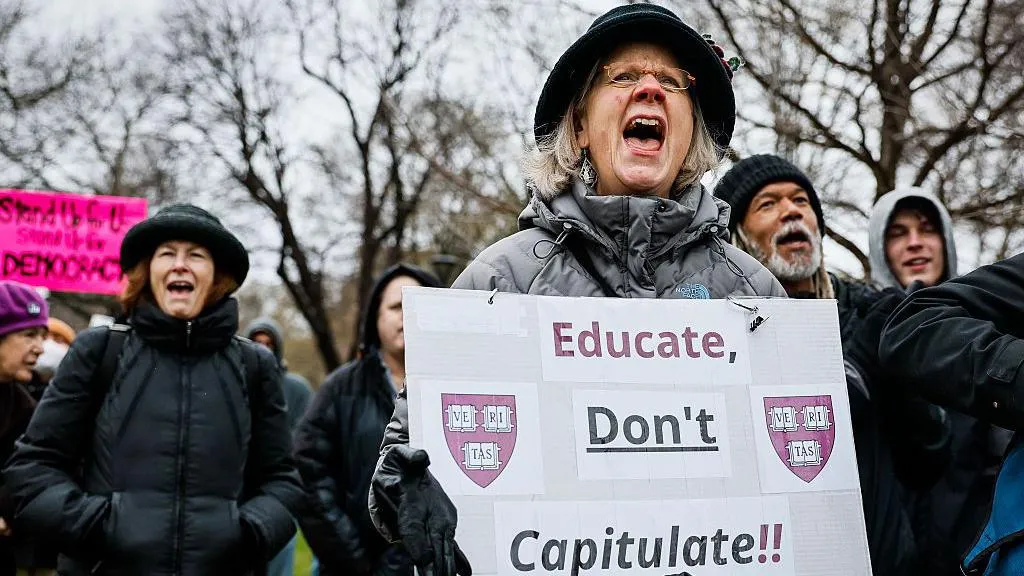
Harvard University is at the center of a growing standoff with the Trump administration after rejecting sweeping demands from the White House aimed at reshaping its internal policies. In response, President Donald Trump has ordered an immediate freeze on more than $2 billion in federal funds allocated to the university, escalating his administration’s campaign to assert control over elite academic institutions.
The White House’s list of demands, sent last week, was presented as part of a broader initiative to combat antisemitism on campus. However, the proposals extended far beyond that scope, calling for changes to faculty hiring, admissions policies, curriculum oversight, and even the reporting of students deemed “hostile to American values” to federal authorities. Among the more controversial elements were requirements for “viewpoint diversity” in academic departments and external audits by government-approved monitors to investigate programs accused of fostering antisemitic harassment.
Harvard became the first major university to reject the terms outright, arguing that the demands represented an unconstitutional overreach. In a strongly worded statement, Harvard President Alan Garber said the university would not “surrender its independence” or “relinquish its constitutional rights under the First Amendment.”
“Although some of the demands are aimed at addressing antisemitism, the majority amount to direct government control over the intellectual conditions at Harvard,” Garber said.
The Department of Education responded within hours, announcing it would suspend $2.2 billion in research grants and $60 million in federal contracts. In a statement, the department criticized what it called a culture of entitlement among elite institutions, accusing Harvard of failing to act against the harassment of Jewish students and enabling disruptions on campus.
Trump, who has made academic institutions a recurring target of his political agenda since returning to office, has cast elite universities as out of touch and hostile to conservative values. His administration has previously threatened schools with funding cuts, and in March, announced a review of $256 million in contracts and an additional $8.7 billion in long-term grants tied to Harvard.
While the freeze may not severely impact Harvard’s day-to-day operations — the university boasts a $53 billion endowment — faculty and students say the move sends a chilling message about academic freedom. Professor David Armitage, a Harvard historian, called the funding freeze a “vengeful” act aimed at silencing dissent. “It’s a not unexpected act of entirely groundless retaliation by the Trump administration, which wants nothing more than to silence freedom of speech,” Armitage told the BBC.
Harvard has since joined a growing legal battle over the administration’s tactics. Professors filed a lawsuit alleging that the government’s actions violate constitutional protections and constitute unlawful political interference in academic life.
The fallout has extended beyond Harvard. Columbia University, another Ivy League school, recently complied with several of the White House’s directives after $400 million in funding was revoked. The move drew internal backlash, with students and faculty accusing the university of capitulating to political pressure.
Meanwhile, the administration’s crackdown appears to be broadening. On the same day Harvard’s funding freeze was announced, a Columbia University student organizer involved in pro-Palestinian protests was arrested by immigration authorities during a citizenship interview. The student, Mohsen Mahdawi, a green card holder scheduled to graduate next month, was detained in Vermont. Other students at Columbia and Tufts University involved in similar protests have also reportedly been detained in recent weeks.
As tensions mount between universities and the federal government, polling from Gallup suggests that public trust in higher education has been declining, particularly among Republicans who believe that academic institutions promote a political agenda.
Harvard’s defiance may prove to be a flashpoint in a broader struggle over the autonomy of American universities and the role of government in shaping campus discourse.