

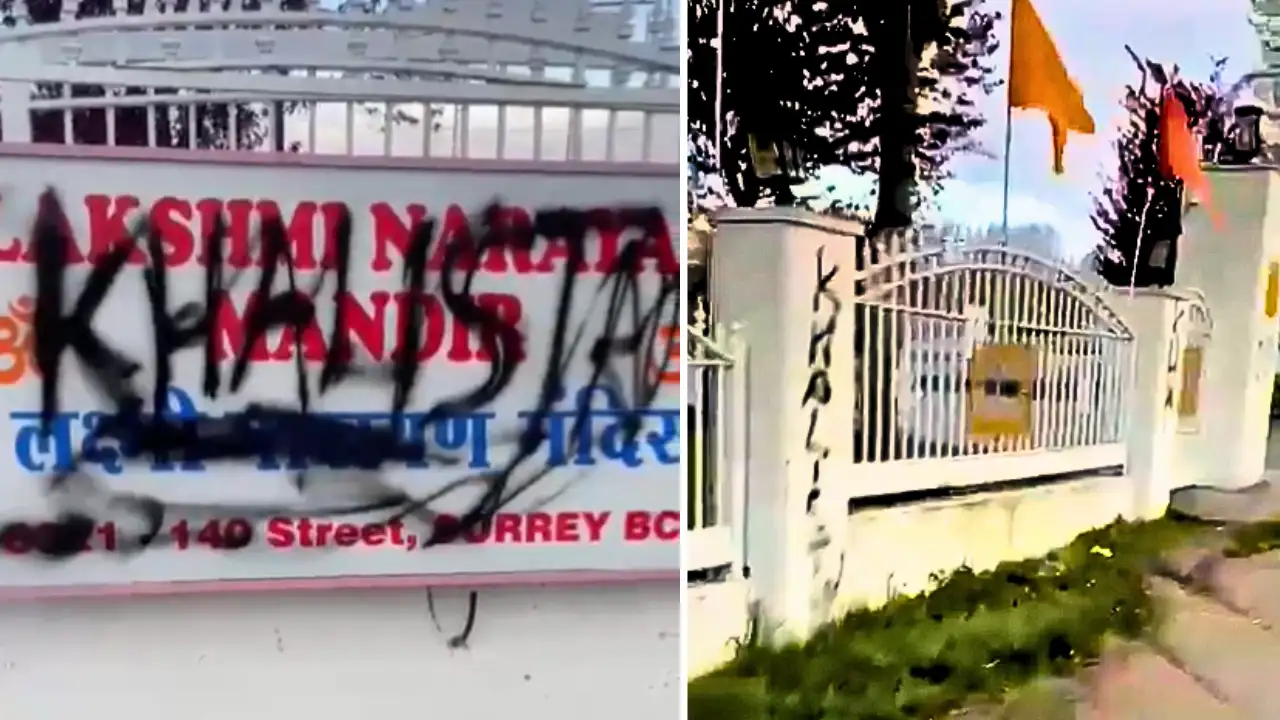
As Canada nears the final voting day of its federal election on April 28, disturbing acts of vandalism have reignited concerns over rising extremism and polarisation within the Indo-Canadian diaspora. Within the span of 24 hours on Saturday, both a gurdwara and a Hindu temple in Surrey were defaced with pro-Khalistan and anti-India graffiti, sending shockwaves through the multicultural communities of British Columbia.
The incidents coincided with the Khalsa Parade in Surrey, which drew over 550,000 attendees and was marked by open displays of Khalistani separatist symbolism, anti-India slogans, and deeply controversial “wanted” posters depicting Indian leaders, including Prime Minister Narendra Modi, Home Minister Amit Shah, and External Affairs Minister S. Jaishankar. Some videos circulating on social media reportedly featured hate speech directed at Indo-Canadians, particularly targeting Hindus with messages to “go back to their country.”
The Khalsa Diwan Society, which oversees the vandalised gurdwara, condemned the act as the work of “a small group of Sikh separatists seeking to instil fear and division.” In a public statement, the society said, “This act is part of an ongoing campaign by extremist forces that undermine the values of inclusivity, respect, and mutual support that are foundational to both Sikhism and Canadian society.” The Society emphasized that it has long promoted Sikh-Hindu unity and rejected Khalistani ideology.
Shortly after, at around 3:00 AM, Lakshmi Mandir, a Hindu temple in Surrey, was also vandalised. CCTV footage reportedly shows two men defacing the walls with hate slogans. This is the third time the temple has been targeted. Members of the temple management expressed frustration over the perceived inaction of both law enforcement and elected officials. “We do not feel like the police or the political establishment cares at all,” one temple representative told media.
Meanwhile, the political landscape has also come under scrutiny. Conservative Party Leader Pierre Poilievre faced backlash after visiting the Guru Nanak Mission Centre (GGNMC) in Brampton the same day—an institution that previously referred to Hardeep Singh Nijjar as a “martyr” and is viewed by many as sympathetic to the Khalistan movement. Poilievre was accompanied by MP Tim Uppal, whose family members have longstanding ties to pro-Khalistani advocacy groups, including the World Sikh Organisation.
These incidents come at a volatile moment in Canada’s political and social environment, especially as reports of foreign interference in elections, rising hate crimes, and diasporic polarisation continue to emerge. The Indian High Commission in Ottawa is expected to raise the matter diplomatically, while local South Asian leaders and interfaith coalitions are calling for an urgent, unified response.
Community advocates are urging political leaders—across all party lines—to condemn these acts unequivocally and work to ensure the protection of all cultural and religious institutions in Canada. There is growing sentiment that silence or political calculation in the face of such extremism risks fuelling deeper divides and undermines the very foundation of Canada’s inclusive and multicultural identity.
The vast majority of the Sikh diaspora in Canada remains committed to peaceful coexistence, cultural preservation, and civic engagement. The actions of a fringe minority must not be allowed to overshadow or define the broader community, which has made immense contributions to the fabric of Canadian society.
It is now more important than ever for political leaders, law enforcement, and civil society to work together to prevent hate-fueled acts and ensure that Canada remains a country where diversity is respected, voices are heard, and unity prevails over division.