

Global stock markets slipped Monday, with U.S. futures and the U.S. dollar also weakening after Moody’s Ratings downgraded the United States’ sovereign credit rating, citing Washington’s ongoing struggle to rein in rising national debt.
Futures for the S&P 500 dropped 1.2%, while the Dow Jones Industrial Average futures declined 0.8%. The U.S. dollar slipped to 144.92 yen from 145.65 yen, and the euro strengthened to $1.1254 from $1.1183. The yield on the 10-year U.S. Treasury note rose to 4.54% from 4.44% late Friday.
European markets also reacted negatively. Germany’s DAX edged down 0.1% to 23,733.96, Paris’s CAC 40 dropped 0.5% to 7,851.46, and Britain’s FTSE 100 lost 0.5% to 8,643.23.
In Asia, markets followed suit. China’s economic indicators disappointed, with retail sales up 5.1% year-over-year in April—below expectations—and industrial output growth slowing to 6.1% from March’s 7.7%. Analysts warned that this could signal rising inventories and weakening domestic demand. Julian Evans-Pritchard of Capital Economics noted, “After an improvement in March, China’s economy looks to have slowed again, with firms and households turning more cautious due to the trade war.”
Hong Kong’s Hang Seng Index dipped 0.1% to 23,332.72, while Shanghai’s Composite Index was flat at 3,367.58. Shares in Alibaba dropped 3.4% in Hong Kong after reports emerged that U.S. officials are investigating a potential Apple-Alibaba partnership to bring AI features to iPhones sold in China.
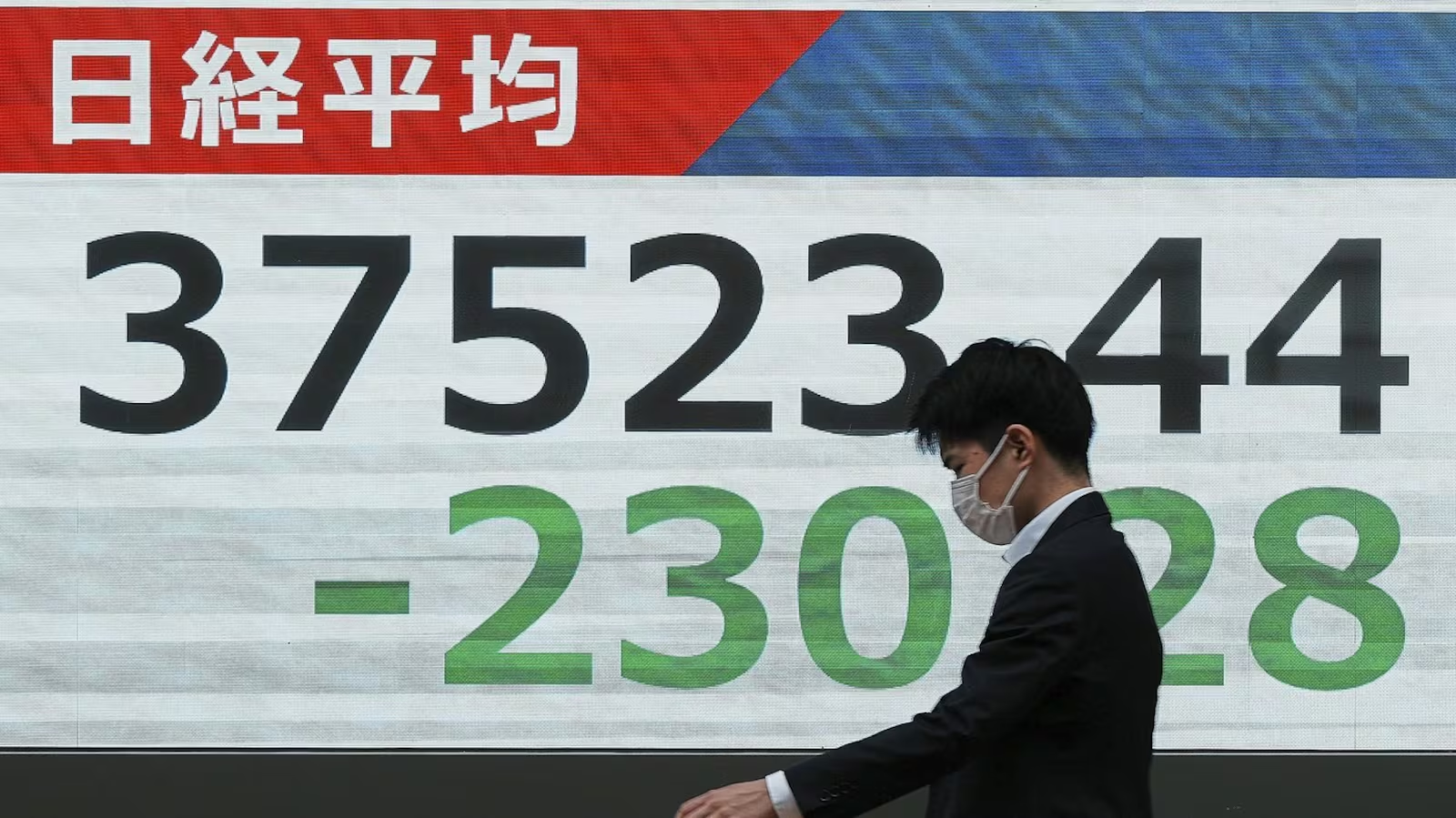
Japan’s Nikkei 225 fell 0.7% to 37,498.63, South Korea’s Kospi lost 0.9% to 2,603.43, Australia’s S&P/ASX 200 declined 0.6% to 8,295.10, and Taiwan’s Taiex led regional losses with a 1.5% drop.
Oil prices also retreated. U.S. benchmark crude fell 47 cents to $61.50 per barrel, while Brent crude dropped 50 cents to $64.91.
The decline comes after Wall Street ended last week on a positive note. The S&P 500 rose 0.7%, inching closer to its all-time high from February. The Dow gained 0.8%, and the Nasdaq climbed 0.5%, boosted by optimism over easing trade tensions.
Markets had been buoyed by the announcement of a 90-day pause in the escalating tariff battle between the U.S. and China, along with better-than-expected inflation reports, offering a glimmer of hope that the Federal Reserve may consider interest rate cuts later this year.
Still, consumer sentiment remains fragile. A University of Michigan survey found that Americans grew more pessimistic in May, although the decline in sentiment was milder than in previous months.
Meanwhile, in corporate news, Charter Communications rose 1.8% after announcing a merger with Cox Communications, a deal that would unite two of America’s biggest cable providers.
While recent data offered some positive signs, investors remain cautious amid ongoing uncertainty over global trade, inflation, and the broader economic outlook.