

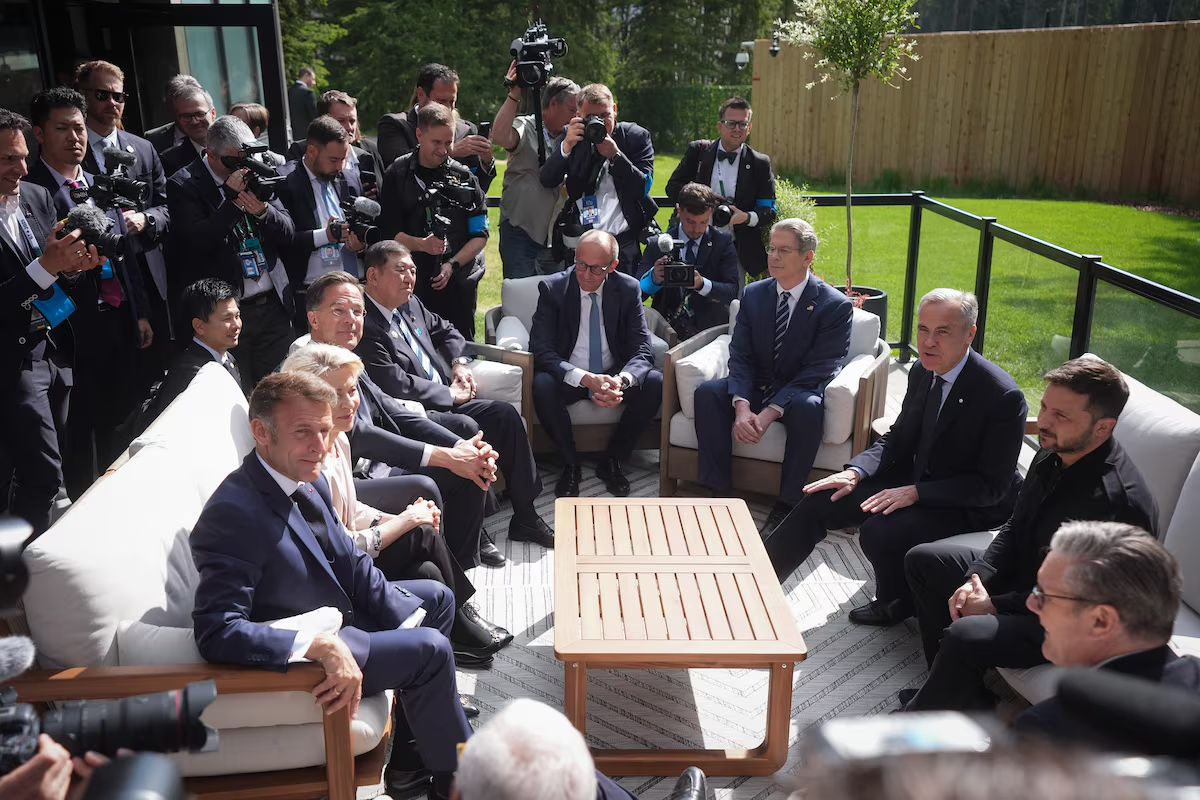
The G7 summit wrapped up in Alberta on Tuesday without a traditional joint communiqué, instead concluding with a series of targeted statements on six key global issues, including transnational repression, AI, quantum computing, and migrant smuggling. The absence of a unified closing document marked a departure from G7 tradition, even as leaders sought to demonstrate consensus through subject-specific declarations.
Noticeably absent was a collective statement on Russia’s invasion of Ukraine, despite the conflict being front and center throughout the summit. Instead, Canada used its role as host to lead with action. Prime Minister Mark Carney pledged $4.3 billion in new support for Ukraine—$2 billion in military aid for equipment such as drones and armored vehicles, and another $2.3 billion in infrastructure loans. The latter will be repaid using interest from frozen Russian assets in Europe.
Carney met with Ukrainian President Volodymyr Zelenskyy on Tuesday morning and forcefully condemned Russia’s latest attacks on Kyiv, which killed 12 people and injured over 130 in what Zelenskyy described as the deadliest bombardment of the capital this year. “This underscores the importance of standing in total solidarity with Ukraine,” Carney said, reiterating that G7 leaders discussed maximizing pressure on Russia to end the war.
Zelenskyy said Ukraine remains ready for peace negotiations and an unconditional ceasefire, but emphasized that sustained international pressure is essential to force Russia to the table.
While the summit lacked a consensus statement on Ukraine, both Canada and the UK independently announced new sanctions targeting Russia’s shadow fleet and energy revenues. Canada’s measures include sanctions against 77 individuals, 39 entities, and 201 vessels used to bypass sanctions through oil, gas, and arms transport.
Carney also reaffirmed Canada’s commitment to meeting its NATO defence spending target of two per cent of GDP—a milestone long delayed under previous governments. He brought that message directly to NATO Secretary-General Mark Rutte, who said that with Canada and Portugal boosting spending, all alliance members are now expected to hit the two per cent mark by 2025. NATO leaders are set to discuss a possible increase to five per cent during their upcoming meeting in The Hague.
Beyond Ukraine, the G7 worked with countries like Australia, India, and South Korea on a joint agreement to develop responsible critical minerals supply chains. A broader wildfire charter was also signed by leaders from Brazil, Mexico, and South Africa, focusing on prevention, response, and recovery.
Indian Prime Minister Narendra Modi attended several key sessions and is expected to meet Carney later in the day. His presence has stirred protests from Sikh separatist groups, particularly in the wake of ongoing RCMP investigations linking Indian government agents to the 2023 killing of Hardeep Singh Nijjar in British Columbia and other alleged crimes in Canada.
Adding to the summit’s turbulence, U.S. President Donald Trump exited the talks a day early, citing mounting violence in the Middle East. His absence was especially notable on a day centered around foreign policy—a key focus for Carney. U.S. Treasury Secretary Scott Bessent stayed behind to represent the American delegation.
On his return to Washington, Trump reignited controversy by suggesting Canada could benefit from becoming a U.S. state. “I think it’s a much better deal for Canada,” he said aboard Air Force One, before warning that if Canada doesn’t join, it will face heavy tariffs and would need to pay $71 billion to participate in the U.S.’s proposed “Golden Dome” missile defence system—an apparent mix-up with the Iron Dome.
As the summit closed, Carney’s leadership drew praise for turning attention to urgent international crises and securing actionable commitments, even in the absence of traditional unity. The statements signed may be shorter than a communiqué, but they reflect a G7 adapting to fractured global realities while still seeking coordinated influence.