

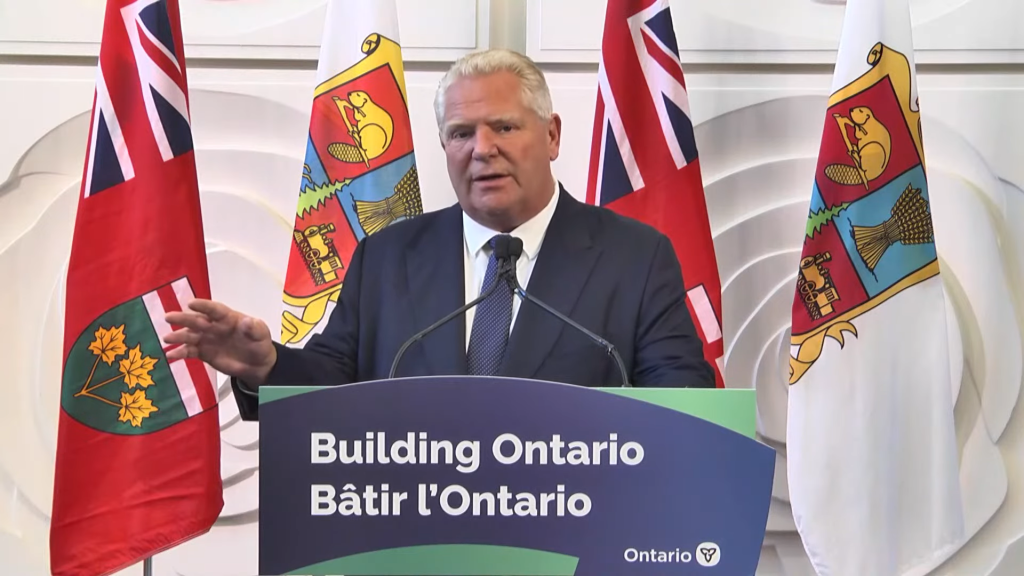
As Ontario’s snap election nears its final stretch, Progressive Conservative Leader Doug Ford is doubling down on his core campaign message: safeguarding the province’s economy against external threats. During a campaign stop in Ottawa on Tuesday, Ford pointed to renewed U.S. tariff threats under President Donald Trump, emphasizing the need for Ontario to be “ready for anything” over the next four years.
Ford’s comments come in response to Trump’s announcement that tariffs—delayed until March 4 following Canada’s agreement to implement new border security measures—are still set to take effect. Under Trump’s executive order, all Canadian imports would face a 25% tariff, with a reduced 10% levy on Canadian energy.
In a show of economic defiance, Ford suggested Ontario could retaliate by increasing the cost of electricity exports to the U.S. “We’re reviewing the cost of electricity we’re sending down there,” Ford said. “And if he puts tariffs on anything in Canada or Ontario, they’re getting a tariff on their electricity.” He did not provide further details on how such a measure would be implemented or how it would align with his previous pledge to cut off energy exports altogether if the tariffs take effect.
Ford’s stance on economic retaliation has been a defining feature of his campaign. Earlier this month, when tariffs seemed imminent, he vowed to tear up Ontario’s $100-million contract with Elon Musk’s SpaceX to provide high-speed internet to northern communities. The deal, along with a broader proposal to ban American companies from provincial contracts, was put on hold when the tariffs were temporarily delayed.
While Ford continues to frame his leadership as Ontario’s best defense against economic instability, his opponents have criticized the election itself as unnecessary. Liberal Leader Bonnie Crombie has repeatedly argued that Ford should have focused on diversifying Ontario’s economy and eliminating interprovincial trade barriers long before tariffs became a concern.
Speaking in Toronto on Tuesday, Crombie acknowledged that electricity exports could play a role in Ontario’s response to a trade war but cautioned that the province’s energy grid is deeply integrated with neighboring U.S. states. “It’s something we have to look at very closely,” she said.
However, Crombie’s campaign event was largely overshadowed by questions about her endorsement of federal Liberal leadership hopeful Mark Carney just two days before the election. Crombie defended her decision, calling Carney “the right person for this moment in time” and arguing that he has the expertise to stand up to Trump on trade issues.
Meanwhile, NDP Leader Marit Stiles continued her campaign in southwestern Ontario, making stops in London, Cambridge, and Waterloo, while Green Party Leader Mike Schreiner focused his efforts in cottage country, campaigning alongside his Parry Sound-Muskoka candidate, Matt Richter.
With just days left before Ontarians head to the polls, Ford is betting that voters will see him as the steady hand Ontario needs amid economic uncertainty. But whether his tough talk on tariffs resonates at the ballot box remains to be seen.