

Canadian retailers are reporting a spike in counterfeit currency, particularly during the busy holiday shopping season, prompting renewed warnings for businesses and consumers alike.
The Retail Council of Canada (RCC) says counterfeit cash is contributing to annual retail losses that exceed $9 billion nationwide. During the lead-up to the holidays, the council told CTV News that its members observed an increase in fake $20, $50 and $100 bills circulating in stores.
Some of the counterfeit notes are so sophisticated that they are increasingly difficult to detect. Michel Rochette, president of the RCC’s Quebec division, said criminals are producing high-quality fakes that closely mimic legitimate currency.
“We have seen a resurgence of very high-quality bills,” Rochette said. “They are extremely credible. The hologram is really well done, and you can’t tell them apart from the real thing. This shows we are dealing with increasingly organized criminal networks.”
CTV News public safety analyst Chris Lewis urged retailers to refresh staff training to help identify counterfeit money.
“Businesses need to educate their staff using reliable online resources that explain Canadian currency and its security features,” Lewis said. “While longer checkout lines may frustrate customers, businesses can’t afford the financial hit of accepting counterfeit bills.”
Inspect before you accept
The Bank of Canada advises retailers, employees and the public to examine the look and feel of high-denomination banknotes carefully. Large bills are the most attractive targets for counterfeiters.
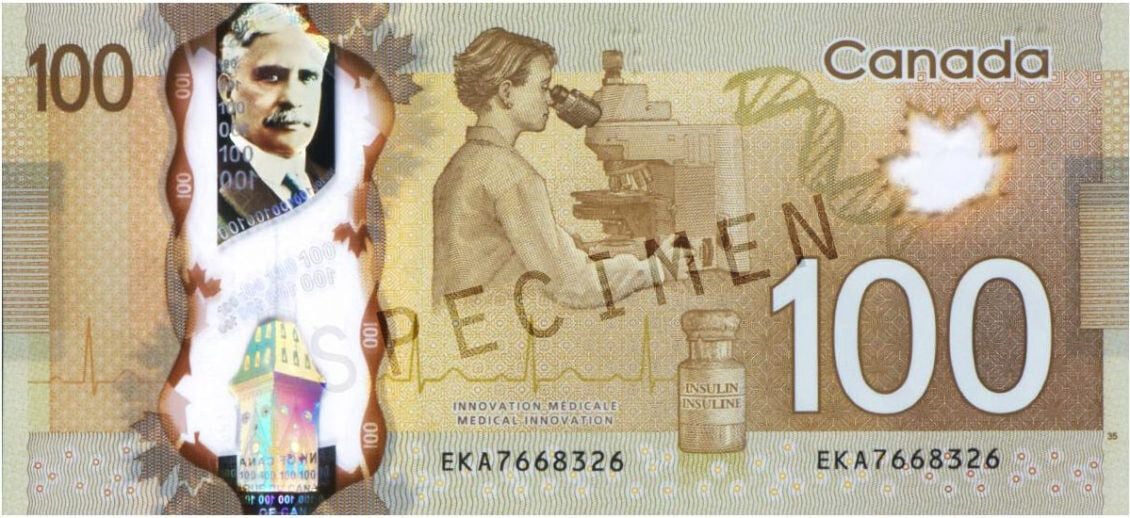
Canada’s polymer notes include a clear window on the right side of the bill. The $50 note features William Lyon Mackenzie King, while the $100 note displays Sir Robert Borden in both the main portrait and the window.
According to the Bank of Canada Museum, polymer banknotes are designed with vibrant colours and transparent windows that improve durability and make counterfeiting more difficult than with older paper notes.
If a cashier pauses to inspect a $20, $50 or $100 bill, the Bank of Canada advises customers not to take offence—it’s a necessary precaution.
Watch for security features
Cpl. Mitch Thompson of the Royal Canadian Mounted Police commercial crime section said careful inspection of security features is essential.
“When printed on polymer, some fake bills may look real if people don’t pay close attention to the embedded security elements,” he said in a previous news release.
Signs a bill may be counterfeit
The Winnipeg Police Service suggests watching for the following red flags:
- Slight differences in colour
- Images that appear worn or rub off easily
- Creasing in the middle of the note
- A paper-like texture instead of smooth polymer
- A holographic strip that lifts off the surface instead of being fully integrated
Bank of Canada data show that $50 and $100 bills are the most frequently counterfeited denominations.
A quick counterfeit checklist
Counterfeiters sometimes recreate the clear polymer window using a separate material and bond it to the note. If you feel a noticeable transition between the clear window and the opaque portion, the bill is likely fake.
Additional checks recommended by the Bank of Canada include:
- Inspect the window: Do the tiny numbers match the bill’s denomination? Does the portrait match the main image?
- Tilt the note: Do the images in the window change colour?
- Feel the ink: Is the main portrait printed in raised ink?
- Check the maple leaf window: Hold it up to a bright light—do you see tiny numbers?
If the answer to any of these questions is “no,” the note may be counterfeit.
No reimbursement for fake cash
Police warn that accepting counterfeit money—even unknowingly—comes with financial consequences.
“If you unknowingly accept counterfeit cash, you can’t be reimbursed,” Thompson said. “You’re responsible for the loss.”
Knowingly using or possessing counterfeit currency is a criminal offence, and smuggling fake money can result in charges under the Criminal Code and the Customs Act.
What to do if you suspect a fake bill
The Bank of Canada advises anyone who suspects a banknote is counterfeit to turn it over to local police.
If the bill is genuine, it will be returned. If not, reporting it helps authorities track counterfeiting activity.
“Timely reporting helps police and prosecutors bring counterfeiters to justice,” the Bank of Canada says.
As counterfeiters grow more sophisticated, officials say vigilance—and a few seconds of inspection—remain the best defence for both retailers and consumers.