

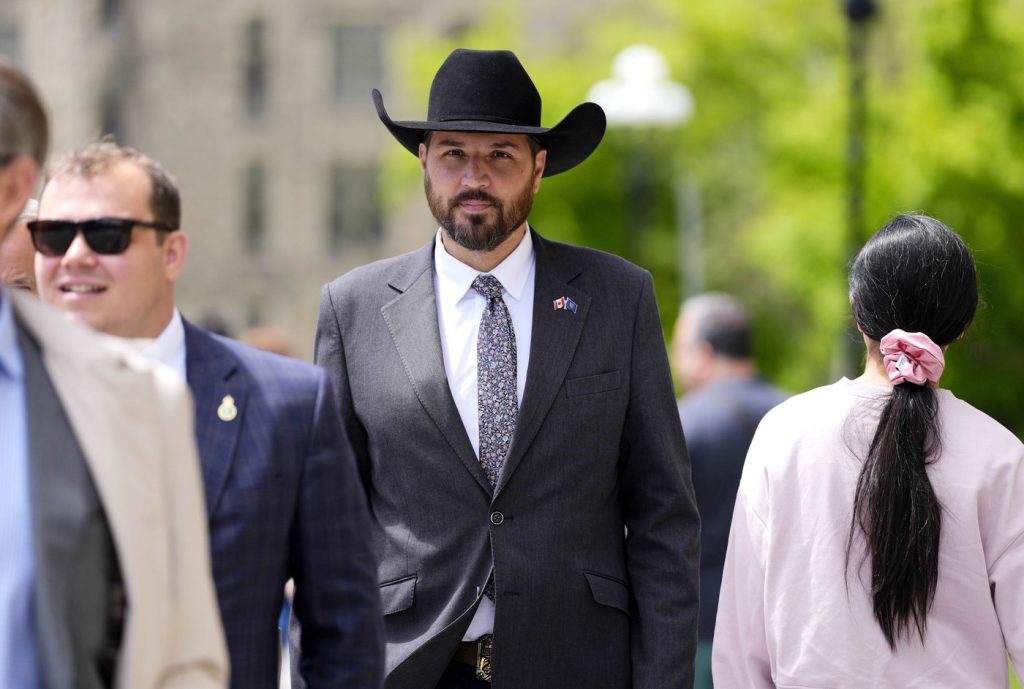
OTTAWA — As he prepares to step away from federal politics, outgoing Conservative MP Damien Kurek is making one final push to leave a lasting imprint on Canada’s identity — by proposing a new national symbol: a livestock brand.
Kurek, who represents Battle River—Crowfoot in Alberta, had introduced a bill in the last Parliament to adopt the brand, which features a maple leaf perched over a curved arch — or “inverted quarter circle” in branding terms. Though the bill stalled before the election, it has now been reintroduced by fellow Saskatchewan Conservative MP Steven Bonk, just as Kurek is poised to vacate his seat.
His early resignation could pave the way for Conservative Leader Pierre Poilievre to run in a byelection in Kurek’s riding, after Poilievre failed to hold his Carleton seat in Ottawa during the last general election. Tuesday marks the first day Kurek is permitted to formally resign under House of Commons rules.
Prime Minister Mark Carney has already indicated he will call a byelection in the riding as soon as legally possible.
While the legislation may now be out of his hands, Kurek is passionate about the symbolic significance of the livestock brand. “Among all of Canada’s national symbols, what’s missing is something that represents our Western and frontier roots — the people and the history that built not just Western Canada, but the entire nation,” he told reporters.
Beyond symbolism, Kurek sees the brand as a gesture of national unity — particularly timely as Alberta gears up for a potential referendum on separation next year amid growing discontent.
“At a time when I hear often that our national unity is in question, being able to symbolically say, ‘Western Canada matters,’ carries weight,” Kurek said. “But of course, it can’t stop at symbolism.”
He emphasized the importance of meaningful inclusion — including policies that ensure Alberta’s natural resources can reach global markets.
Kurek, whose great-grandfather registered a cattle brand known as the “J K quarter circle,” said the design resonates deeply with agricultural families like his. Though his family no longer farms, the brand has been passed down through generations, serving as a proud connection to their heritage.
His father, Jay Kurek, passed away last year at age 54 — a loss that deepened Damien’s commitment to preserving that legacy.
As he trades politics for life on the farm, Kurek hopes the brand proposal can live on in Parliament.
“It speaks to something bigger than oneself. Even if I’m not the one to carry it across the finish line, it means something to so many Canadians — and that’s what matters.”
If passed, the national livestock brand would join Canada’s official symbols alongside the flag, maple tree, beaver, hockey, the national horse, and the coat of arms — which Kurek notes also holds historical weight as a “heraldic symbol.”
The Culture Ministry says it is currently reviewing the proposed legislation and will respond once it reaches second reading in the House.