

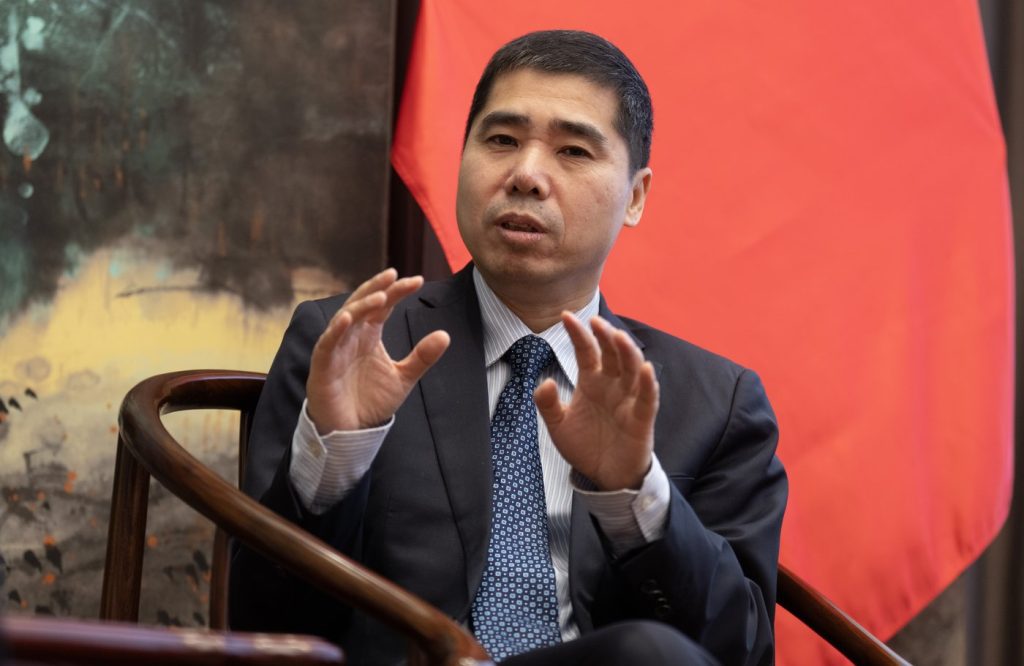
China’s ambassador to Canada is urging Ottawa to move swiftly to implement a series of agreements signed during Prime Minister Mark Carney’s visit to Beijing, saying both governments must act quickly to meet public and industry expectations in an increasingly unstable global environment. In his first interview since the trip, Chinese Ambassador Wang Di told The Canadian Press that progress will depend on mutual sincerity and timely follow-through on commitments made by both sides.
During Carney’s visit, he and Chinese President Xi Jinping agreed to resolve a tariff dispute that saw Beijing impose levies on Canadian agricultural products in response to Ottawa’s tariffs on Chinese electric vehicles. The two governments also signed memorandums aimed at reviving bilateral working groups and institutional mechanisms covering sectors such as finance, lumber, oil, green technology and tourism. Wang said these agreements are intended to accelerate communication between departments in both countries and generate tangible results.
Carney has said he plans to return to China in November for the Asia-Pacific Economic Cooperation summit in Shenzhen, giving officials roughly 10 months to demonstrate progress. Wang said that timeline should be treated as a deadline for action, allowing the two leaders to assess the future of bilateral relations “at a higher level” when they meet again.
The renewed engagement, however, stops short of sectors Ottawa considers sensitive to national security, including artificial intelligence, critical minerals and defence—areas analysts say could also draw concern from Washington during ongoing continental trade discussions. Wang acknowledged those sensitivities and said Beijing is focused on advancing cooperation in areas that remain open, repeating China’s long-standing position of “seeking common ground while reserving differences.”
Carney has described his approach as a recalibration rather than a full reset of Canada’s relationship with China, maintaining concerns over foreign interference, human rights and regional security while emphasizing economic cooperation in public messaging. That stance has raised questions about the future of Canada’s Indo-Pacific strategy, released in 2022, which described China as a disruptive global power and sought to limit Canada’s economic exposure to Beijing. Wang said the strategy caused serious concern in China and argued it is inconsistent with the idea of a new strategic partnership promoted by the current Canadian government.
While analysts continue to urge caution, warning against allowing economic incentives to mute criticism on contentious issues, Wang said businesses and citizens in both countries are looking to leaders for stability and opportunity. He added that translating last week’s agreements into concrete outcomes is now essential and expressed hope that ties will deepen further when Foreign Affairs Minister Anita Anand hosts her Chinese counterpart, Wang Yi, in Canada later this year.