

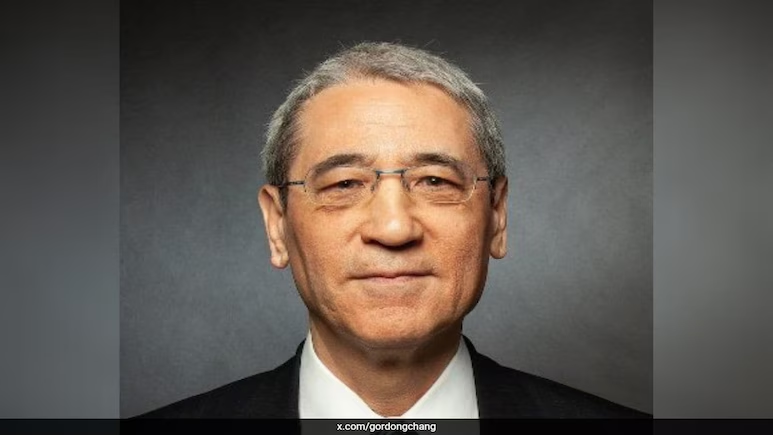
In a chilling warning, Gordon G. Chang, a leading American expert on China, has raised the alarm about the threat of biological and agricultural warfare following the recent arrest of two Chinese scientists accused of smuggling a dangerous fungus into the United States. Chang, speaking to Fox News, described the situation as a form of “agroterrorism” that could escalate into a crisis “worse than COVID.”
The Fungus and the Charges
The U.S. Department of Justice revealed that Yunqing Jian (33) and Zunyong Liu (34) conspired to smuggle Fusarium graminearum, a toxic fungus, into the U.S. The pathogen is known for causing head blight—a severe disease that affects major crops like wheat, barley, maize, and rice. The fungus is classified as a potential agroterrorism agent due to its capacity to damage food security and public health.
The fungus not only devastates crops but also produces mycotoxins that are harmful to both humans and livestock—causing vomiting, liver damage, and reproductive issues.
According to U.S. authorities, both suspects had previously conducted research on the fungus in China and were allegedly attempting to continue working with it inside the United States without proper authorization.
Gordon Chang: “This Is War”
Gordon Chang, author of China Is Going to War, interpreted the smuggling attempt as a broader campaign by the Chinese Communist Party (CCP) against the U.S. In an interview with Fox News, he declared:
“This was an attack on the United States at a time when China believed it was at war with us.”
Chang referenced a 2019 editorial in China’s People’s Daily, which he said explicitly referred to a “people’s war” against the U.S. He warned that such language, while often overlooked by Americans, carries significant implications in CCP rhetoric—suggesting justification for covert aggression.
A Broader Pattern? Seeds, Fentanyl, and Fungus
Chang contextualized the smuggling within a larger pattern of hostile behavior:
- In 2020, Americans across all 50 states reported receiving unsolicited seed packets from China, raising fears of invasive species being introduced intentionally.
- In 2025, similar incidents occurred involving seed packets from Temu, a Chinese online retailer.
- He also linked this case to the ongoing fentanyl crisis, where synthetic opioids—many originating from China—continue to flood U.S. communities.
“Sever All Ties With China”
Chang made an extreme but clear recommendation: total diplomatic and economic severance with China.
“The only way to stop this is to sever relations with China. And I know people think that’s drastic, but we are being overwhelmed,” he said. “Xi Jinping talks about going to war all the time, and he is mobilizing all of Chinese society for it. We’re not defending ourselves with the vigour and determination that’s necessary.”
Chang even went so far as to say that those involved in such acts should be sent to Guantanamo Bay, emphasizing that national security should trump diplomatic hesitation.
The Bigger Picture
This controversy arises amid already strained U.S.-China relations. Issues ranging from intellectual property theft, military expansion in the Indo-Pacific, aggressive cyber campaigns, and espionage cases have only added to mounting suspicion between the two superpowers.
The Fusarium case adds a new layer: the possibility of agricultural sabotage—a silent, yet potentially devastating form of warfare targeting a nation’s food supply and economic stability.
While the full extent of the smuggling case remains under investigation, Gordon Chang’s stark warning has reignited national debate on how the U.S. should respond to covert threats from adversaries like China. Whether his recommendation to “sever ties” is heeded or not, one thing is clear: America’s vulnerability to non-traditional forms of attack is now squarely in the spotlight.