

A sobering new global study warns that rising temperatures could slash the production of key food crops in the United States by up to 50% by the end of the century, with profound implications for global food security. The study, published in Nature and conducted over eight years, offers one of the most comprehensive assessments to date of how climate change is poised to transform agriculture worldwide—and the limits of our ability to adapt.
Led by scientists from Stanford and the University of Illinois, the research analyzed six staple crops—maize, soybeans, rice, wheat, cassava, and sorghum—across 12,000 regions in 54 countries. These crops account for over two-thirds of the world’s caloric intake. The findings are alarming: for every 1°C increase in global temperature above pre-industrial levels, global food production drops enough to strip the equivalent of 120 calories per person per day from the global diet. At 3°C of warming—where the world is currently headed—that’s roughly like everyone skipping breakfast, every day.
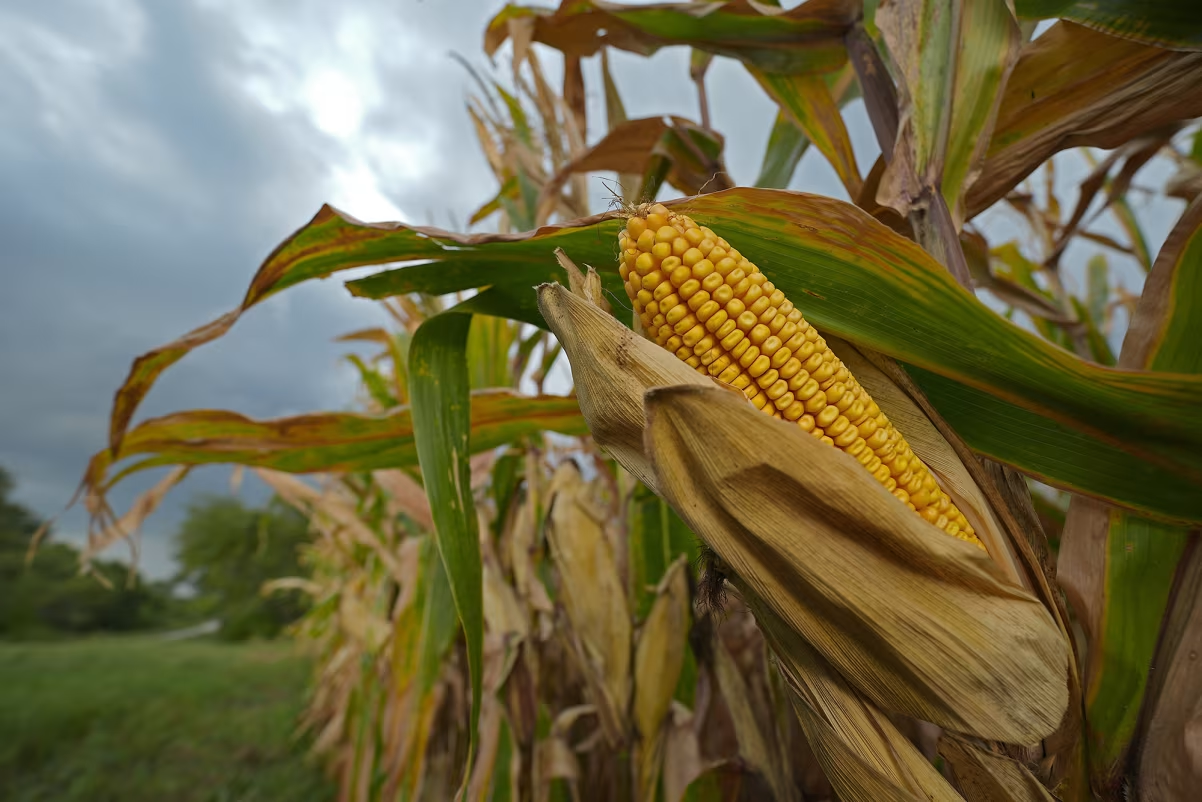
In high-emissions scenarios, maize yields in the U.S. Corn Belt could fall by 40%, while wheat and soybean yields across the U.S., China, Russia, and Canada could see similar drops. Soybean production in the U.S. alone is expected to decline by as much as 50%. Of the six crops studied, rice may be the only one to avoid major losses, with warming nighttime temperatures potentially boosting yields.
One of the most striking findings is that wealthier nations—particularly the U.S.—stand to lose the most. While low-income countries already operate under harsher conditions and have developed some resilience, advanced economies like the U.S. and parts of Europe are heavily optimized for today’s temperate climate. That optimization becomes a liability under extreme heat, drought, and shifting precipitation patterns.
“We’re looking at a future where the U.S. Midwest, today’s breadbasket, might no longer be able to sustain corn and soybean production as it does now,” said co-author Andrew Hultgren of the University of Illinois Urbana-Champaign.
Still, low-income nations are far from immune. The study shows cassava, a vital subsistence crop in sub-Saharan Africa, will also suffer under extreme heat despite its reputation for drought resilience—posing a serious threat to food access for some of the world’s poorest populations.
The study also evaluated farmers’ current adaptive strategies, including changing irrigation practices and crop varieties. While some adaptation is already happening, experts warn it is nowhere near enough. “This shows the importance of adaptation but also its limits,” said Shelby McClelland, a climate and agriculture expert at NYU. Another climate expert, Erin Coughlan de Perez of Tufts University, pointed out that while the study is groundbreaking, it doesn’t fully account for adaptation strategies like shifting planting dates or crop locations—changes already being observed in the U.S.
Still, the broader message is clear: current adaptation is insufficient, and political will is lagging. “The data pile up. The politicians turn a blind eye,” said food policy expert Tim Lang of City St George’s, University of London. “The global wriggle room diminishes.”
Lead author Solomon Hsiang of Stanford hopes the study forces policymakers to reckon with the massive consequences of inaction. “This is a major problem. It’s incredibly expensive,” he said. “As a species, we have never confronted anything like this.”
With global warming threatening the stability of the food system itself, the time to act—on energy, land use, and emissions—is rapidly running out.