

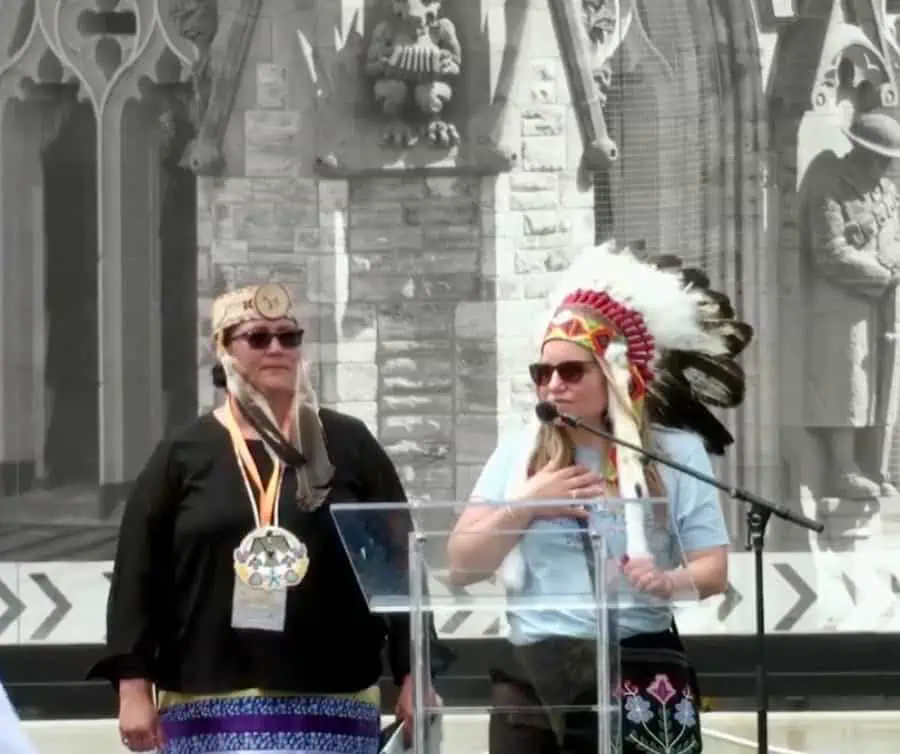
First Nations leaders from across Ontario gathered on Parliament Hill Tuesday in a powerful show of resistance against Bill C-5, federal legislation designed to accelerate the development of large-scale infrastructure and economic projects across Canada. The proposed law, called the One Canadian Economy Act, promises to eliminate federal barriers to internal trade and labor mobility while advancing so-called “nation-building” projects. However, it is drawing sharp criticism for bypassing meaningful consultation with Indigenous communities whose lands and rights may be directly impacted.
About 350 First Nations members, allies, and leaders brought drums, signs, and their voices to Ottawa, calling out what they see as a blatant exclusion from a process that deeply affects their sovereignty and future. Mississaugas of Scugog Island First Nation Chief Kelly LaRocca addressed the crowd, praising Indigenous youth for standing strong. “The youth bring us hope and I want to say chi-miigwech to all of you. We stand on the shoulders of giants. I heard the words ‘by any means necessary,’ and I think we ought to really think about what that means,” she said.
While Prime Minister Mark Carney insists the bill is essential to counter unjustified trade tariffs and boost Canada’s productivity and energy security, the legislation does not currently include any formal provisions for Indigenous consultation. Though Carney has promised to form an Indigenous Advisory Council, critics point out that no such clause appears in the bill’s text.
The opposition intensified as leaders from the Chiefs of Ontario, including delegates from their annual assembly at Hiawatha First Nation, traveled to join the rally. Nishnawbe Aski Nation Grand Chief Alvin Fiddler, who represents 49 northern Ontario First Nations, warned of strong resistance ahead if the government moves forward without Indigenous consent. “We will not sit idly by and watch any government come to our territory and take whatever they want,” he said.
The Chiefs of Ontario passed an emergency resolution opposing both the content of the bill and what they call an undemocratic attempt to rush it through Parliament without hearings or proper study. Ontario Regional Chief Abram Benedict emphasized that First Nations are not against development, but demand a rightful place at the table. “We want to build and we want to partner. But we cannot accept a law that can remove us from the consultation process,” he stated.
Concerns also center around a provision in the bill that allows cabinet to designate projects as being in the national interest—effectively guaranteeing federal approval regardless of potential impacts on Indigenous rights, environmental integrity, or public health. “This is not how partners are treated,” said Temagami First Nation Chief Shelly Moore, who introduced the emergency resolution. “Our rights are not obstacles. They are the foundation of this country’s future.”
Federal Indigenous Services Minister Mandy Gull-Masty acknowledged the backlash and stated that any legislation must be viewed through an Indigenous lens. She noted that Prime Minister Carney is open to new approaches from the cabinet’s Indigenous caucus.
First Nations leaders are also raising the alarm about similar legislation at the provincial level. Ontario’s Bill 5—the Protect Ontario by Unleashing Our Economy Act—proposes the creation of special economic zones where environmental and regulatory protections could be bypassed to accelerate resource development, especially in the mineral-rich Ring of Fire region. Indigenous communities fear the erosion of land rights and insufficient environmental oversight.
As tensions escalate, Indigenous leaders are preparing for what they describe as a “long, hot summer” of resistance if the government continues to ignore calls for meaningful engagement and respect for Indigenous sovereignty.