

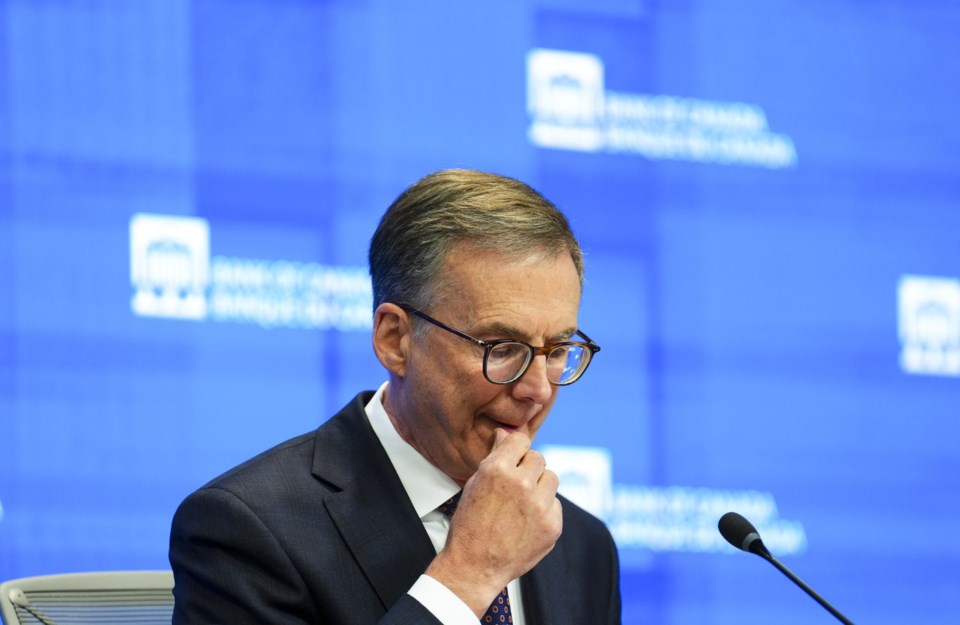
OTTAWA — The Bank of Canada is widely expected to leave its benchmark interest rate unchanged this week, closing out a turbulent 2025 marked by trade tensions, shifting forecasts and unpredictable economic signals. Economists say the central bank is poised to move to the sidelines after months of navigating unprecedented uncertainty.
The policy rate sits at 2.25 per cent heading into Wednesday’s final decision of the year — a full percentage point lower than where it began in January. Financial markets see a near-certain outcome: LSEG Data & Analytics estimates a 93 per cent chance the bank will hold the rate steady.
A string of stronger-than-expected economic indicators has solidified that outlook. Canada posted surprisingly robust job gains this fall, and real GDP grew at an annualized 2.6 per cent in the third quarter — enough momentum, analysts say, to keep the central bank from cutting further.
“Pulling these strands together, there is now no doubt the bank will stand aside,” BMO chief economist Doug Porter wrote in a note to clients.
The Bank of Canada has already delivered four quarter-point cuts this year — two early in 2025 and two in the fall — while pausing throughout the spring and summer amid intense uncertainty over U.S. tariffs and Canada’s retaliatory measures. Those trade shocks made forecasting inflation unusually difficult, forcing the bank to abandon its traditional economic projections for much of the year in favour of scenario modelling.
Governor Tiff Macklem repeatedly warned that policymakers needed clarity on how tariffs would feed into consumer prices. The fear was a rare “stagflation-like” shock — a mix of slowing growth and rising inflation — as companies reconfigured supply chains and costs increased even while demand softened.
“I think the Bank of Canada did act prudently through this period of heightened uncertainty,” said Randall Bartlett, deputy chief economist at Desjardins.
Only after its second consecutive rate cut in October did the bank return to a normal forecasting approach, projecting weak growth of about 0.75 per cent for the second half of 2025 followed by a modest recovery in later years. With tariffs now better understood and the federal budget passed, analysts say monetary policy has room to step back and let fiscal measures carry more of the load.
Bartlett expects the central bank to remain on hold not only this week, but throughout all of 2026. After guiding the economy through the initial tariff shock, he said, “the Bank of Canada is probably satisfied with its work to date.”
The coming year will bring another major question: how the bank’s mandate will evolve when it is renewed in 2026. Officials acknowledged earlier this year that core inflation measurements were distorted by one-off policy changes, including tariff effects and the removal of the consumer carbon price. Economists will be watching closely to see how the bank adjusts its tools to better capture underlying price pressures.
For now, the message from forecasters is clear — after a year of uncertainty and shifting expectations, the Bank of Canada appears ready to press pause and watch how the economy absorbs the shocks of 2025.