

The Federal Court of Appeal is expected to rule today on whether the Liberal government acted reasonably when it invoked the Emergencies Act in early 2022 to respond to weeks-long protests in downtown Ottawa and disruptions at key Canada–U.S. border crossings.
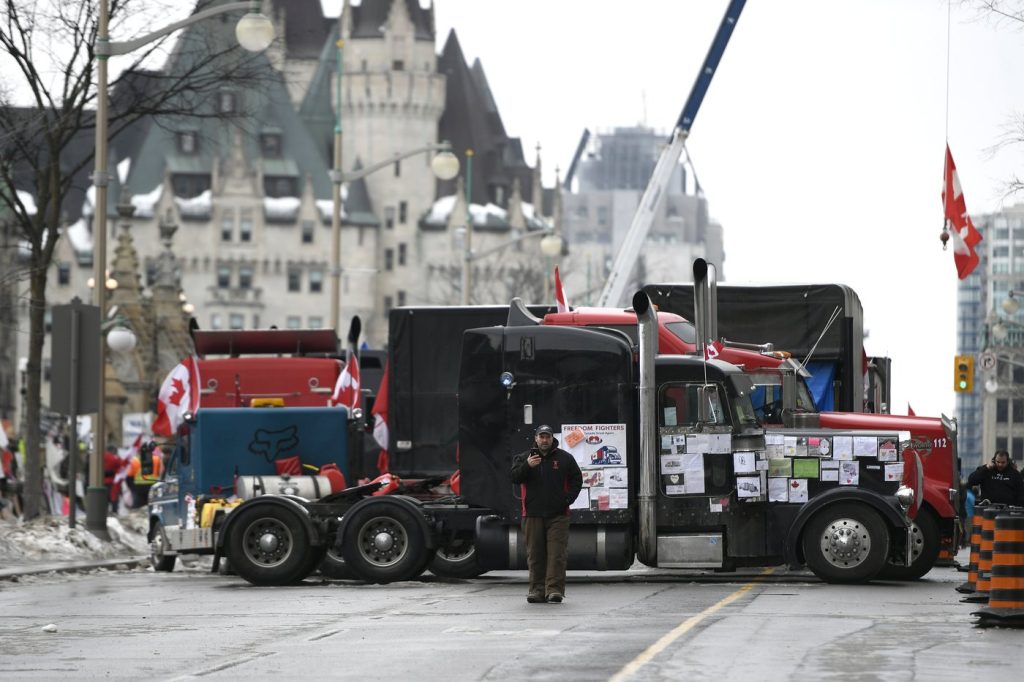
For nearly three weeks in January and February 2022, large demonstrations—many involving tractor-trailers—occupied streets near Parliament Hill. The protests brought constant horn-blaring, diesel fumes and makeshift encampments, including a hot tub and a bouncy castle, as participants settled into the city core.
The prolonged presence strained Ottawa residents and businesses. Some shops closed temporarily, while residents reported noise, pollution and incidents of harassment. Authorities also faced blockades at major border points, including Windsor, Ont., and Coutts, Alta., disrupting cross-border trade.
While many participants said they were protesting COVID-19 public health measures, the demonstrations also drew people with broader grievances against then–prime minister Justin Trudeau and his government, including individuals linked to far-right movements.
On Feb. 14, 2022, the federal cabinet invoked the Emergencies Act for the first time since the legislation replaced the War Measures Act in 1988. The declaration authorized temporary measures such as restrictions on public assemblies, the designation of secure areas, directions to financial institutions to freeze certain assets, and bans on providing support to protest participants.
In a letter to provincial premiers the following day, Trudeau said the government believed Canada was facing “a national emergency arising from threats to Canada’s security.”
A mandatory post-event review by the Public Order Emergency Commission concluded in early 2023 that the government had met the high legal threshold required to invoke the act.
The decision was also challenged in court by the Canadian Civil Liberties Association and other groups and individuals, who argued the federal government lacked sufficient legal grounds to impose the emergency measures.
The government maintained that its actions were targeted, proportionate and time-limited, and that they complied with the Canadian Charter of Rights and Freedoms.
In a January 2024 ruling, retired Federal Court judge Richard Mosley disagreed. He found that the government’s decision did not meet the standard of reasonableness—lacking adequate justification, transparency and intelligibility—and was not supported by the relevant facts and law. Mosley concluded there was no national emergency warranting the use of the Emergencies Act and said the measures infringed constitutional rights.
The federal government appealed that decision.
During hearings last February, government lawyer Michael Feder argued before the Federal Court of Appeal that the trial judge improperly assessed the government’s actions with the benefit of hindsight.
Feder said the peaceful de-escalation that followed was itself influenced by the emergency measures. “Who, outside of a courtroom, would seriously suggest the situation was going to get better in the absence of emergency measures?” he asked.
He told the court that the government only needed reasonable grounds—not a flawless assessment—to conclude that the statutory conditions for invoking the act had been met.
“The government’s conclusion doesn’t have to be perfect,” Feder said. “It just has to be reasonable.”