

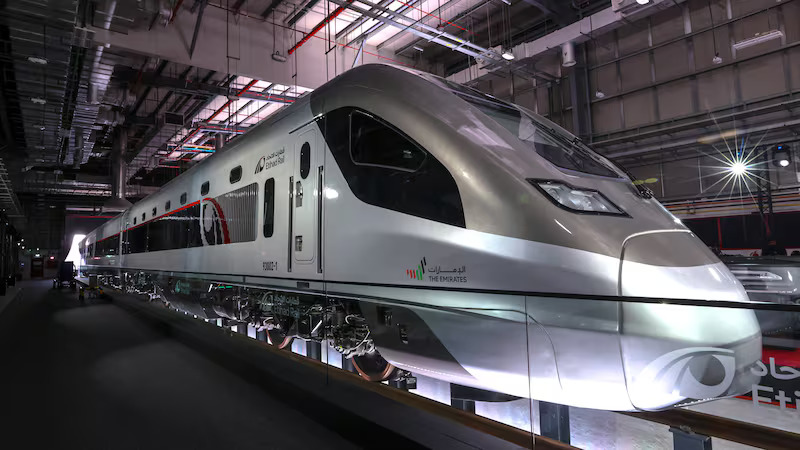
New 30-Minute Rail Link to Transform UAE’s Transportation Landscape
A groundbreaking high-speed rail service between Abu Dhabi and Dubai was officially announced on Thursday, marking a significant milestone in the UAE’s transport sector.
According to the Abu Dhabi Media Office, the new Etihad Rail line will cut the journey time between the two emirates to just 30 minutes, with trains running at speeds of up to 350kph. The route will connect “key destinations and tourist attractions,” enhancing mobility across the region.
The electrified high-speed line will include six strategically located stations: Reem Island, Yas Island, Saadiyat Island, Zayed Airport, Al Maktoum Airport in Dubai, and Jaddaf near Dubai Creek. While detailed designs and specific locations for the stations are yet to be disclosed, officials emphasized that additional areas could be included in future phases.
Sheikh Khaled bin Mohamed, Crown Prince of Abu Dhabi, and Sheikh Hamdan bin Mohammed, Crown Prince of Dubai and Deputy Prime Minister, attended the announcement ceremony at Al Faya Depot in Abu Dhabi.
“This project reflects the nation’s vision to advance infrastructure and elevate mobility services to world-class standards,” Sheikh Khaled said, as reported by state news agency WAM. Sheikh Hamdan highlighted how the new service would transform daily commutes, benefiting citizens, residents, and tourists alike.
Sebastien Mangeant, Executive Director for High-Speed Rail at Etihad Rail, shared insights into the project’s transformative potential. “Commuters can expect a high-frequency service that ensures safer and faster travel while reducing the need for long car journeys,” he said. Mangeant also emphasized the railway’s role in boosting tourism and improving travel safety.
The project’s initial phase will feature trains capable of carrying 400 to 600 passengers, depending on the stock. The network is expected to provide a seamless experience for travelers, integrating with metro and bus lines to ensure connectivity.
The high-speed service is distinct from the previously announced Etihad Rail passenger line, where trains will travel at 200kph and operate on the same tracks as the UAE’s freight trains. While there is no confirmation yet on whether the two services will be fully integrated, officials hinted at ongoing efforts to create a cohesive transportation network.
High-speed rail systems are renowned for their efficiency, reducing travel times while easing congestion on roads and cutting emissions. The Etihad Rail project is no exception. Officials estimate the new line will contribute Dh145 billion ($40 billion) to the UAE’s GDP over the next 50 years.
“This is not just a transportation project; it’s a catalyst for economic growth and sustainable development,” Mangeant added.
Beyond the high-speed line, Etihad Rail’s main passenger network will link 11 cities and regions across the UAE. A regular rail service connecting Abu Dhabi to Dubai is expected to take 57 minutes, with plans to expand to Fujairah and Sharjah. Officials project that more than 36 million passengers will use the network annually by 2030.
The UAE’s vision also extends beyond its borders. A rail link between the UAE and Oman is under development, with Hafeet Rail—a partnership involving Etihad Rail, Oman Rail, and Mubadala Investment Company—spearheading the project. This network will connect Abu Dhabi to Sohar, with travel times as short as 1 hour 40 minutes.
While the official start date for the high-speed rail service remains undisclosed, tenders for construction contracts have been issued, and network designs have been approved. Construction is expected to begin soon, with the first phase focused on laying the foundation for a high-speed, environmentally sustainable transportation system.
Officials are confident that the project will redefine mobility in the UAE, setting a new standard for travel and solidifying the nation’s position as a global leader in transportation innovation.