

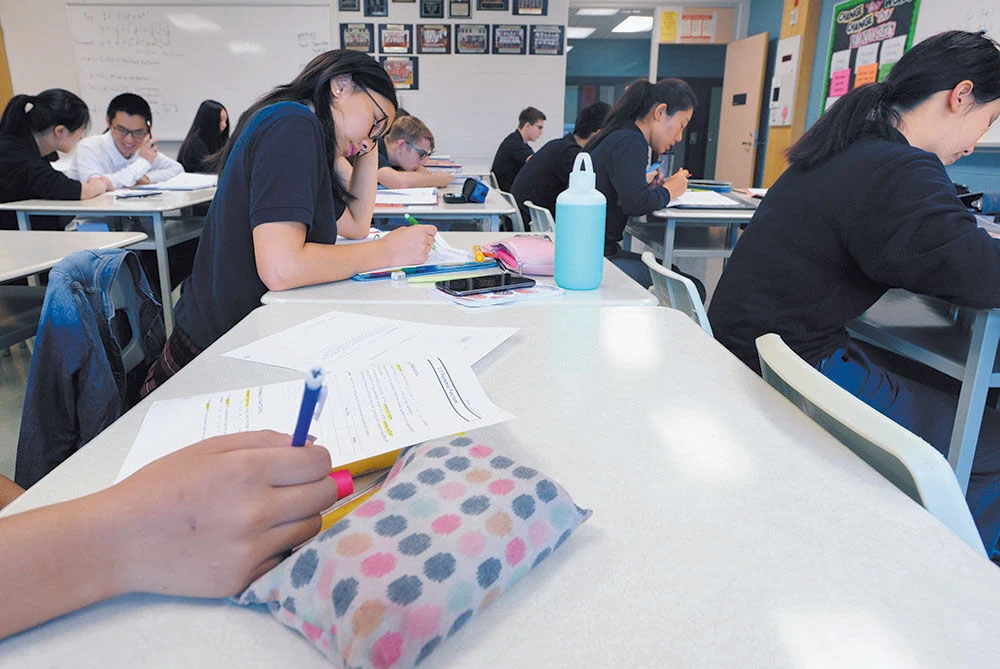
TORONTO — Ontario high school students are heading into the 2026-27 school year under significant new academic requirements, with written final exams carrying greater weight, attendance affecting grades and financial literacy becoming a graduation requirement.
The changes mean students and parents will need to pay closer attention not only to classroom performance, but also to attendance, final examinations and the completion of new financial education requirements.
Under the new provincial rules, students in Grades 9 and 10, as well as students entering high school in future years, will be required to successfully complete a financial literacy component in order to earn an Ontario Secondary School Diploma.
The requirement will be incorporated into the compulsory Grade 10 Career Studies course and will include learning modules and assessment questions developed by TVO.
Students will be required to achieve at least 70 per cent on the financial literacy component. They will have two opportunities during the Grade 10 course to successfully complete it, and the assessment can account for up to five per cent of their final Career Studies mark.
Once successfully completed, the financial literacy graduation requirement will be recorded on the student’s Ontario Student Transcript.
The province is also placing greater emphasis on traditional written examinations.
For students in Grades 9 and 10, written final exams in English, mathematics, Canadian and world studies, and science will generally account for 20 per cent of the final course grade. In many other courses, the written examination will account for 10 per cent, accompanied by a final culminating task worth another 10 per cent.
The stakes become even higher in senior grades. For Grades 11 and 12, written final examinations in English, mathematics and science will account for 25 per cent of the final grade. Other courses will generally have written exams worth between 10 and 15 per cent, along with culminating assignments worth another 10 to 15 per cent.
Written final examinations will normally take place during designated examination periods, with the Grade 9 EQAO mathematics assessment treated separately.
Another major change involves attendance.
Under the new framework, attendance and classroom engagement will play a role in determining a student’s final mark. Attendance-related evaluation will account for 15 per cent of the mark in Grades 9 and 10 and 10 per cent in Grades 11 and 12.
The policy distinguishes between excused and unexcused absences. Legitimately excused absences will not negatively affect a student’s grade.
Examples can include absences for medical reasons, mental-health concerns, bereavement, recognized cultural or religious observances, certain school activities and situations in which severe weather prevents students from attending school.
Family vacations and other planned absences may require parents or guardians to submit a written request to the school specifying the period during which the student will be away.
Students absent for 15 consecutive school days may be classified as being on a prolonged absence and could be required to provide supporting documentation.
Repeated unexplained absences, particularly when combined with limited classroom participation, could significantly reduce the attendance and engagement portion of a student’s grade.
Grade 9 mathematics students will see another important change. The annual Education Quality and Accountability Office mathematics assessment will now account for 20 per cent of a student’s final mathematics mark.
Ontario’s restrictions on cellphone use in schools also remain in effect.
Students from kindergarten through Grade 6 generally cannot use cellphones or other personal mobile devices during the school day unless specifically permitted for educational or other authorized purposes. Students in Grades 7 through 12 are generally prohibited from using their phones during instructional time unless directed by their teacher.
Taken together, the changes represent a significant shift in how Ontario evaluates high school students.
The province is placing renewed emphasis on written examinations, regular attendance, classroom participation and practical financial knowledge — meaning students will have to demonstrate consistent performance throughout the semester rather than relying primarily on assignments and projects.
For parents, the new system also makes monitoring attendance and understanding assessment requirements increasingly important.
With exams carrying as much as one-quarter of the final grade in some senior courses and attendance forming a separate component of assessment, missing classes without an accepted reason could have greater academic consequences than in previous years.
The financial literacy requirement, meanwhile, is intended to ensure young Ontarians leave high school with practical knowledge that can help them manage money, make financial decisions and prepare for adult life.
For Ontario’s high school students, the message for the new academic year is clear: showing up, preparing for exams and learning how to manage money will all matter more on the road to graduation.