

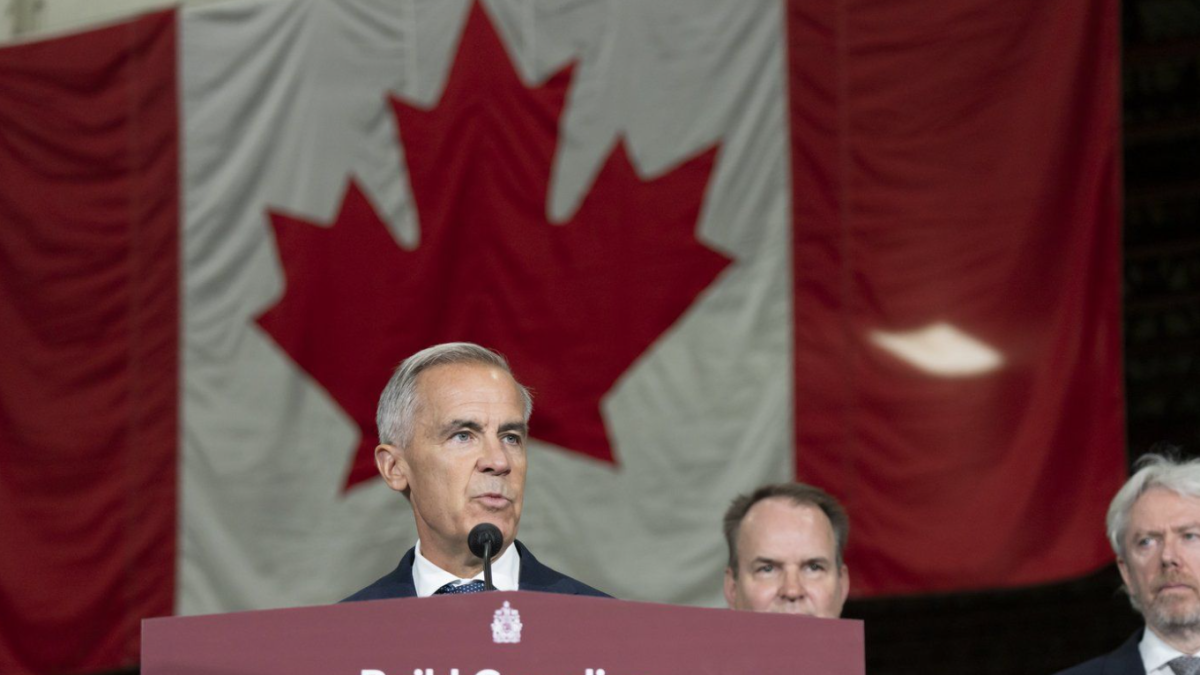
THUNDER BAY, Ont. — Prime Minister Mark Carney is pushing back against claims from senior members of U.S. President Donald Trump’s administration that Canada deliberately derailed trade negotiations for domestic political advantage, as tensions between the two countries continue to escalate.
Speaking Thursday at a news conference in Thunder Bay, Carney rejected suggestions from U.S. officials that his government walked away from a potential agreement because confronting Trump would benefit the Liberals politically in Canada.
Carney questioned whether appointed members of the U.S. administration were in a position to judge the political motivations of the Canadian government, maintaining that Ottawa’s decisions were based on protecting Canada’s economic and national interests.
The prime minister was in Thunder Bay to announce a $4.7-billion contract for Alstom’s local manufacturing plant to build passenger rail cars for VIA Rail. Carney pointed out that VIA Rail cars had previously been manufactured in the United States, presenting the new investment as another example of Canada strengthening its domestic industrial capacity at a time of deteriorating economic relations with Washington.
Relations between the two longtime allies have become increasingly strained since trade negotiations broke down last month. The United States has imposed tariffs of 50 per cent on a range of Canadian products, including cement, honey and hockey sticks, while Canada is preparing to introduce retaliatory duties next week.
Shortly after Carney’s remarks, Trump escalated the war of words on social media, accusing Canadian politicians of portraying him as an enemy for political benefit. Trump warned that such a strategy could ultimately hurt Canada’s economy and become politically damaging for Carney.
Canadian and American officials have traded accusations since negotiations were suspended, with each side alleging that the other introduced unacceptable demands during the final stages of talks.
Carney has maintained that Washington presented new conditions that Canada considered economically unacceptable and unfair. He has also said some U.S. proposals could have restricted Canada’s ability to negotiate trade agreements with other countries or protect elements of Canadian language and culture, including the French language.
Tariffs affecting medium- and heavy-duty trucks also emerged as a major point of disagreement. U.S. officials have claimed Canadian negotiators raised objections to Trump’s sector-specific tariffs late in the negotiations, while Canadian officials maintain that relief from those duties had been part of the discussions throughout the process.
U.S. Commerce Secretary Howard Lutnick has publicly accused Canada of introducing what he characterized as unreasonable proposals during the final hours of negotiations. In several U.S. media appearances this week, Lutnick suggested the Canadian government may have preferred a confrontation with Trump because it believed doing so would offer domestic political advantages, even if the dispute damaged Canada’s economy.
Other Trump administration officials, including U.S. Trade Representative Jamieson Greer, have made similar arguments about the breakdown of negotiations.
Lutnick has also dismissed Canadian concerns surrounding French-language and cultural protections, an issue Carney cited Thursday while defending Ottawa’s negotiating position.
Carney said some of the issues Canada considered unacceptable were treated by Washington as firm conditions until the closing stages of negotiations. He questioned why such provisions remained part of the proposed agreement if, as U.S. officials now suggest, they were not important to Washington.
The prime minister said Canadian negotiators were not seeking a quick political victory but an agreement capable of surviving future economic and political pressures.
Reports have indicated that Lutnick played an increasingly significant role in the negotiations and communicated with Carney several times before the talks collapsed. He was also involved in disputes surrounding the delayed opening of the Gordie Howe International Bridge and changes to its revenue agreement.
The controversy over who changed the terms at the last minute was further fuelled when Trump was asked by CNN last month whether the United States had altered its demands during the closing hours of negotiations. Trump responded in a way that appeared to acknowledge that possibility, although members of his administration later said the president had been speaking casually.
Despite the increasingly sharp rhetoric from both capitals, Carney indicated that Canada remains prepared to return to the negotiating table.
He said Ottawa wants a durable agreement that protects Canadian economic interests rather than accepting terms simply to secure an immediate deal.
For now, however, the Canada-U.S. dispute appears set to intensify as tariffs and retaliatory measures take effect and both governments continue to blame the other for the collapse of negotiations between two countries whose economies have been deeply interconnected for generations.