

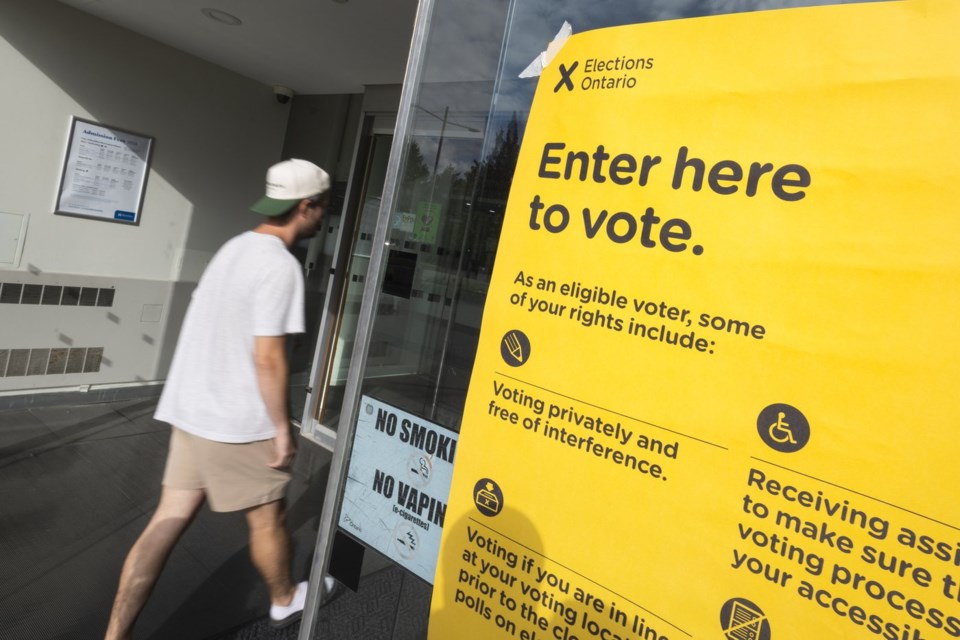
TORONTO — Ontario’s political landscape remains largely unchanged following three closely watched byelections Thursday, with Premier Doug Ford’s Progressive Conservatives retaining two seats while the New Democrats successfully held another.
The Progressive Conservatives emerged victorious in Hamilton East–Stoney Creek and York–Simcoe, while the NDP captured Scarborough Southwest, leaving the balance of power at Queen’s Park essentially unchanged.
In Hamilton East–Stoney Creek, longtime Hamilton city councillor Jeff Beattie won for the Progressive Conservatives with nearly 39 per cent of the vote, defeating NDP candidate Monique Taylor, who received about 33 per cent.
Taylor previously represented a neighbouring provincial riding for 14 years before resigning to make an unsuccessful run for federal office. Liberal candidate Heino Doessing finished third with approximately 23 per cent.
The Hamilton victory was particularly significant for Ford’s party because the riding is located in the heart of Ontario’s steel industry, which faces growing uncertainty amid escalating trade tensions and U.S. tariffs.
In York–Simcoe, Progressive Conservative Susan Lahey comfortably retained the riding for the governing party, capturing 49.8 per cent of the vote compared with 38.8 per cent for Liberal candidate Naomi Davison.
Lahey succeeds former Treasury Board president Caroline Mulroney, who resigned in June. The riding has remained in conservative hands since it was created in 2007.
Ford celebrated the victories by portraying his government as the strongest defender of Ontario workers and businesses during the continuing trade confrontation with U.S. President Donald Trump.
Speaking at Beattie’s campaign gathering in Hamilton, Ford pledged to continue challenging Trump’s tariffs while protecting Ontario jobs and communities from the economic fallout.
Beattie said economic uncertainty involving Canada’s largest trading partner had become one of the dominant concerns he heard from voters during the campaign. He argued that many residents were increasingly anxious about their jobs and economic future and saw Ford as a strong advocate for Ontario.
The New Democrats, meanwhile, had their own reason to celebrate in Scarborough Southwest, where Fatima Shaban won with more than 40 per cent of the vote in a race largely fought between the NDP and Liberals.
Shaban used her victory speech to emphasize affordability, promising to make the cost of living a central focus of her work at Queen’s Park.
NDP Leader Marit Stiles described the result as evidence that her party remains the strongest alternative to Ford’s Progressive Conservative government. She argued that the three byelections demonstrated the NDP’s ability to challenge the Conservatives in the next provincial election.
Throughout the campaigns, candidates reported hearing concerns about health care, education and affordability while knocking on doors. Canada’s escalating trade dispute with the United States, however, also emerged as a major issue, particularly in communities whose industries could be directly affected by American tariffs.
Peter Graefe, a political science professor at McMaster University, said the trade dispute may have worked to Ford’s advantage by encouraging voters to rally around the provincial government during a period of economic uncertainty.
That effect may have been especially important in Hamilton East–Stoney Creek, where steel tariffs could have a direct impact on workers, businesses and families.
The byelections also came amid controversies surrounding Ford’s government, including criticism over government spending and expenses.
Ford faced backlash over a decision to purchase a private jet for nearly $29 million before reversing the move following public criticism. His government has also faced scrutiny over Toronto-area cabinet ministers and legislators charging hotel stays in the city to taxpayers.
The hotel-expense controversy contributed to the resignation of Tourism Minister Stan Cho, while several other politicians were required to repay expenses.
Despite those controversies, voters did not deliver a significant political setback to the Progressive Conservatives in Thursday’s contests.
The results were less encouraging for the Ontario Liberals. Although the party finished a relatively strong second in York–Simcoe and competed closely with the NDP in Scarborough Southwest, it failed to capture any of the three seats.
Turnout was also notably low. According to unofficial Elections Ontario results, only slightly more than 25 per cent of eligible voters participated across the three byelections.
The results ultimately leave Queen’s Park looking much as it did before voting began: Ford’s Progressive Conservatives remain firmly in control of government, the NDP retains its position as the Official Opposition, and the Liberals continue searching for opportunities to expand their presence in the legislature.
For Ford, the night provided evidence that recent controversies have not yet translated into significant electoral losses. For Stiles and the NDP, the Scarborough Southwest victory offered its own message — that the party intends to remain a serious challenger as Ontario’s political parties begin looking toward their next province-wide electoral battle.