

MONTREAL — A nearly century-old Montreal food tradition is getting a distinctly Canadian makeover as U.S. tariffs and rising costs ripple through supply chains and push businesses to look closer to home.
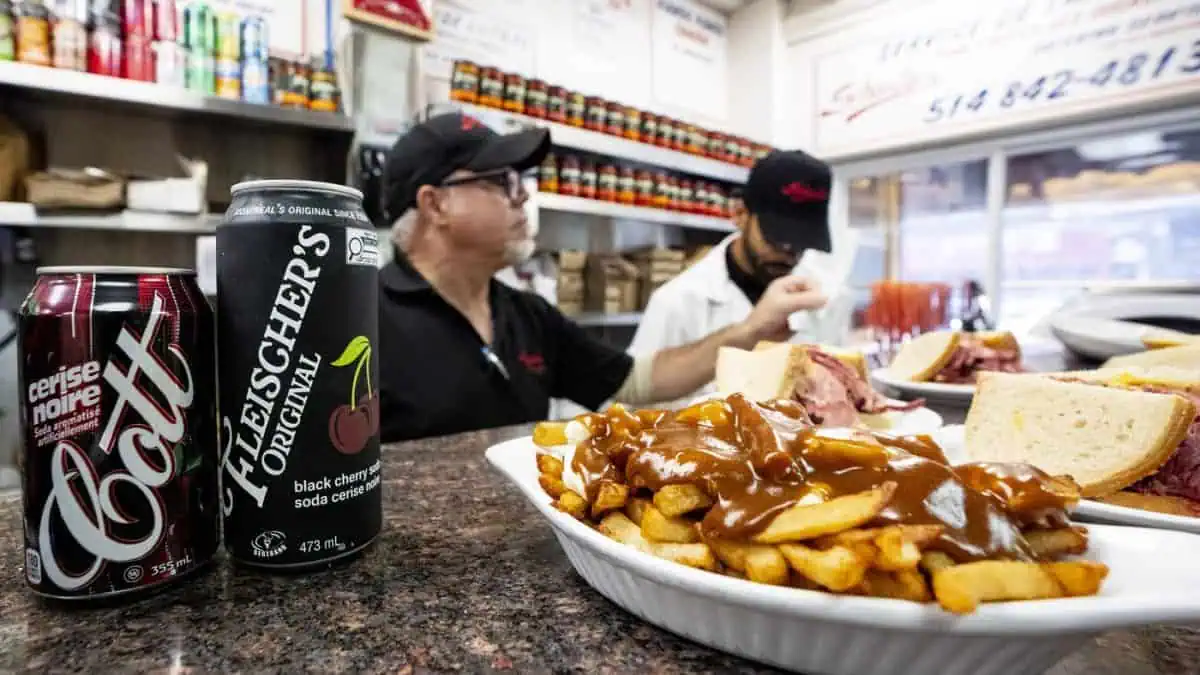
For generations, a smoked-meat sandwich at Montreal’s famous Schwartz’s Deli was often accompanied by a can of Cott’s Black Cherry Soda. The sweet, dark cherry drink became almost as closely associated with the landmark deli as its smoked meat, pickles and famously long lineups.
But that familiar combination has changed.
Schwartz’s has replaced Cott’s with Fleischer’s Original Black Cherry Soda, a Quebec-made alternative, after Canadian production of Cott products was discontinued. The change comes at a time when tariffs, inflation and growing “Buy Canadian” sentiment are reshaping purchasing decisions for businesses and consumers.
Cott’s Black Cherry Soda has deep Montreal roots. Originally produced locally, the drink became a longtime favourite at Schwartz’s, where customers discovered that its sweetness paired particularly well with the spices and saltiness of smoked meat.
Cott was eventually acquired by multinational beverage producer Refresco, which has confirmed that it stopped manufacturing Cott products in Canada.
According to Schwartz’s general manager Frank Silva, rising aluminum costs linked to U.S. tariffs were among the pressures affecting the canned beverage. Changes to Quebec’s recycling and deposit system may also have contributed to increasing costs.
For a niche product such as black cherry soda, even relatively modest increases in packaging expenses can make production difficult to justify.
When Schwartz’s remaining supply of Cott ran out in March, the deli turned to Fleischer’s, produced in St-Hyacinthe, Quebec.
The replacement costs considerably more than the former Cott product, but customers appear willing to embrace it. The Fleischer’s can is larger, allowing some diners to share, and its Canadian identity has become an additional selling point.
Toronto visitor Liam Keenan noticed that the black cherry can looked different when he returned to Schwartz’s, but said the taste still worked perfectly with the deli’s classic smoked-meat sandwich.
Other customers have also welcomed the switch, particularly because the drink is locally produced. Vancouver resident Ann Thinghuus, who was sharing a can with her children, said the soda complemented the smoked meat well and that seeing the Canadian flag on the can made the choice even more appealing.
The story behind Fleischer’s also reflects an effort to preserve a Montreal culinary tradition.
Montreal-born brewer Victor Lukoshius began developing his own version of black cherry soda about two years ago after hearing that Cott might end Canadian production. Having grown up drinking black cherry soda with smoked-meat sandwiches, he saw an opportunity to keep the tradition alive.
His St-Hyacinthe facility now produces Fleischer’s soda using locally sourced ingredients, while the cans are printed in Montreal.
The Quebec producer is not completely protected from tariffs or inflation. Lukoshius says his company is absorbing some higher costs and operating at a smaller production scale in order to keep the product available.
The situation illustrates how tariffs aimed at major industries can eventually reach everyday consumer products.
McGill University operations management professor Saibal Ray says aluminum tariffs have affected the beverage sector even though larger industries such as aerospace, automobiles and appliances were among the principal targets.
Packaging represents a significant portion of the cost of producing soft drinks. With Canadian aluminum potentially crossing the border and returning in manufactured cans, tariffs can be applied at different stages of the supply chain, increasing costs further.
For high-volume beverages, producers may have enough sales to absorb some of those increases. Smaller specialty products have much less room to manoeuvre, making them particularly vulnerable when packaging and transportation costs rise.
At Schwartz’s, however, black cherry soda appears to be in no danger of disappearing.
Demand for the Quebec-made replacement has been so strong that Silva recently ordered 100 cases, only to learn that his supplier had 87 immediately available and was working to provide more.
More importantly, the change may now be permanent.
Even if Cott’s Black Cherry Soda eventually becomes readily available again, Schwartz’s says it has no plans to abandon its new Quebec supplier.
What began as a supply problem caused partly by rising costs has instead given a local producer an opportunity and strengthened a Canadian alternative.
For Schwartz’s customers, the famous combination remains essentially unchanged: smoked meat, a pickle and a cold black cherry soda.
Only now, the soda beside the sandwich is once again proudly made in Quebec.