

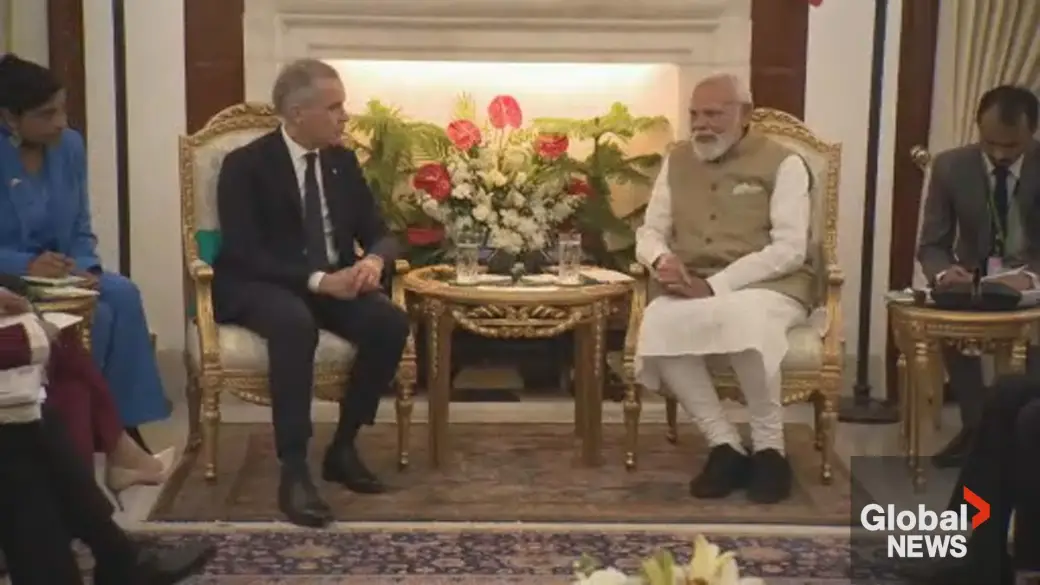
Prime Minister Mark Carney has invited Indian Prime Minister Narendra Modi to visit Canada later this year, marking another significant step in the ongoing effort to restore and strengthen relations between the two countries.
The invitation was extended during a meeting between the two leaders on the sidelines of the G7 Summit, where discussions focused on expanding cooperation in security, trade, defence, migration, and economic development.
One of the key outcomes of the meeting was an agreement to begin negotiations on a General Security of Information Agreement, a framework that would facilitate the exchange of classified defence and security information between Canada and India. Such agreements are often viewed as important building blocks for deeper strategic and military cooperation between nations.
The two leaders also discussed advancing dialogue in several areas of mutual interest, including defence cooperation, financial collaboration, migration policies, and economic partnerships. Modi thanked Carney for the invitation, and both sides agreed to continue discussions through diplomatic channels to determine a suitable date for the visit.
The developments represent a notable shift in Canada-India relations, which deteriorated sharply in 2023 following allegations by the Canadian government that Indian agents were linked to the killing of Sikh activist Hardeep Singh Nijjar in British Columbia. The allegations led to diplomatic tensions, suspension of trade negotiations, and the expulsion of diplomats from both countries.
Since becoming Prime Minister, Carney has pursued a policy aimed at rebuilding ties with India while maintaining Canada’s commitment to protecting national security and democratic institutions. Earlier this year, Carney travelled to India, where both governments agreed to revive discussions on a long-awaited free trade agreement and establish new cooperation in the energy sector.
Canada’s renewed engagement with India comes as Ottawa seeks to diversify trade and strategic partnerships amid ongoing global economic uncertainty and changing geopolitical dynamics. India, now one of the world’s fastest-growing major economies and the most populous country, is increasingly viewed as an important partner for Canada in areas ranging from trade and investment to technology, education, and clean energy.
However, the relationship continues to face challenges. Concerns surrounding foreign interference, transnational repression, and criminal activities linked to organized networks remain sensitive issues in Canada. Sikh advocacy groups have expressed concerns about the government’s renewed engagement with India and continue to call for accountability regarding allegations involving threats and violence against members of the Sikh community.
Carney has repeatedly emphasized that Canada will not tolerate foreign interference or transnational repression from any country. At the same time, his government appears committed to maintaining dialogue with India and pursuing areas of shared interest while addressing security concerns through diplomatic and law enforcement channels.
The invitation to Modi and the planned security information agreement suggest that both countries are seeking a pragmatic path forward. If the proposed visit takes place, it would represent one of the most significant milestones in the ongoing effort to rebuild trust and cooperation between Canada and India after several years of strained relations.
As both nations work to balance economic opportunities with security concerns, the evolving relationship will likely remain one of the most closely watched aspects of Canada’s foreign policy in the coming months.