

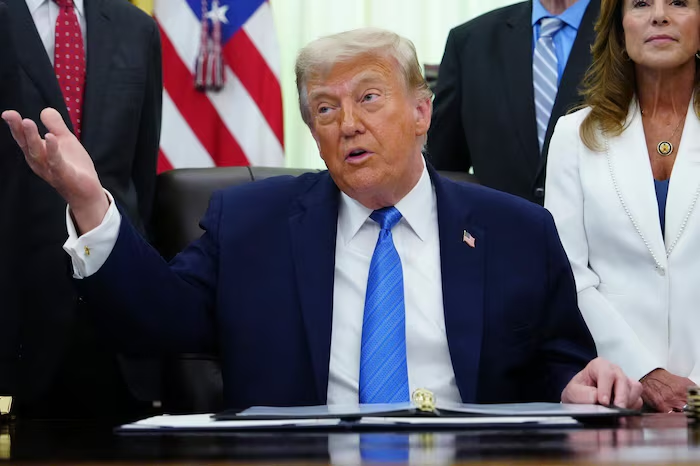
Uncertainty over the future of North America’s most important trade agreement intensified Wednesday after U.S. President Donald Trump suggested he is not inclined to renew the Canada-United States-Mexico Agreement (CUSMA), arguing that the United States does not need goods from either Canada or Mexico.
Speaking in Washington, Trump was asked about the upcoming mandatory review of CUSMA and responded that he is “not looking to renew it.” He stated that while Canada and Mexico depend heavily on access to the American market, the United States would perform better without the agreement and does not require what its North American partners have to offer.
The comments come ahead of a key July 1 deadline when Canada, the United States, and Mexico must indicate whether they wish to extend the trade pact for another 16 years or proceed with annual reviews as outlined in the agreement. The review process is expected to be one of the most closely watched economic negotiations on the continent this year.
Despite his criticism, Trump praised one feature of the agreement that replaced the former North American Free Trade Agreement (NAFTA). He noted that CUSMA includes a sunset review mechanism that allows member countries to reconsider the deal periodically, a provision he said was absent from NAFTA.
The remarks have generated concern because CUSMA has served as the foundation of North American trade since it came into force in 2020. The agreement governs hundreds of billions of dollars in annual trade and has protected many Canadian exports from broad U.S. tariffs.
Trade data illustrates the depth of economic integration between the two countries. So far in 2026, Canada has exported approximately US$127 billion worth of goods to the United States while importing roughly US$114 billion in American products. This has resulted in a U.S. trade deficit of approximately US$12 billion with Canada, a figure Trump has repeatedly cited as evidence of an unfair trading relationship.
However, many economists note that Canada’s exports to the United States are heavily concentrated in energy products, particularly crude oil. Canada supplies large volumes of oil to American refineries, helping meet U.S. energy needs while supporting industries and consumers across the country. Industry data indicates that energy exports remain Canada’s largest export category, surpassing sectors such as minerals, manufacturing, agriculture, transportation equipment, and forestry products.
Prime Minister Mark Carney declined to directly respond to Trump’s comments when questioned by reporters on Parliament Hill. However, Canada’s position on the agreement remains clear. The federal government has repeatedly stated that it supports renewing CUSMA and views the agreement as highly beneficial to all three member countries.
Last week, Dominic LeBlanc formally communicated Canada’s intention to renew the pact in a letter sent to American and Mexican trade officials. In the correspondence, LeBlanc described CUSMA as a critical pillar of the integrated North American economy and an agreement that delivers significant benefits to all participating nations.
Meanwhile, provincial leaders have been actively promoting closer economic cooperation with the United States. Doug Ford recently concluded a two-day visit to Washington, D.C., where he met with business organizations, agricultural groups, and automotive industry representatives. Ford has been advocating for what he calls a “Fortress North America” strategy aimed at strengthening economic ties and reducing trade barriers between Canada and the United States.
Political analysts suggest Trump’s comments may be part of a broader negotiating strategy rather than a definitive policy position. Tom Mulcair described the remarks as a familiar negotiating tactic intended to strengthen the U.S. bargaining position ahead of formal discussions.
Mulcair argued that the economies of Canada, the United States, and Mexico have become deeply interconnected over decades of trade integration. He noted that Canada’s energy exports play a major role in the trade balance and that access to Canadian oil, minerals, manufacturing components, and agricultural products remains important to American industries and consumers.
As the July review deadline approaches, governments, businesses, and investors across North America will be watching closely for signs of how negotiations unfold. While Trump’s remarks have added uncertainty to the process, Canadian officials continue to emphasize the economic advantages of maintaining a stable and predictable trade framework among the three North American partners.
The coming weeks are expected to be critical in determining whether CUSMA remains the cornerstone of North American trade for years to come or enters a period of prolonged renegotiation and uncertainty.