

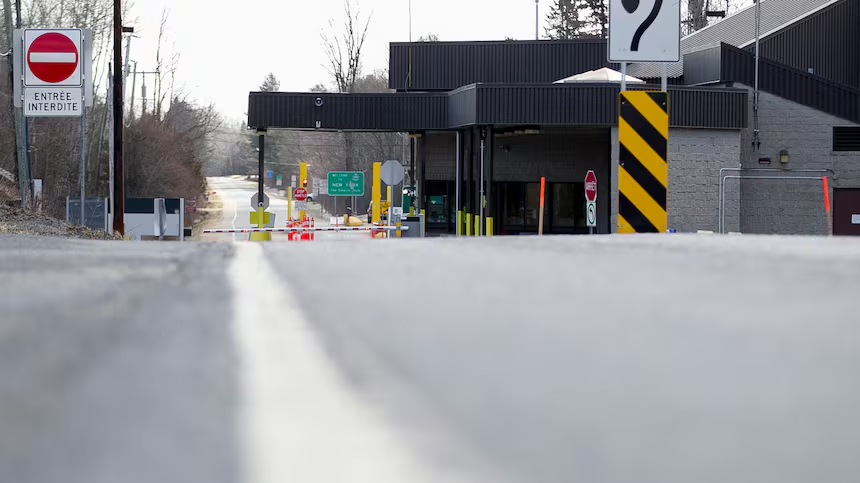
New research suggests Canadians are avoiding travel to the United States at a far greater rate than previously believed, highlighting what experts are calling a major shift in cross-border relations and tourism patterns.
According to data analyzed by researchers at the University of Toronto School of Cities, visits by Canadians to the U.S. dropped by approximately 42 per cent over the past year — significantly steeper than the roughly 25 per cent decline reported through official government border statistics.
The study used anonymized Canadian cell phone data to track travel between April 1, 2025, and March 31, 2026 — a period marked by escalating tensions between Canada and the United States following tariffs imposed by Donald Trump and controversial remarks suggesting Canada could become the “51st state.”
Researchers found some of America’s most popular tourist destinations for Canadians experienced dramatic declines in visits. Myrtle Beach recorded one of the sharpest drops, with Canadian travel falling by 65 per cent year-over-year.
Several Florida destinations — including Orlando, Miami, Naples, and Cape Coral — also saw declines of more than 50 per cent.
The downturn extended beyond vacation hotspots. Business and technology centres such as San Francisco, New York City, Boston, and several Michigan cities tied to Canada’s auto sector also experienced substantial reductions in Canadian visitors.
Karen Chapple, director of the School of Cities research team, described the trend as a “sea change” in Canada-U.S. travel behaviour, noting that the decline reflects not only reduced leisure travel but also changing business relationships between the two countries.
“The places most impacted by tariffs are also the ones most affected by the loss of travel,” Chapple said, pointing to industrial regions linked to Ontario’s automotive sector.
The data suggests Canadian consumers and businesses are increasingly redirecting tourism and commercial activity toward other international markets instead of the United States.
The economic consequences for the U.S. tourism industry could be severe. The U.S. Travel Association previously estimated that a 10 per cent drop in Canadian tourism would cost the American economy approximately $2.1 billion US. If the 42 per cent figure proves accurate, the impact could exceed $8 billion US.
The decline has been especially damaging for border-area businesses and tourism-dependent cities such as Las Vegas, where Canadians have historically represented the largest group of international visitors.
New tourism figures from Las Vegas show Canadian visits dropped by 17 per cent last year, while Mexican tourism nearly matched Canadian visitor numbers for the first time outside the COVID-19 pandemic period.
Canadian airlines servicing Las Vegas also reported major declines in passenger traffic, with significant drops recorded by WestJet, Air Canada, Porter Airlines, and Flair Airlines.
The downturn has also severely impacted duty-free retailers along the Canada-U.S. border. Barbara Barrett of the Frontier Duty Free Association said some stores have seen sales collapse by as much as 80 per cent compared to pre-pandemic levels.
Meanwhile, Prime Minister Mark Carney recently praised Canadians for supporting domestic tourism and Canadian-made products during the ongoing trade tensions with the United States.
Despite efforts by American tourism officials and cities to lure Canadians back with promotions and public appeals, current data suggests the travel boycott remains strong more than a year after it began.