

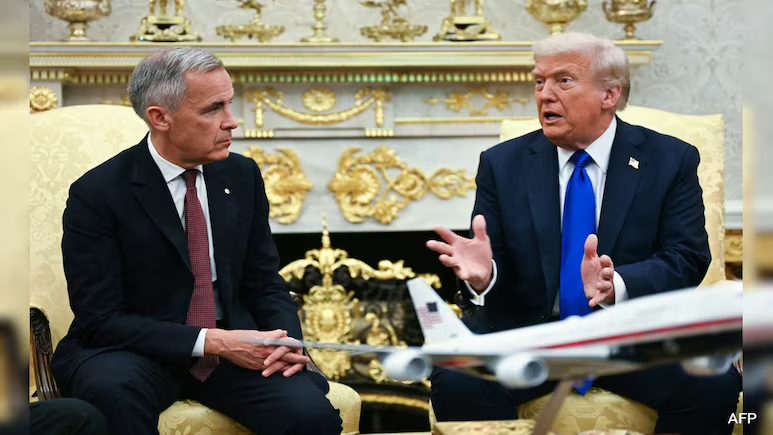
Prime Minister Mark Carney says Canada must rethink its long-standing economic relationship with the United States, warning that ties once seen as a major national advantage have now become a strategic vulnerability.
In a national video address released Sunday, Carney said the global environment has changed dramatically and Canada can no longer depend so heavily on one partner for trade, growth and security. He pointed to rising U.S. tariffs, economic uncertainty and shifting American priorities as signs that Ottawa must adapt quickly.
“The world is more dangerous and divided,” Carney said, arguing that many of Canada’s former strengths, rooted in close integration with the United States, now require urgent correction.
His remarks come as Canada faces continuing trade tensions with the administration of Donald Trump. Tariffs and cross-border uncertainty have already affected key Canadian sectors, including auto manufacturing and steel, while businesses remain cautious about new investments.
Carney said his government’s response will focus on building a more self-reliant economy. That includes attracting new global investment, expanding trade partnerships beyond North America, increasing clean energy capacity, lowering internal trade barriers between provinces and strengthening domestic industries.
He also highlighted plans to boost defence spending, lower taxes and improve housing affordability as part of a broader national resilience strategy.
The prime minister’s message reflects a larger shift in Canadian policy thinking: moving from dependence to diversification. While the United States remains Canada’s largest trading partner, Carney argued that hoping for a return to past stability is not a strategy.
He repeated a phrase that has become central to his leadership style: “Hope isn’t a plan, and nostalgia is not a strategy.”
Carney’s comments also carry political significance. They come just days after the Liberals secured a House of Commons majority and ahead of a scheduled July review of CUSMA Review, the continental trade pact between Canada, the U.S. and Mexico.
While Canada and the United States remain deeply connected through geography, trade and defence, Carney’s speech signals that Ottawa intends to pursue a future where economic security depends less on any single country and more on Canada’s own capacity to compete and adapt.