

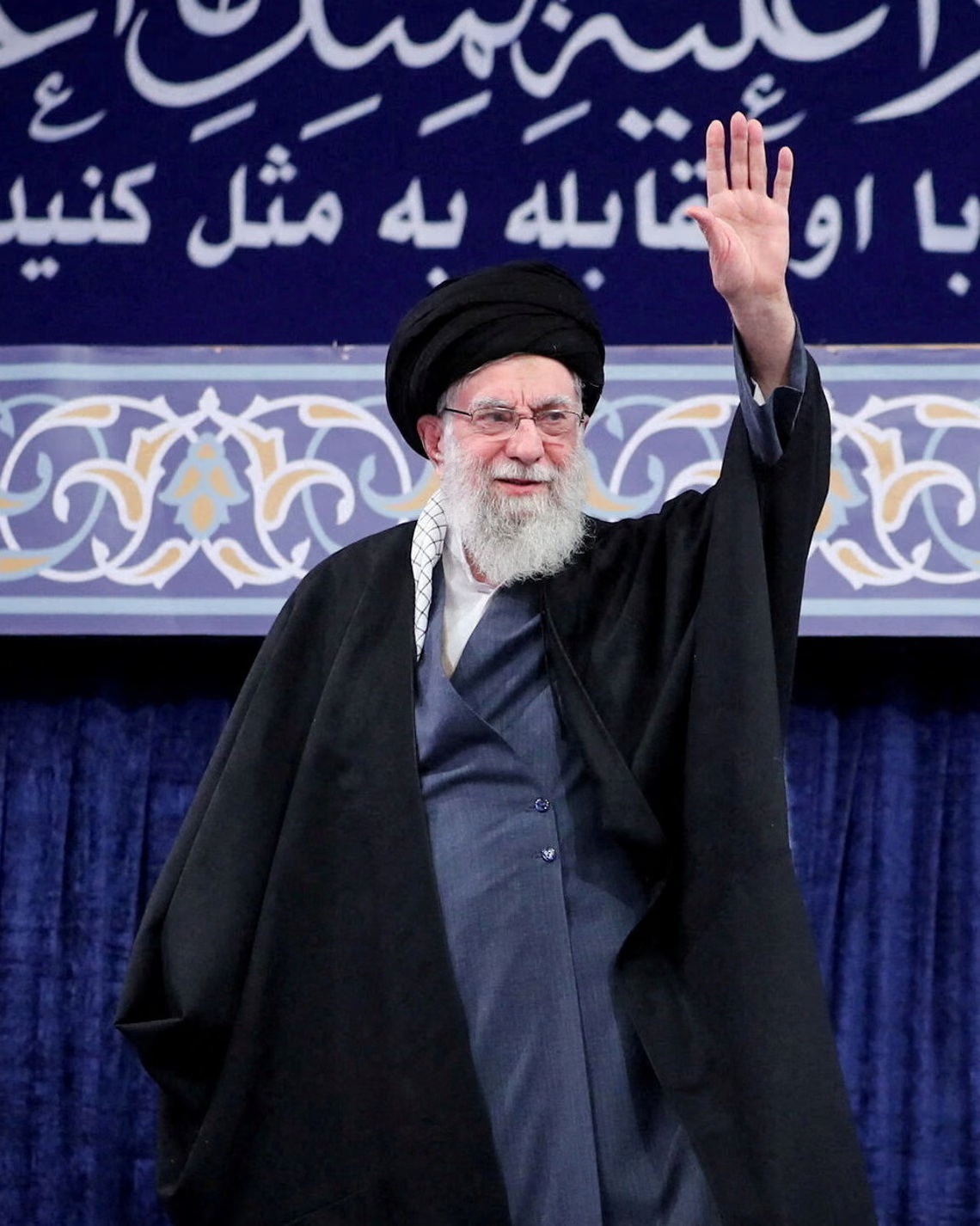
Iran’s long-serving supreme leader shaped a hardline state — and may now be succeeded by even tougher forces
After more than three decades at the helm of the Islamic Republic, the rule of Ali Khamenei appears to have reached a dramatic and uncertain turning point.
Reports emerging amid large-scale U.S. and Israeli strikes on Iran suggest the country’s supreme leader may have been killed, though Iranian authorities have not officially confirmed his death. Israeli Prime Minister Benjamin Netanyahu said there were indications Khamenei “is no longer with us,” while U.S. President Donald Trump publicly supported the military campaign targeting Iranian leadership and infrastructure.
If confirmed, the end of Khamenei’s leadership would close a chapter that began in 1989 and reshaped Iran’s domestic politics and regional posture.
From Revolutionary Cleric to Supreme Authority
Born in 1939 in Mashhad to a modest clerical family, Khamenei came of age during political upheaval under Shah Mohammad Reza Pahlavi. Influenced by Shia theology and the revolutionary ideology of Ruhollah Khomeini, he became active in Islamist opposition networks in the 1960s and 1970s.
He was repeatedly imprisoned before the 1979 Islamic Revolution brought Khomeini to power. Khamenei rose steadily through the ranks of the new regime, surviving an assassination attempt in 1981 that left one arm paralyzed. He later served as president before being selected as supreme leader following Khomeini’s death in 1989, after constitutional changes expanded the powers of the office.
Though not the most senior cleric, Khamenei consolidated authority through control of key institutions, most notably the Islamic Revolutionary Guard Corps (IRGC), which evolved into a dominant military, economic and political force.
A Strategy of Proxies and Power
Khamenei’s leadership was marked by a dual approach: pragmatic calculation in moments of crisis, combined with ideological rigidity on core revolutionary principles.
He strengthened Iran’s network of regional allies — often referred to as the “axis of resistance” — including Hezbollah in Lebanon, Hamas in Gaza, militias in Iraq and Syria, and the Houthi movement in Yemen. This strategy aimed to project Iranian influence and deter Israel and the United States without engaging in direct large-scale war.
At home, however, dissent was frequently met with force. Reformist efforts, including those under President Mohammad Khatami in the late 1990s, were constrained. Periodic waves of protest over economic hardship and social freedoms were suppressed, contributing to growing public discontent.
Khamenei also presided over Iran’s controversial nuclear program. While he permitted negotiations that led to the 2015 nuclear agreement, he remained skeptical of Western intentions and supported a posture of strategic resistance. Subsequent tensions, sanctions and military confrontations further isolated the country.
Mounting Pressure in Later Years
In recent years, Iran faced intensifying economic sanctions, domestic unrest and military pressure from Israel and the United States. Strikes targeting Iranian assets and allied militias exposed vulnerabilities in Tehran’s regional network.
The reported targeting of Khamenei’s secure compound during the latest air campaign signals how central he remained to Iran’s power structure.
Analysts have long speculated about succession plans, particularly given his age and health concerns. Intelligence assessments previously suggested that, if removed, Khamenei would likely be replaced by hardline figures aligned with the IRGC, potentially maintaining — or intensifying — the ideological direction of the regime.
An Uncertain Transition
Khamenei’s leadership was defined by survival: balancing internal factions, confronting external adversaries and preserving the system created by the 1979 revolution.
Whether dead or alive, the current crisis suggests that era is nearing its end. What follows may determine not only Iran’s domestic future but also the trajectory of security and stability across the Middle East.
If power shifts to more uncompromising hardline elements, regional tensions could deepen. Alternatively, prolonged instability could open space for internal recalibration. For now, the legacy of Ali Khamenei — revolutionary cleric, strategic tactician and polarizing ruler — stands at the centre of one of the most consequential moments in modern Iranian history.