

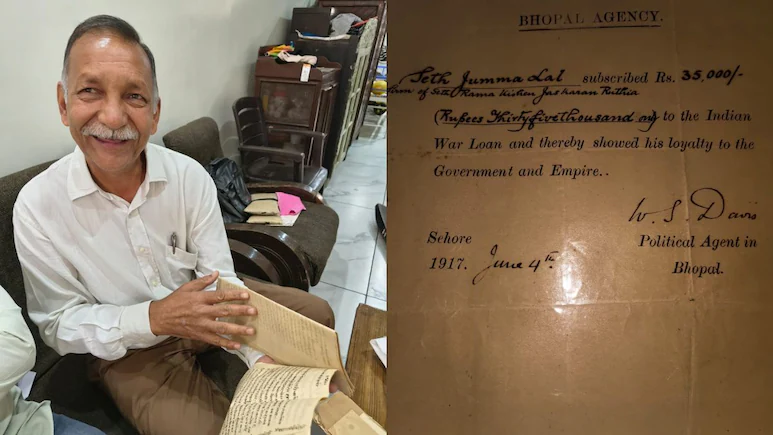
A family in Sehore, Madhya Pradesh, says it is preparing legal action against the British government over an alleged unpaid loan dating back to 1917 — a sum of ₹35,000 that they claim was never repaid.
According to the Ruthia family, during the height of World War I, colonial authorities borrowed the amount from Seth Jummalal Ruthia, a prominent businessman in Sehore and the Bhopal princely state. The loan was reportedly categorized as a “war loan,” intended to support administrative management under British rule.
More than a century later, Vivek Ruthia — grandson of Seth Jummalal — says recently uncovered family documents, including certificates and correspondence found after his father’s passing, indicate the amount remains outstanding.
“In 1917, my grandfather loaned ₹35,000 to the British government. That amount has not been repaid to this day,” Vivek Ruthia stated, adding that the family is preparing to send a legal notice seeking recovery of what he describes as a “historic and unpaid sovereign debt.”
At the time, ₹35,000 was considered a substantial sum — capable of financing estates and influencing local governance. While modest by modern standards, the family argues its present-day equivalent could run into crores of rupees if adjusted against gold prices or long-term value benchmarks.
Seth Jummalal Ruthia passed away in 1937, nearly two decades after the alleged loan was issued. The family says the matter gradually faded into obscurity until the rediscovery of archival documents.
Legal experts note that cases involving colonial-era financial claims are rare and legally complex. Questions of sovereign liability, jurisdiction, and statute limitations would likely arise. However, documented pre-independence financial transactions between private individuals and colonial administrations could trigger intricate international legal discussions if formally pursued.
Before India’s Independence, the Ruthia family was regarded as one of the most affluent and influential in Sehore and the Bhopal region. Historical accounts suggest they owned extensive land holdings, and even today, a significant portion of Sehore’s settlements is said to stand on land once associated with the family.
The family continues to hold property in Sehore, Indore, and Bhopal, with interests spanning agriculture, hospitality, and real estate. Like many legacy landowning families, they are also involved in longstanding property and tenancy disputes.
Whether the 109-year-old claim gains legal traction remains uncertain, but the case highlights how unresolved colonial-era transactions can resurface decades later — raising complex questions about history, accountability and sovereign responsibility.