

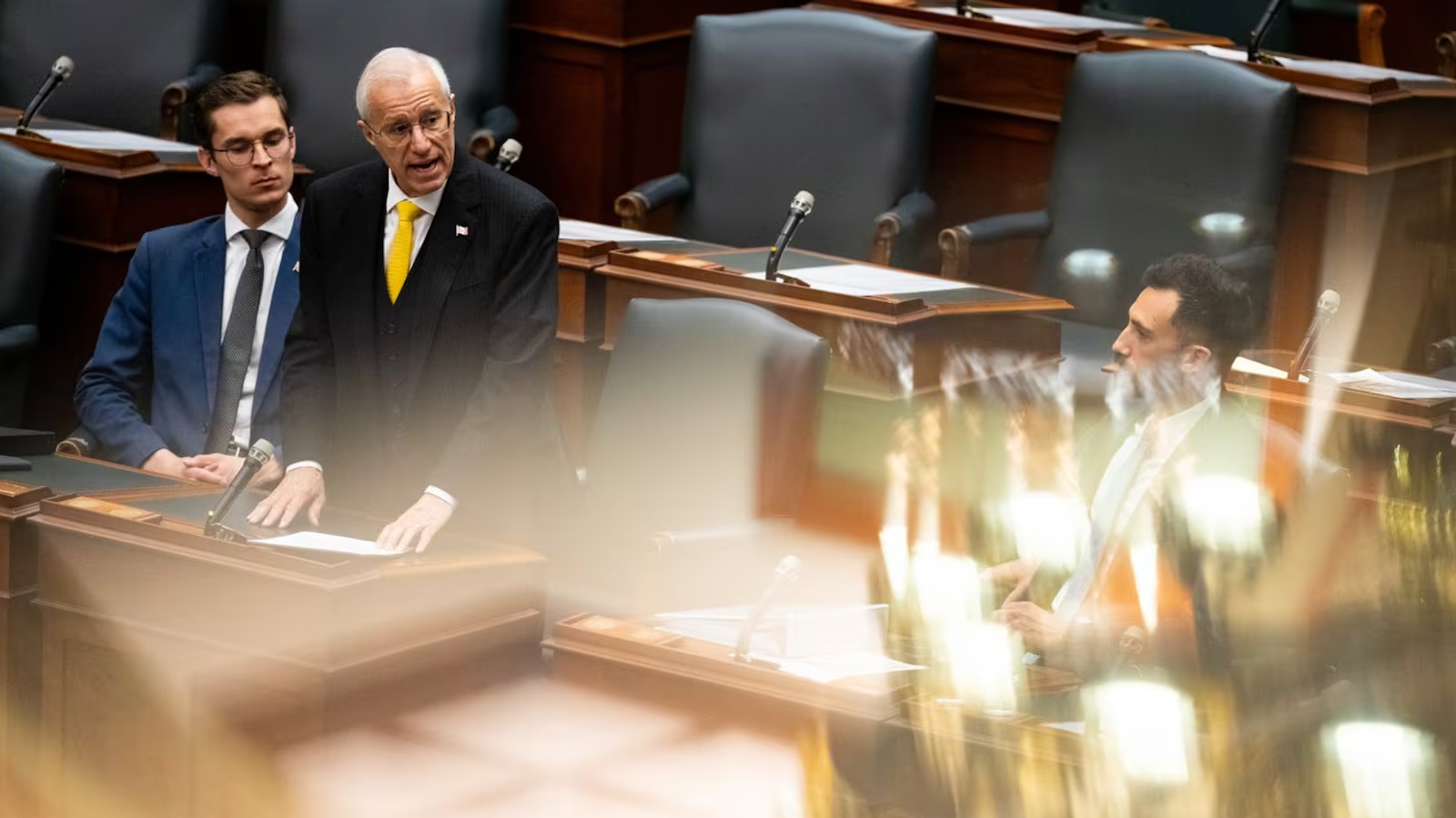
After a year marked by U.S.-driven trade upheaval, Ontario’s economic development minister says the province will focus on defence-sector investment in 2026 as it works to stabilize and grow its economy.
Vic Fedeli, Ontario’s minister of economic development, job creation and trade, said in a recent interview that global uncertainty sparked by shifting American trade policies has pushed the province to seek stronger partnerships elsewhere.
“The theme around the world is, how can we work together around the U.S.?” Fedeli said. “You wake up every morning with one eye half-cocked, looking at Twitter and wondering, ‘What new hell have we been delivered this morning?’”
Often described as Ontario’s chief salesperson, Fedeli travelled to 20 countries this year to build relationships and attract investment.
He said international outreach will continue in 2026, though at a slightly slower pace.
“Twenty countries was a lot,” he said. “We’ve got to let some of that mature now and close these deals that we believe are all now pending. But you’ll really see us more focused on the places that we go to, focused on defence.”
Fedeli said the province aims to attract new defence manufacturing to Ontario, help local firms access foreign markets and strengthen domestic production.
One opportunity, he said, lies at Algoma Steel, where both provincial and federal governments see potential to support increased steel production to meet rising global defence demand. He pointed to expected spending such as the European Union’s €1.3-trillion ReArm Europe plan, which would require large amounts of steel.
Fedeli said discussions are underway for a second steel plate line at Algoma and new capacity to produce I-beams for infrastructure.
“We’re working with the feds and Algoma in a three-way partnership to fund these two things that are going to be really permanent additions to Algoma and hire back lots and lots of people,” he said.
Algoma recently announced plans to cut about 1,000 jobs as it transitions from coal to electric arc furnaces, a move driven by U.S. tariffs. The cuts drew criticism because both the federal and Ontario governments previously provided the company with $500 million in support — funding critics argue should have come with stronger job guarantees.
Fedeli said the province remains willing to invest further in the company.
“That kept them alive,” he said. “They honestly just would not be open today if they didn’t have that injection.”
Fedeli said about 300 Ontario companies are involved in defence manufacturing, and he hinted that more provincial support announcements are coming in the new year to help firms develop their products.
One such company, Brampton-based Roshel, recently drew attention after it was revealed that U.S. Immigration and Customs Enforcement had ordered 20 of its armoured vehicles. Human rights groups, including Amnesty International and Human Rights Watch, have linked ICE to serious violations, and some advocates argue Roshel should not sell to the agency.
Premier Doug Ford has defended the company, a position Fedeli also supports, saying he has seen strong demand for its products at defence trade shows.
Mining companies, including Juno Corp., are also eyeing the U.S. military as a potential customer for critical minerals.
Fedeli said Ontario wants more of those minerals processed domestically, supported by a $500-million critical minerals processing fund. He said that approach aligns with the province’s goal of reducing reliance on U.S. trade while still backing companies that do business there.
“Those are private deals between private companies and the U.S.,” he said. “We want to help these companies process these minerals here. Our goal is to create the jobs.”
Fedeli said Ontario’s broader strategy is to add value within the province, strengthen key industries and position the economy to weather continued global uncertainty in the year ahead.