

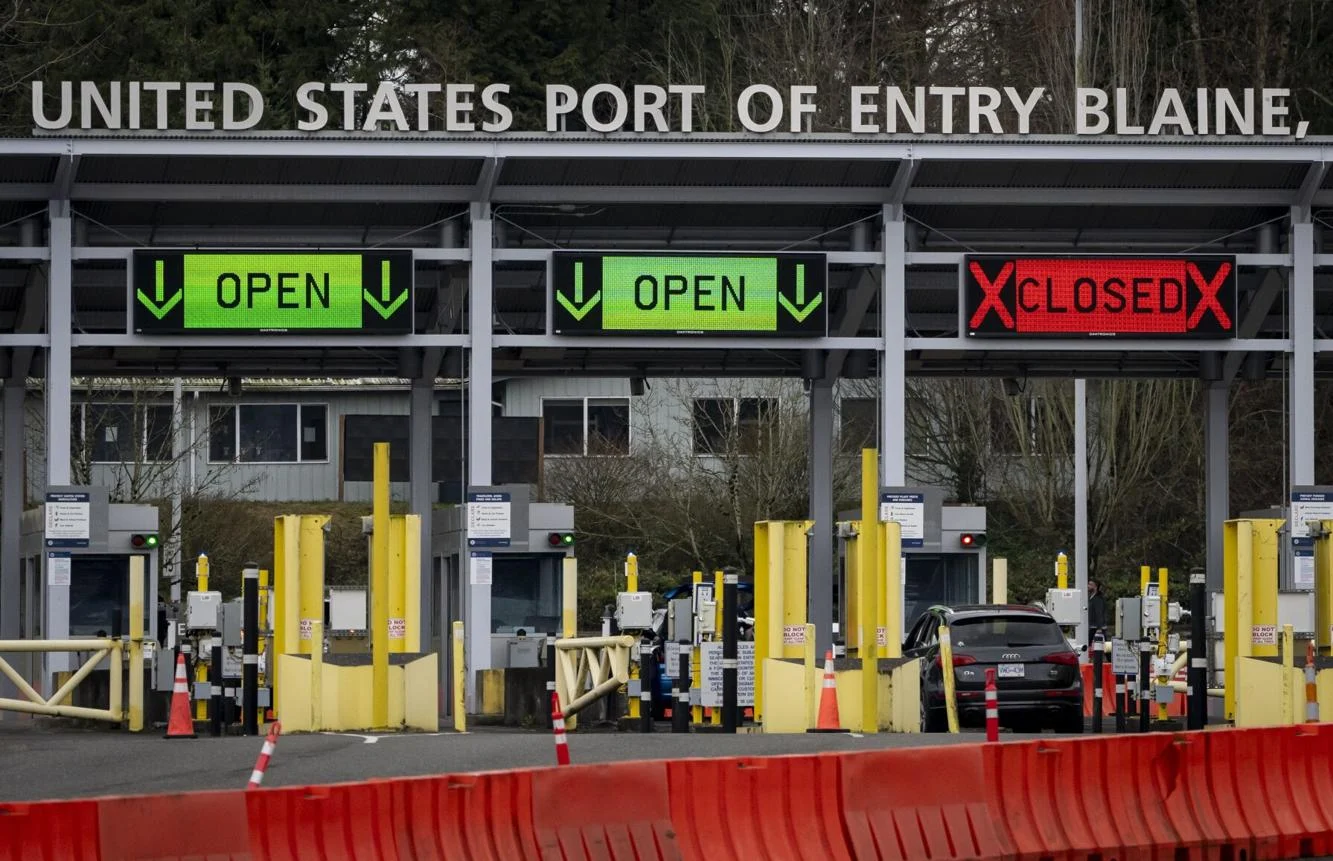
Travel by Canadians to the United States continues to decline, with new Statistics Canada data showing a sharp year-over-year drop as political tensions, tougher border rules and rising costs discourage cross-border trips.
Statistics Canada reported that return trips from the U.S. by Canadian residents fell 30.9 per cent in September compared with the same month last year. The decline included a 33.8 per cent drop in travellers returning by car and a 19.3 per cent decrease in those flying back to Canada.
For some Canadians, the decision to stay away is personal.
Caril Nash, an Ontario resident with close family in the U.S., said she has chosen to boycott travel south of the border following repeated comments by U.S. President Donald Trump suggesting Canada should become the “51st state.”
“My identity as a Canadian was threatened by his desire to absorb us,” Nash said. “Despite the warm welcome of my family in the States, I won’t be going down to visit.”
Nash is among a growing number of Canadians opting to avoid U.S. travel, citing political rhetoric, aggressive tariffs and widening ideological differences between the two countries. The travel sector has become one of the most visible casualties of the strained relationship, as U.S. travel policies also grow more complex for foreign visitors.
“The year has not been good for the Americans regarding tourism,” said Frédéric Dimanche, a professor in hospitality and tourism at Toronto Metropolitan University.
The trend extends beyond Canada. A fall report from the U.S. Travel Association projects that international visits to the U.S. will fall to 67.9 million in 2025, down 6.3 per cent from 72.4 million in 2024 — marking the first decline since the pandemic.
Dimanche said that while the broader impact on the U.S. economy may be limited, certain states are being hit harder, including Florida, New York, Nevada and border states that traditionally rely heavily on Canadian visitors.
Even Canada’s “snowbirds,” long considered the most reliable stream of winter travellers to the U.S., are beginning to reconsider. A survey by Snowbird Advisor of 4,000 Canadian snowbirds found that 70 per cent plan to visit the U.S. this winter, down from 82 per cent last year.
Stephen Fine, founder of Snowbird Advisor, said many still head south because about 70 per cent drive, making other international destinations less practical, and because many own property in the U.S.
“At least 30 per cent own property in their destinations,” Fine said. “You’re not just going to let it sit empty for the year and pay to go somewhere else or stay at home.”
At the same time, Dimanche said other countries are seizing the opportunity to attract Canadian travellers, with destinations such as Mexico, Costa Rica and Portugal growing in popularity.
“This winter, at the world’s largest tourism trade show, you can be sure a lot of people will be trying to seduce Canadian tour operators and travel agencies,” he said, referring to the Internationale Tourismus-Börse Berlin in February.
For Canadians who do choose to travel south, border crossings are becoming more demanding.
Toronto-based immigration lawyer Ksenia Tchern McCallum said travellers should be prepared for more detailed questioning by U.S. customs officials, including requests for proof of Canadian residence and employment, as well as evidence of sufficient funds for their stay.
“What the border officers are assessing every time you enter is whether or not you are a bona fide visitor,” she said. “They want to make sure that no one is overstaying.”
Non-residents planning to stay 30 days or longer must register with U.S. Citizenship and Immigration Services. Failure to do so can result in fines of up to $5,000 US or up to six months in jail.
Beginning Dec. 26, travellers entering or exiting the U.S. at all ports of entry should also expect biometric screening, including fingerprinting and photographs. The photos will be checked using facial recognition technology to ensure matches between entry and exit records.
“We’ve been very fortunate as Canadians — we’ve never had to go to the consulate to apply for a visa,” Tchern McCallum said. “Now it’s a little bit more time-consuming.”
Additional costs may also discourage travel. In late November, the U.S. Department of the Interior announced “America-first pricing” at 11 national parks, including Yosemite, the Grand Canyon and Yellowstone. Starting Jan. 1, 2026, non-U.S. residents will pay an extra $100 US per person on top of the standard $20 entry fee. A non-resident annual pass will cost $250 — more than three times the resident rate.
For Nash, the changes reinforce her decision to explore closer to home.
“I have spent 60-plus years trusting that the USA was our friend,” she said. “I wouldn’t have thought that I would be so affected, but I am.”
She said her American cousin now plans to visit her in Canada instead.
“I’ve seen some of my country but most certainly not enough of it,” Nash said. “I’ve come to realize that maybe it’s time that I get around to it.”