

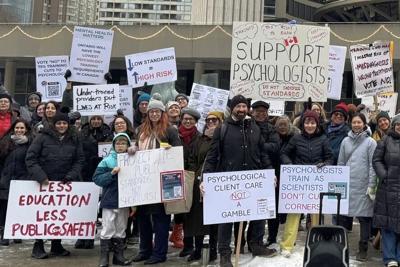
The governing body for psychologists in Ontario has approved a series of controversial changes to its registration standards, a move the regulator says will expand access to care but that many practitioners warn could lower training requirements and put patients at risk.
On Dec. 12, the College of Psychologists and Behaviour Analysts of Ontario voted to adopt amendments aimed at “modernizing” the province’s registration process. The college says the reforms will help address shortages in mental health care, improve diversity in the profession and align Ontario’s entry requirements with those in other provinces.
But critics describe the changes as “sweeping” and potentially dangerous, arguing they could lead to misdiagnoses and ineffective — or even harmful — treatment, particularly for people with complex mental health needs.
Among the most contentious changes is a proposal to allow individuals to register as psychologists with only a master’s degree from board-approved programs, rather than the current PhD requirement. The amendments would also replace the existing four-year supervised work experience requirement for master’s-level candidates with just one year of supervised practice. The latter change still requires approval from the provincial ministry.
The college also voted to recognize accrediting bodies outside the United States, opening the door to more internationally trained applicants.
A college survey of 10,000 respondents — including practitioners and members of the public — found that about 90 per cent did not believe the changes were in the public interest.
Fears of harm to patients
Skye Fitzpatrick, an associate professor in York University’s Department of Psychology and director of the TULiP Lab, said the proposed supervision changes would dramatically reduce the hands-on experience new psychologists receive.
“By our calculations, this is literally a matter of going from having seen hundreds of patients under supervision, to a handful,” she said. “It’s getting quite dangerous.”
Fitzpatrick said she has seen patients spend years in therapies that failed to help because they were treated by providers without sufficient training.
“That can be really consequential for a kid who needs support,” she said. “Suicide risk signs in a teenager could be missed if somebody doesn’t have the adequate training to catch and intervene on those things.”
Other changes approved by the college include allowing unlimited attempts to pass the general psychology knowledge exam and replacing the pass/fail ethics exam with a no-fail online learning module — measures that would not require ministry approval.
“The more of these things you do, the more risk we put the public,” said Martin Anthony, professor and chair of psychology at Toronto Metropolitan University. “You add it all together, it’s a race to the bottom in terms of quality.”
Todd Cunningham, a clinical and school psychologist and associate professor at the University of Toronto’s Ontario Institute for Studies in Education, said modernization is needed but warned against eroding safeguards.
“Reducing or removing the safeguards from the profession is not modernization,” he said. “That’s just butchering the discipline.”
Natalie Michel, a clinical and counselling psychologist and clinic director at Connect and Thrive Psychology, said patients may need to be more cautious if the changes take effect.
“It’ll be very important for the public to be more discerning when you’re seeking out services,” she said, “and ask if this is enough training for what I think I would like in a mental health provider.”
Supporters say access will improve
Not all psychologists oppose the changes. Monnica Williams, a professor at the University of Ottawa and Canada Research Chair in Mental Health Innovation and Equity, said Ontario’s four-year supervision requirement has long been a barrier to growing the workforce.
“There’s no other mental health degree where after you get your degree, you have to be supervised for that long,” she said, calling Ontario’s standard “the most extreme” she has seen.
Williams said there is no evidence that psychologists trained at the master’s level with one year of supervision provide poorer care.
“Nobody has done any research study showing that you don’t get good care,” she said. “Nobody has demonstrated that there’s more complaints or more people losing their licence” compared to doctoral-level psychologists.
She noted that Canada has about 20,000 psychologists — a figure that has remained relatively flat over the past decade — and said the changes could help meet demand in a growing population. She also suggested opposition reflects a degree of professional gatekeeping.
“We as psychologists should be looking to make our tent bigger,” Williams said. “We’re keeping it small, and that’s wrong.”
Williams added that recognizing international accrediting bodies could significantly expand and diversify the profession.
College defends reforms
Tony DeBono, the college’s registrar and executive director, said in a statement that the changes are designed to preserve high standards while removing unnecessary barriers.
“These changes will maintain the profession’s high standards while removing unnecessary delays that prevent qualified professionals from entering practice,” he said, noting that Ontario trails Alberta and Quebec in psychologist availability. He added that Ontario already accepts psychologists from other provinces who trained at the master’s level with one year of supervised practice.
“To be clear, these changes are about eliminating barriers, not lowering standards,” DeBono said. “Our examinations, supervision and oversight requirements remain rigorous and aligned with public protection.”
Another debated reform would move toward psychologists self-identifying their areas of practice, rather than being formally designated by specialization. Some practitioners fear this could weaken oversight of competencies, but the college disputes that characterization.
“Psychology registrants must continue to ensure they possess the necessary knowledge, skill and judgment before providing any service to a client group or in a specific area of practice,” DeBono said.
The Canadian Psychological Association has said it opposes the amendments, warning they would “undermine public protection (and) dilute professional competence.”
By contrast, the Ontario Association of Mental Health Professionals said it is encouraged by what it called a clear move toward modernization, including expanded accreditation pathways and reforms to address equity and professional mobility.
With ministry approval still required for some elements, the debate is likely to continue as Ontario weighs how to balance access to care with training standards in a system under growing strain.