

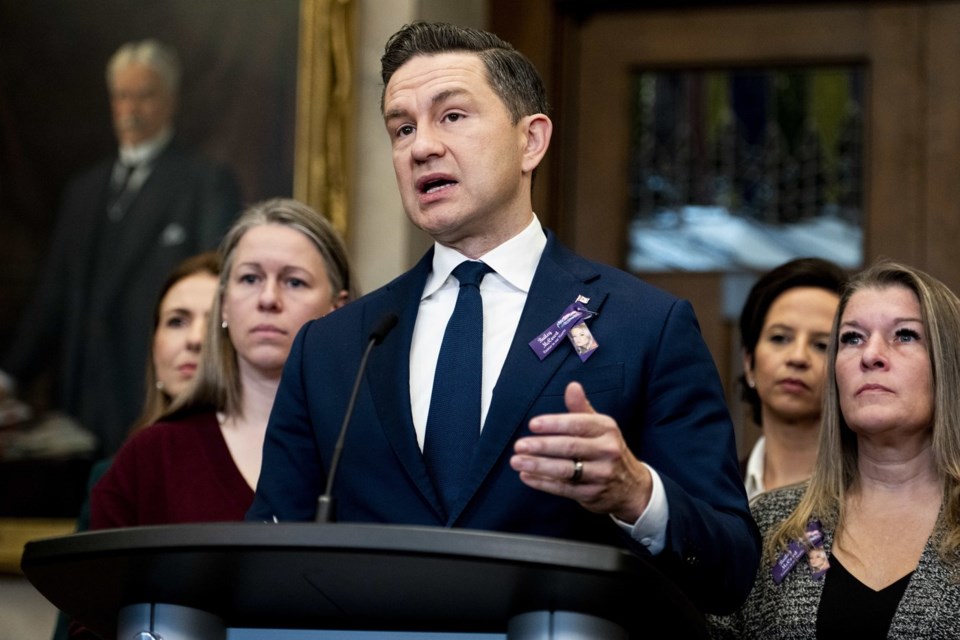
Ottawa — Conservative Leader Pierre Poilievre is calling on MPs from all parties to support a private member’s bill aimed at imposing tougher penalties on perpetrators of intimate partner violence (IPV), as new national data shows the problem has worsened in recent years.
Introduced by Conservative MP Frank Caputo, Bill C-225 would make the killing of an intimate partner automatically first-degree murder, regardless of premeditation, and would bar peace officers from releasing suspects arrested for intimate partner offences if they had a prior conviction for a similar crime within five years.
“There are countless people who have lost their lives because Liberal laws have turned their perpetrators loose on our streets,” Poilievre said outside the House of Commons. “We encourage every party to join with us — it doesn’t matter who gets the credit. Let’s do the right thing now.”
Poilievre’s appeal came the same day Statistics Canada released a report showing a 14% increase in reports of intimate partner violence between 2018 and 2024. The data also revealed that women and girls remain disproportionately affected, with incidents involving female victims occurring 3.5 times more often than those involving men.
Caputo said his bill was shaped by consultation with victims and families. He introduced Debbie Henderson, whose niece Bailey McCourt was killed in Kelowna, B.C., in July. McCourt’s ex-husband, now charged with second-degree murder, had recently been released on bail after being convicted of choking and uttering threats.
“There’s no need to wait,” Henderson said tearfully. “The next person could be you or one of your family members. We don’t want anyone else to go through the horror our family has faced.”
During Question Period, Caputo pressed the Liberal government to support the legislation. Liberal MP Nathalie Provost, a survivor of the 1989 École Polytechnique massacre, responded that the government prefers a broader, integrated approach, pointing to ongoing federal reforms.
Justice Minister Sean Fraser’s office noted that recent bail reform legislation already makes it harder for those accused of serious sexual offences — including choking or strangulation — to be released, and restricts house arrest for sexual assault convictions.
Meanwhile, British Columbia Attorney General Niki Sharma said earlier this month she hopes the new bail reforms will prevent tragedies like McCourt’s.
Statistics Canada’s report also found that nearly half of IPV victims were living with their abusers at the time of the incident. Most victims (72%) were physically assaulted, while 9% suffered sexual offences and 7% faced criminal harassment.
The study highlighted a troubling trend among seniors as well: family violence against seniors rose 49% between 2018 and 2024, with 7,622 senior victims reported last year. Over one-third (36%) were victimized by their own children.
Poilievre said the bill is meant to send a clear message: “Victims deserve protection — not another chance for their abusers.”