

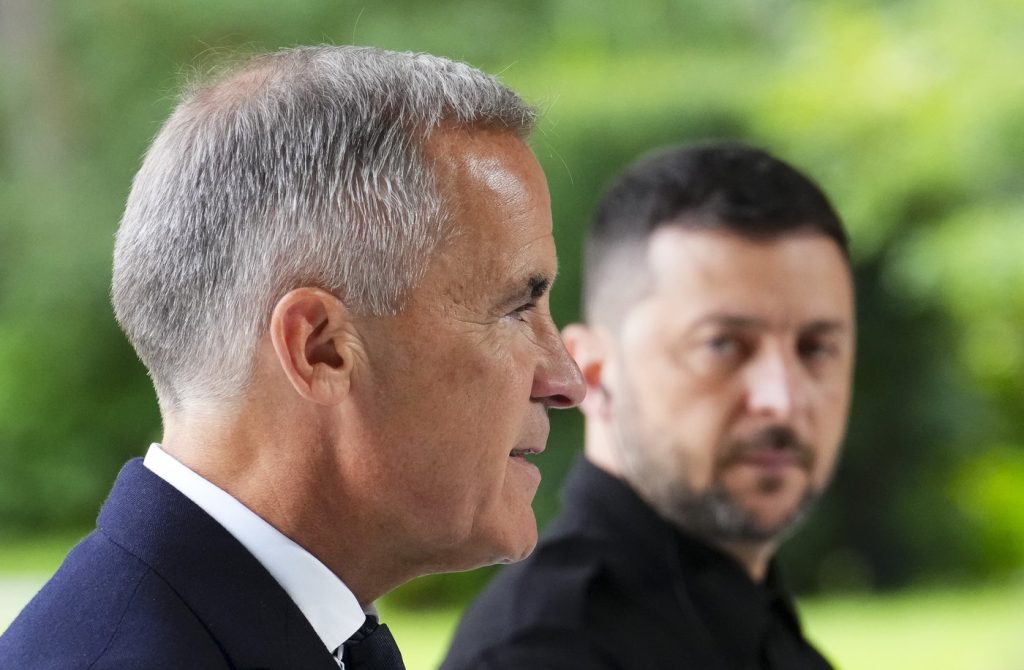
Prime Minister Mark Carney has stirred debate over Canada’s military role in Ukraine after suggesting he would not rule out sending troops once the war with Russia ends. Analysts say the comments reflect a cautious stance — one that signals solidarity without offering clarity on what Canada could realistically provide.
At a joint press conference in Kyiv alongside Ukrainian President Volodymyr Zelenskyy, Carney said Canada is “working through” security guarantees with allies in the so-called Coalition of the Willing, adding, “I would not exclude the presence of troops.”
The remark, however, drew scrutiny. France and the U.K. have committed to deploying a multinational brigade postwar, while Italy is seeking looser guarantees. Justin Massie, political science professor at Université du Québec à Montréal, said Canada’s position falls somewhere in between — ambiguous and less defined.
“If the worst scenario happens where Europe is at war against Russia, we’re not ready at all,” Massie warned, noting decades of underfunding, recruitment shortfalls, and outdated equipment.
Canada’s military posture is already stretched thin. With 2,000 troops in Latvia — its largest overseas mission — and only about 13,000 deployable soldiers, any major deployment to Ukraine would likely require redeploying forces. “The cupboard is pretty bare beyond what we have right now,” said David Perry of the Canadian Global Affairs Institute, suggesting a smaller, specialized mission is more plausible than large-scale support.
Internal reports back up those concerns. National Defence’s latest plan cautioned that the Canadian Army is already at its “force generation sustainability limit,” raising questions about how Ottawa could sustain further commitments abroad.
Defence Minister David McGuinty defended the prime minister’s remarks, framing them as part of a range of possibilities. He said options could include intelligence sharing, logistical support, financial assistance, or specialized teams rather than large deployments.
For now, Canada’s position remains deliberately open-ended — a show of solidarity that stops short of the firm commitments made by key European allies. Whether Ottawa can back up that posture with real capacity, experts say, is far less certain.